Carousel

Sponsored Links

Looking for House and Lot Within Tagaytay Area? CONTACT US!

Name

Email *

Message *

Showing posts with label Health Insurance. Show all posts

Tuesday, December 14, 2021

Mas pinaraming Solo Parent benefits, lusot na sa Senado!


MANILA, Philippines —LUSOT na sa Senado ang panukalang batas na magbibigay ng buwanang cash subsidies, automatic health insurance at iba pang dagdag na benepisyo sa mga Filipino solo parents.

Noong Lunes, Disyembre 12, pinaboran ng mga senador sa botong 22-0-0 ang Senate Bill 1411 na magpapataas ng mga benepisyo na kasalukuyang tinatanggap ng ma solo parents sa ilalim ng Republic Act 8972 o Solo Parents Welfare Act of 2000. 

Sa ilalim ng panukalang batas, pinalapad din ang pagsasalarawan ng solo parent na kinabibilangan ng mga sumusunod:
  • Asawa ng low or semi-skilled overseas Filipino worker na patuloy na nagtatrabaho sa abroad sa loob ng 12 buwan o higit pa

  • Foster parent na kinikilala ng Department of Social Welfare and Development

  • Legal guardian na kinikilala ng korte

  • Kamag-anak na nag-iisang responsable sa pag-aaruga sa isang bata
Ads


Sa kasalukuyan, sa ilalim ng RA 8972 ang mga sumusunod ay ikinokonsidera na solo parents:
  • A woman who gives birth as a result of rape and other crimes against chastity

  • Parent whose spouse died

  • Parent whose spouse is detained or is serving sentence for a criminal conviction for at least one year

  • Parent whose spouse was certified by a public medical practitioner as either physically or mentally incapacitated, or both

  • Parent left alone with the responsibility of parenthood due to legal separation or de facto separation from spouse for at least one year

  • Parent whose marriage was annulled and is left with the custody of the children

  • Parent whose spouse abandoned them for at least one year

  • Unmarried mother or father who has preferred to rear his or her children 

  • Any person who solely provides parental care and support to a child

  • Any family member who assumes responsibility of head of family as a result of the death, abandonment, disappearance, or prolonged absence of parents
Sa ilalim ng panukalang batas, ang mga solo parents ay magkakaroon ng 20% discount sa mga infant formula, diapers, medicines, vaccines, medical equipment, food supplements, at iba pang mga basic necessities, hospital bills, at tuition fees sa kanilang mga anak.

Iniuutos din ng panukalang batas na makakatanggap ang solo parents ng comprehensive package of social protection services na kinabibilangan ng livelihood opportunities, legal advice and assistance, at counseling.

Sa ilalim ng Senate Bill 1411, makakatanggap din ng buwanang cash subsidy na nagkakahalaga ng P1,000 ang bawat solo parent.

Maaari ding ma-avail ng mga solo parents ang parental leave. Inaatasan din ng panukalang batas ang mga companies at government offices ng daycare centers. 

Awtomatiko din na kwalipikado sa Philippine Health Insurance Corporation o PhilHealth coverage ang mga solo parents na may premiums na babayaran ng gobyerno.

Binibigyan din ng prioridad ng SB 1411 ang mga solo parents, partikular na ang mga solo mothers na makabalik sa trabaho at kanilang mga anak sa mga apprenticeship at scholarship programs ng Technical Education and Skills Development Authority, ngunit “subject to eligibility and qualifications.”

Ads

Sponsored Links


Naniniwala naman si Senator Risa Hontiveros, isa ring solo parent at isa sa mga primary authors ng panukalang batas na malaking tulong sa mga solo parents ang malapit nang maipasang batas lalo na ngayong panahon ng Covid-19 pandemic.

“Bukod sa kailangang magtrabaho, biglang kailangan namin maging teacher sa aming anak. ‘Pag may magkasakit, COVID-19 man o hindi, wiped out ang konting ipon at walang kahalili sa gastos. Kaya nga habang may pandemya, lalong mahalagang mapabilis pa ang pagsasabatas nito,” pahayag ni Hontiveros sa manifestation nito sa ipinasang SB 1411.

Una nang ipinasa ng House of Representative ang kanilang version ng Expanded Solo Parents’ Welfare Act noong Enero. Ibig sabihin, kailangang mag-convene ang Senado at House of Representative bilang isang bicameral conference committee upang mapag-usapan ang mga hindi nagkakatugmang mga provisions sa kanilang magkaibang versions ng panukalang batas.

Kailangan ratipikahan ng Senado at Kongreso ang kanilang reconciled version ng solo parents welfare bill bago ito dalhin sa Malacañang para sa pirma ni Pangulong Rodrigo Duterte.

©2020 THOUGHTSKOTO

Saturday, August 21, 2021

PhilHealth, may Covid-19 package na para sa mga naka-home quarantine!


MANILA, Philippines — SIMULA Setyembre 2, 2021, sasagutin na ng Philippine Health Insurance Corporation o PhilHeath ang check-up at home kit ng mga miyembro na mag-popositibo sa coronavirus disease o Covid-19 na walang sintomas o asymptomatic at sa bahay na magpapagaling.

Ayon sa PhilHealth Circular 2021-0014, nagkakahalaga ng P5,900 ang package para sa mga PhilHealth member na nag-positibo sa Covid-19 na asymptomatic o mild lang ang sintomas at sa bahay lang magka-quarantine, pagkatapos dumaan as Barangay Health and Emergency Response Team o BHERTS. 

"Kung meron na, yun tatanggapin na sya ng provider, first consultation kailangan face to face tapos yung susunod virtual na... Inilagay na namin sa package ang home kits na may alcohol, pulse oximeter, thermometer, vitamins, oral rehydration," ani PhilHealth spokesperson Dr. Shirley Domingo. 


Ads


Narito ang PhilHealth Circular 2021-0014 o Covid-19 Home Isolation Package o CHIBP.


Ads

Sponsored Links


Nilinaw ng Philhealth na bukas lamang ang nabanggit na package sa mga lugar na idedeklara ng Inter-Agency Task Force o IATF na may surge o labis na pagtaas ng kaso ng Covid-19.

Mananatili naman ang ibang COVID-19 insurance package ng PhilHealth sa mga miyembrong makakaranas ng mild, moderate, severe, at critical na kaso ng COVID-19.

Ngunit ang mga kinakailangang gamot gaya ng pinabibiling remdesivir o tociluzimab ay sasagutin na ng pasyente.


©2020 THOUGHTSKOTO

Monday, May 04, 2020

Pres. Duterte Inatasan ang Philhealth: Gawing Boluntaryo ang Pagbabayad ng mga OFW

Sa ulat ni Presidential Spokesperson Harry Roque galing sa Malacanang sa press briefing ngayong araw. Nag-isyu na ng direktiba si Pangulong Duterte sa Philhealth na gawing boluntaryo lamang ang pagbabayad ng mga OFW ng Philhealth premium. Ibig sabihin hindi ito magiging mandatory o sapilitan.
Ads

Nagpalabas na rin ng announcement si DOH Secretary Francisco Duque III na sinususpende niya ang 
provision sa batas na Universal Health Care (UHC) na magpapataw ng dagdag na bayarin sa premium ng mga Overseas Filipino Workers. Ayon pa sa tweet ni Sec Duque:

"I call for the suspension of Section 10.2.C of the IRR (Implementing Rules and Regulations) of the UHC law in light of COVID-19 and its economic impact on OFWs."
Ads


Sponsored Links

Here is the tweet of Health Secretary Duque regarding the suspension of Philhealth insurance premium payment of the OFWs
Ayun pa kay Spokesperson Roque:

Inanunsyo na rin po ng POEA at OWWA na hindi na irerequire ang pagbabayad ng Philhealth bago maisyuhan ng kaukulang papeles o OEC bago makalabas ng bansa. 

"Bilang isa sa pangunahing nagsulong ng Universal Healthcare Law sa 17th Congress, lilinawin ko lang po.Wala po sa batas na nagsasabi na dapat patawan ang mga OFWs ng karagdagang premiums sa pamamaraan na nais ipatupad ng Philhealth. Yan po ay nasa implementing rules and regulations para lang po sa kaalaman ng lahat."


READ:
OFW, Are you Ready to Pay Philhealth P21,600 Yearly If Your Monthly Salary is P60K Above? Narito ang mga tanong at sagot hinggil sa Philhealth OFW Premium payment.

More Details Here: THOUGHTSKOTO https://www.jbsolis.com/2020/05/ofw-philhealth-premium.html


©2020 THOUGHTSKOTO

Sunday, May 03, 2020

OFW, Handa ka na Bang Magbayad sa Philhealth ng P7,200 to P21,600 Yearly?

'Bakit ginagatasan?': OFWs pumalag sa dagdag-kontribusyon ng PhilHealth video from TV Patrol


Senator Bong Go Statement Regarding Philhealth Premium for OFWs

RE: Complaint of Some OFWs Regarding Their Increased PhilHealth Premium Contributions
Naiintindihan ko ang mga kasalukuyang hinaing ng ating mga OFWs hinggil sa mas mataas na bayarin nila sa kanilang PhilHealth contributions.
Nais ko lang po klaruhin para sa kaalaman ng lahat na ang pagtaas sa PhilHealth contributions ay naaayon sa Universal Health Care Law na naisabatas noon pang nakaraang 17th Congress. Layunin ng batas na ito ang mas lalong mapabuti at mapalawak ang mga benepisyo at iba pang programang pangkalusugan para sa kapakanan ng lahat ng mga Pilipino – kasama na diyan ang OFWs abroad at ang kanilang mga pamilya o dependents na nandito sa Pilipinas.
Sa katunayan nga, sinabi ng PhilHealth na sa nakaraang taon, mas malaki pa ang amount of benefits claimed by OFWs and their dependents kumpara sa premiums paid ng mga ito. Kung baga, sa normal na sitwasyon, sulit na investment po ito para sa kalusugan ng ating pamilya.
Subalit kailangan rin natin intindihin ang kakaibang sitwasyon ngayon dahil sa patuloy na paglaganap ng sakit na COVID-19 sa buong mundo at pagka-paralisa ng ating mga kabuhayan. Dahil dito, umaapela po ako on behalf of our OFWs.
Una, mapag-aralan dapat ng PhilHealth kung maaaring i-delay muna ang pagbabayad sa premium contributions o kung maaari ay i-delay ang pagtaas sa bayaring ito. Suriin dapat ang lahat ng pwedeng magawa upang hindi ito maging pabigat lalo na sa kasalukuyang sitwasyon ng karamihan ng ating mga OFWs.
Karamihan po ng mga OFWs natin, umaasa pa ng dagdag na tulong mula sa gobyerno bukod sa ipinamahagi na ng DOLE na 10,000php one-time financial assistance sa mga nawalan ng trabaho o naapektuhan ang kanilang kabuhayan sa ibang bansa. Hindi naman po tama na sa panahong umaasa sila sa dagdag na tulong mula sa gobyerno, kaya pa natin sila sisingilin ng dagdag na kontribusyon.
Ang hinihingi ko lamang ay mabigyan natin ng kinakailangang ‘palugit’ ang mga OFWs sa kabila ng pinapasan nilang hirap ngayon. Lahat ng palugit na pwede natin maibigay sa panahon ng krisis, ibigay na po natin. Sabi nga nila, “in times of crisis, every single peso saved counts”.
Balansehin lang natin ito para hindi rin naman mailagay sa alanganin ang kabuuang pondong pangkalusugan na makakatulong sa mas maraming Pilipino lalo na ngayon na nasa health crisis pa tayo.
Pangalawa, umaapela rin ako sa PhilHealth na i-amyenda ang kanilang Circular kung saan kasali pa ang “Overseas Filipinos in Distress” sa dapat magbayad ng kontribusyon. Kung pu-pwede ay huwag na isama yung repatriated OFWs at yung mga lubos na apektado ng krisis sa sisingilin pa ng gobyerno sa panahong sila ang nangangailangan ng tulong mula sa atin.
Pangatlo, umaapela din ako sa PhilHealth na mas lalong pagbutihin pa ang inyong pagbibigay ng mga sapat na impormasyon upang mas maintindihan ng lahat ng mga Pilipino kung saan napupunta ang mga kontribusyon nila.
Ipaliwanag natin ng maayos ang lahat ng mga benepisyo ng pagiging miyembro ng PhilHealth. I-kumpara ang kabuuang halaga ng binabayaran na premiums sa kabuuang halaga ng lahat ng benepisyong nakukuha nila at ng kanilang pamilya. At i-identify kung ano ang mga idinagdag na mga benepisyo dahil sa pagtaas ng bayarin sa PhilHealth.
Sa bawat pisong lumalabas sa bulsa ng ating mga kababayan, dapat alam nila kung anu-anong mga benepisyo ang naibibigay naman sa kanila ng gobyerno.
Bilang Chair ng Senate Committee on Health, layunin nating mas lalong mapagbuti ang lahat ng mga programa at serbisyong medikal. Pero sa panahon ng krisis, ang kapakanan ng lahat ng mga Pilipino, lalo na yung mga lubos na nangangailangan ng tulong, ang aking pangunahing prayoridad.
Kailangan nating mas lalong magtulungan at magbayanihan para mapagaan ang pinapasan ng kapwa nating Pilipino at malampasan ang krisis na ito bilang isang nagkakaisang bansa.
- Kuya Bong Go


Sponsored Links


DFA Secretary Teddy Boy Locsin said this about OFWs and paying Philhealth premium:

"After the abolition of the income tax on OFWs they've figured another way to tax you for the great privilege of being born Filipino, poor and jobless at home. Let's all sing for nothing. "

"It is like an income tax which was abolished for OFWs and even their tax-free income filings were destroyed. They are just totally out of the purview of government exactions for which they will not benefit at all."

"Why don't we just leave OFWs alone except to help them when they are in trouble. Their blood but better wages abroad account for 10% of our GDP according to the assholes who want to take some of their earnings."

It is like an income tax which was abolished for OFWs and even their tax-free income filings were destroyed. They are just totally out of the purview of government exactions for which they will not benefit at all. https://t.co/NrNYGsUMt1


OFW, Are you Ready to Pay Philhealth P21,600 Yearly If Your Monthly Salary is P60K Above? Narito ang mga tanong at sagot hinggil sa Philhealth OFW Premium payment.
Tanong: Ano ang dahilan ng pagtaas ng babayaran ng mga OFW sa Philhealth?
Sagot: Ang UNIVERSAL HEALTH CARE ACT (REPUBLIC ACT NO. 11223) na nilagdaan ni Pangulong Rodrigo Duterte noong 2019 at tuluyang nasimulan noong last quarter ng 2019. Watch the videos of the news below dated October 2019 

Tanong: Ano ang premium rate sa bawat taon? 

Sagot: Ayon sa UHC Law, ang sumusunod ay ang mga panuntunan sa premium rates:
Tanong: Paano ang pagkwenta ng kontribusyon ng isang Overseas Filipino? 

Sagot: Nakabase sa monthly salary o buwanang sahod ng isang OFW ang kanyang kontribusyon at sa kasalukuyang premium rate. Halimbawa: Kung ang buwanang sahod/kita sa taong ito, 2020 ay P20,000, sa 3% ikaw ay magbabayad ng P600 kada buwan o P7,200 kada taon 
Sponsored Links

Narito ang table ng kontribusyon na babayaran ng OFW sa taong 2020 lamang ayun sa Philhealth. Nagbabago at tumataas ito sa mga susunod na taon dahil yan ang naaprubahan na batas.
Narito ang table ng kontribusyon na babayaran ng OFW sa taong 2020 lamang. Nagbabago at tataas pa ito sa mga susunod dahil yan ang naaprubahan na batas.

Ads

Tataas ang binabayarang premium sa PhilHealth ng mga land-based OFW. Magiging salary-based na kasi ito o depende sa kanilang suweldo. Pangamba ng isang grupo dahil lalaki ang bayarin ng mga OFW, baka mapilitan silang kumapit sa illegal recruiters.
Sponsored Links


Tanong: Sino-sino ang sakop ng circular na ito? 

Sagot: Lahat ng Overseas Filipinos na naninirahan o nagtatrabaho sa ibang bansa kasama na ang mga nakabakasyon o ang naghihintay ng dokumentasyon, nakarehistro o hindi rehistrado sa National Health Insurance Program (NHIP).

Tanong: Sinu-sino ang mga Overseas Filipinos (OFs)? 


Sagot: Ang mga sumusunod ay mga Overseas Filipinos (OFs), kasama na ang kanilang mga dependents: 


1. Land-based OFWs 
2. Seafarers and other sea-based workers 
3. Filipinos with dual citizenship (RA 9225) 
4. Filipinos living abroad 
5. Overseas Filipinos in distress 
6. Other overseas Filipinos not previously classified elsewhere

Tanong: Ano ang Transition Period? 

Sagot: Ang taong 2020 ay itinuturing na transition period. Sa panahong ito, pinapayagan ang isang landbased OFW na magbayad ng Php 2,400 bilang paunang bayad (initial payment). Ang balanse sa taunang premium ay maaaring bayaran sa loob ng labingdalawang (12) buwan. 
Halimbawa:
philhealth ofw contribution transition period

Tanong: Ano ang mangyayari pagkatapos ng transition period? 

Sagot: Simula sa taong 2021, ang pinakamababang paunang kontribusyon ay katumbas ng tatlong (3) buwang premium. Maaari pa ring bayaran ng miyembro ang balanse kada tatlong (3) buwan o sa isang hulugan. 
Halimbawa:
philhealth ofw contribution after transition period
Tanong: Paano kung hindi nabayaran ng miyembro ang kaukulang premium sa takdang oras? 

Sagot: Ang isang miyembrong hindi nakapagbayad sa takdang oras ay kinakailangang bayaran ang premium na hindi nabayaran at ang kaakibat na interes (compounded monthly). 

Tanong: Ano-ano ang iba't ibang dokumentong dapat ipakita bilang patunay na kinikita? 

Sagot: Maaaring ipakita ang alinman sa mga sumusunod bilang patunay ng sahod/kita*: 


1. Land-based OFWs 
a. Employment Contract; 
b. Overseas Employment Certificate (OEC); 
c. Overseas Employment Offer Letter; 
d. Certificate of Employment with Income; 
e. Payslip (current); 
f. iba pang dokumentong maaaring tanggapin ng PhilHealth. 

2. Seafarers and other sea-based workers (on-vacation or separated) Certification mula sa Manning Agency 
3. Filipinos with Dual Citizenship and other Filipinos living abroad 
a. Income-tax return; 
b. duly-notarized affidavit of income declaration; 
c. iba pang dokumentong maaaring tanggapin ng PhilHealth 

*isasailalim sa pagsusuri ng PhilHealth

Tanong: Ano ang Statement of Premium Account? 

Sagot: Ang Statement of Premium Account o SPA ay isang papel kung saan nakasaad ang kinakailangang mabayarang kontribusyon ng isang miyembro kasama na ang naaangkop na interes.

Tanong: Ano ang panuntunan sa pagbabayad (Payment Terms)? 
Sagot: Para sa land-based OFWs, ang pagbabayad ay maaaring gawin tuwing ika- tatlong (3) buwan, ika-anim (6) na buwan o ika-labingdalawang (12) buwan. Para sa sea-based OFWs, ang pagbabayad ng premium ay buwan-buwan sa pamamagitan ng pagbabawas sa kanilang suweldo ng Manning Agencies/Employers.


Tanong: Ano ang settlement period? 

Sagot: Ang settlement period ay ang panahon mula sa araw ng paunang bayad (initial payment) hanggang sa huling araw bago patawan ng interes. Para sa land-based OFWs, ito ay labingdalawang (12) buwan mula sa araw ng paunang bayad. Hindi ito naaangkop sa sea-based OFWs.
Tanong: Anong mangyayari sa binabayad o hinuhulog mo bawat taon sa Philhealth?
Sagot: Wala. Kada taon, nawawala ang insurance mo sa Philhealth. Kapag hindi ka nagbayad ngayong taon, wala kang coverage kasama ang iyong mga dependents.

Samantala ito naman ang paglilinaw ng POEA regarding dito: Hindi pa nirerequire ng POEA ang isang OFW na dapat magbayad ng Philhealth bago mabigyan ng OEC.


Narito ang buong PhilHealth Circular No. 2020-0014 entitled " Premium Contribution and Collection of Payment of Overseas Filipino Member" 


SIGN THE ONLINE PETITION HERE

MY TAKE ON THE ISSUE:

Mas madami pa akong tanong na naghahanap ng kasagutan. Unang una, napakalaking halaga ng P7,200 na babayaran mo kung ikaw ay kasambahay at sumasahod bawat buwan ng 400$ o P20,000. Uulitin ko ito ay naisabatas na so kailangan nating sundin, dahil ang makakapigil lamang nito ay ang Korte Suprema o kailangang maiamend ang batas. Salamat at hindi pa ito nirerequire sa mga OFW bago makakuha ng OEC, pero posibleng irequire na bayaran ang P2,400 na buo bilang initial payment. Pero kagaya ng sagot sa tanong sa itaas, nasa transition period this year. Initial muna ang babayaran, P2,400 pero may utang ka na babayaran at kapag hindi mo nababayaran, may interes. Pagkatapos ng 2020, sa susunod na taon tataas pa lalo ang babayaran ng mga OFW. Kung hindi tumaas ang sahod mo ng P20K bilang kasambahay, ang babayaran mo na ay P8,400 kada taon. Seryoso? Ang ibang OFW nga halos walang naiipon o minsan hindi talaga nakakapagipon tapos pababayarin pa sila ng ganyan kalaking halaga. Mas mabuti pang sa SSS o sa PAG-IBIG FUND nila ilalagay ang perang iyan dahil bumabalik at babalik pa sa kanila na may interes.

SOME MORE QUESTIONS:


Bakit kailangang magbayad ng OFW ng PHILHEALTH kung may sarili silang healthcare sa kanilang mga bansa na tinatrabahuan? Libre sa abroad, wala silang binabayaran at karamihan mas maganda at maayos pa ang benepisyo?


Kailangan pa bang magbayad talaga kung ang isang OFW na may pamilya sa Pilipinas ay may asawa na nagtratrabaho din sa Pilipinas at nagbabayad din ng Philhealth Premium at ang dependents ay pamilya at mga anak?


Nakalagay ang mga OF raw ay kasama ang mga 

1. Land-based OFWs 
2. Seafarers and other sea-based workers 
3. Filipinos with dual citizenship (RA 9225) 
4. Filipinos living abroad 
5. Overseas Filipinos in distress 
6. Other overseas Filipinos not previously classified elsewhere

Sila bang lahat ay magbabayad ng Philhealth premium? Seryoso, distress OFWs? Filipinos with dual citizenship? Anyone, basta Filipino living abroad? Kailangan maclarify at maiklaro ng Philhealth ang Philhealth Circular 2020-14 na ito.

Pwede bang ang pamilya ng OFW ay magbayad na lang ng Dependents/Voluntary Membership Premium na nasa P3,600 to P6,000 yearly sa minimum na P10,000 monthly salary computation?


Natatakot ako na maaring sa implementing rules and regulations ay mailagay na ang POEA ang isa sa mga tutulong para makapagbayad ang mga OFWs, at dahilan kung bakit hihingan ng payslip or patunay ang mga OFW kung magkano ang sahod nila dahil kapag di sila nagbayad ng isang buong taon na bayaran ay masisingil o mahahabol sila dahilan para hindi mabigyan ng OEC o makabalik sa bansang pinapasukan o maaring hindi na muna uuwi si OFW para maiwasang magbayad ng malaking halaga sa Philhealth. Imagine kung ang sahod ni OFW ay P60,000 kada buwan o $1200 o SAR4,500 magbabayad siya ng P21,600 ngayong taong 2020 sa PHILHEALTH . Iilang OFW ay mabilis nakakaipon ng P21K?

Imagine kung magiging mandatory ito at nawawala kada taon, ang babayaran ng isang OFW na sumasahod ng P20,000 kada buwan ay P60,000, kapag nilagay mo yan sa SSS Flexifund or sa Pag-Ibig MP2 Savings program, within 5 years meron kang 5% to 8% na interest yearly ng iyong pera. 


5% ng P60,000 yearly = P75,000

8% ng P60,000 yearly = P84,000

pero sa Philhealth, literally na hindi ka makikinabang, nawawala pa bawat taon ang perang binabayad ng mga OFWs. 


Read the Implementing Rules and Regulations of the Universal Healthcare Act here
Read the Republic Act 11223 or the Universal Health Care Act here

©2020 THOUGHTSKOTO

Wednesday, October 16, 2019

Philhealth Fee Will Be P6,000 a Year Starting 2020 If Your Salary is P10,000+


Starting next year, contribution to the Philippine Health Insurance Corporation (PhilHealth) will increase. According to reports, a 0.25 percent premium rate increase will be implemented even though PhilHealth has yet to draw up additional benefits for its direct contributors as mandated by the Republic Act 11223 or the Universal Health Care (UHC) Act.  According to the Implementing Rules and Regulations (IRR) of the said law, direct contributors or the salaried workers, professionals and those who can pay Philhealth premiums would see their contribution rise from current 2.75 percent to 5 percent by 2024.  This means that if you are earning P10,000 a month,  your contribution will increase from P3,600 to P6,000 per year starting 2020 to 2024. By 2024, the income ceiling would be P100,000. Anyone earning that much would need to shell out an annual premium of P60,000.  The IRR also covers overseas Filipino workers (OFWs), who currently pay a fixed annual rate of P2,400.  According to Philhealth President Ricardo Morales, the increase aims quality and cost-effective health services for all Filipinos under UHC. On the other hand, Health Secretary Francisco Duque III said that direct PhilHealth contributors are indeed guaranteed additional benefit packages.  “It is stated under the law that direct contributors should receive bigger benefits because they are giving bigger premium contributions,” he said. “There’s no problem with that.”
Starting next year, contribution to the Philippine Health Insurance Corporation (PhilHealth) will increase. According to reports, a 0.25 percent premium rate increase will be implemented even though PhilHealth has yet to draw up additional benefits for its direct contributors as mandated by the Republic Act 11223 or the Universal Health Care (UHC) Act.

According to the Implementing Rules and Regulations (IRR) of the said law, direct contributors or the salaried workers, professionals and those who can pay Philhealth premiums would see their contribution rise from current 2.75 percent to 5 percent by 2024.

Ads


This means that if you are earning P10,000 a month, your contribution will increase from P3,600 to P6,000 per year starting 2020 to 2024. By 2024, the income ceiling would be P100,000. Anyone earning that much would need to shell out an annual premium of P60,000.
Read: What are the OFW's Benefits from PhilHealth and How to Claim It?

The IRR also covers overseas Filipino workers (OFWs), who currently pay a fixed annual rate of P2,400.
As an Overseas Filipino Worker (OFW) it is important that you are prepared with health insurance that you can lean on in times of emergency, not just for yourself, but also for your dependents here in the Philippines.  Here in the Philippines, the most common health care insurance program is the Philhealth from the government. As OFW, you are encouraged to be an active member to fully enjoy its benefit.


WATCH THE VIDEO BELOW OF THE AFFIRMATION OF PHILHEALTH PREMIUM CONTRIBUTION

Ads

Sponsored Links

According to Philhealth President Ricardo Morales, the increase aims quality and cost-effective health services for all Filipinos under UHC. On the other hand, Health Secretary Francisco Duque III said that direct PhilHealth contributors are indeed guaranteed additional benefit packages.

“It is stated under the law that direct contributors should receive bigger benefits because they are giving bigger premium contributions,” he said. “There’s no problem with that.”


Read: How To Check PhilHEALTH Dependents Or Beneficiaries Online
As a member of Philhealth,your family can also enjoy hospitalization benefits.Just make sure that they are listed as your beneficiaries or dependents. Qualified dependents are non-member spouse,children(legitimate,acknowledges,illegitimate,and legitimated) adopted child/children below 21 years of age,single and unemployed.
To do it, you need to create a Philhealth online account. If you don't have an online account at this moment, we suggest that you visit  our article: 

"STEP-BY-STEP PROCESS IN CREATING PHILHEALTH ONLINE ACCOUNT"

The article will provide you the complete steps on how to create your online account. Follow the steps carefully.
More Details Here: THOUGHTSKOTO https://www.jbsolis.com/2016/09/how-to-check-philhealth-dependents-or.html


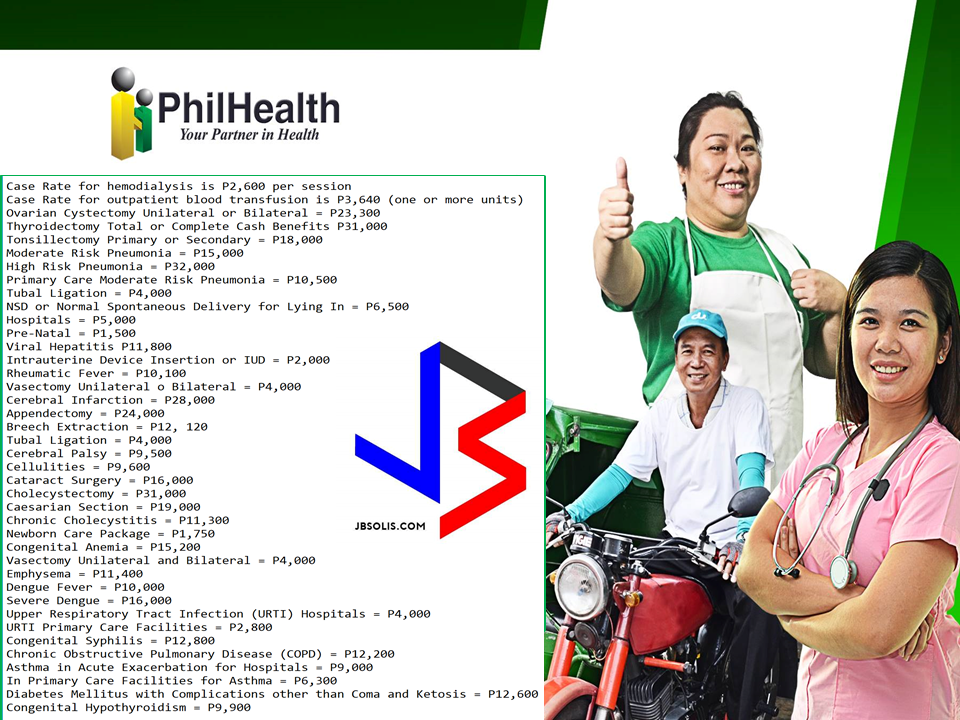
Check Here How Much is Your PhilHealth Cash Benefit for a Specific Illness (TAGALOG GRAPHICS)
More Details Here: THOUGHTSKOTO https://www.jbsolis.com/2017/08/philhealth-member-your-cash-benefit.htmlThis blog post features a variety of comprehensive health care services -from basic primary care to catastrophic packages to provide Philhealth and OFW members and their families with the information they need on CASH benefits and and links on benefits availment. It also includes links to Philhealth website to know more on eligibility requirements, coverage, general guidelines for specific diseases and selections criteria among others.  The following are the PhilHealth Cash Benefits.   Case Rate for hemodialysis is P2,600 per session Case Rate for outpatient blood transfusion is P3,640 (one or more units) Ovarian Cystectomy Unilateral or Bilateral = P23,300 Thyroidectomy Total or Complete Cash Benefits P31,000 Tonsillectomy Primary or Secondary = P18,000 Moderate Risk Pneumonia = P15,000 High Risk Pneumonia = P32,000 Primary Care Moderate Risk Pneumonia = P10,500 Tubal Ligation = P4,000 NSD or Normal Spontaneous Delivery for Lying In = P6,500 Hospitals = P5,000 Pre-Natal = P1,500 Viral Hepatitis P11,800 Intrauterine Device Insertion or IUD = P2,000 Rheumatic Fever = P10,100 Vasectomy Unilateral o Bilateral = P4,000 Cerebral Infarction = P28,000 Appendectomy = P24,000 Breech Extraction = P12, 120 Tubal Ligation = P4,000 Cerebral Palsy = P9,500 Cellulities = P9,600 Cataract Surgery = P16,000 Cholecystectomy = P31,000 Caesarian Section = P19,000 Chronic Cholecystitis = P11,300 Newborn Care Package = P1,750 Congenital Anemia = P15,200 Vasectomy Unilateral and Bilateral = P4,000 Emphysema = P11,400 Dengue Fever = P10,000 Severe Dengue = P16,000 Upper Respiratory Tract Infection (URTI) Hospitals = P4,000 URTI Primary Care Facilities = P2,800 Congenital Syphilis = P12,800 Chronic Obstructive Pulmonary Disease (COPD) = P12,200 Asthma in Acute Exacerbation for Hospitals = P9,000 In Primary Care Facilities for Asthma = P6,300 Diabetes Mellitus with Complications other than Coma and Ketosis = P12,600 Congenital Hypothyroidism = P9,900 Emphysema = P11,400 Coronary Artery Bypass Graft Standard Risk = P550,000 Expanded Z Morph Package for Prosthesis- Above Elbow = P70,000 Expanded Z Morph Package for Prosthesis - Hip Disarticulation = P135,000 Cervical Cancer Chemoradiation with Cobalt and Brachytheraphy= P120,000  Cervical Cancer Chemoradiation with Linear and Brachytheraphy= P175,000  Colon Cancer Stage 1 and 2 Low Risk = P150,000 Colon Cancer Stage 2 High Risk to Stage 3 = P300,000 Expanded Z Morph Package Spinal Cervicothoracic = P45,000 Expanded Z Morph Package Spinal - Thoralumbosacral = P40,000 Expanded Z Morph Package Spinal -Lumbosacral = P30,000 Breast Cancer Early Stage 0 to Stage 3A = P100,000 Acute Lymphocytic/Lymphoblastic Leukemia Standard Risk = P210,000  Kidney Transplantation = End Stage Renal Disease (Low Risk) = P600,000 Expanded Z Morph Package Prosthesis - Below Elbow = P50,000 Expanded Z Morph Package Prosthesis - Above Knee/Knee Disarticulation = P70,000 Expanded Z Morph Package Ortho/Prosthesis - Ankle Foot = P17,500 Expanded Z Morph Package Orthoses - Hip Knee Ankle Foot = P80,000 Expanded Z Morph Package Prosthesis - Van Ness Rotationplasty = P85,000

RECOMMENDED READINGS:
HOW TO ACCESS YOUR PHILHEALTH MEMBERS DATA RECORD

HOW TO MAKE A PHILHEALTH ONLINE ACCOUNT

OWWA AND PHILHEALTH MEDPLUS?

FREE PHILHEALTH FOR SENIOR CITIZENS

This article is filed under health insurance, PhilHealth, Universal Health Care, health care program, and insurance contributions.

©2019 THOUGHTSKOTO

Monday, September 25, 2017

Expats Who Got Injured At Work To Be Taken Care By GOSI


The General Organization for Social Insurance (GOSI) has reiterated that it will bear their cost of living should any expatriate worker got injured while doing their duties..  If an injured worker needs the help of others to run his daily affairs of life he or she will be entitled to be paid about 50 percent of the proceedings of his insurance with a maximum ceiling of SR3,500 every month, GOSI said.  But if a worker objects to the preliminary medical report, he will be responsible to bear his expenses as long as his objection is under review.  “If the objection is accepted, the worker will be compensated,” GOSI said.  If a worker’s injury results in permanent disability then GOSI will bear the travel expenses of the worker to his or her home country.  GOSI said the entire compensation will be paid before the injured worker leaves for his or her home country.  GOSI said that it will be considered a work injury if an expatriate worker is injured in a traffic accident while on his/her way to work place or back home from work. Sponsored Links “It will be considered a work injury if an expatriate worker is hit by a car while on his way to have food or on his way to pray in a nearby mosque,” it said.  GOSI said it will also pay the cost of repatriating the dead body of an expatriate worker if he or she dies of a work injury. This will include paying the cost of Ghusl (washing) and other expenses, it added.  During the first nine months of 2016, GOSI registered 38,767 work injuries among Saudi and expatriate workers. It said that there were 375 deaths during the same period.  According to GOSI’s figures, there were 10,502 inured workers during the first nine months of the past year who were under medical treatment. It said, 920 of them have recovered and 128 have died due to work injuries. Source: Saudi Gazette

Advertisements


The General Organization for Social Insurance (GOSI) has reiterated that it will bear their cost of living should any expatriate worker got injured while doing their duties.
The General Organization for Social Insurance (GOSI) has reiterated that it will bear their cost of living should any expatriate worker got injured while doing their duties..  If an injured worker needs the help of others to run his daily affairs of life he or she will be entitled to be paid about 50 percent of the proceedings of his insurance with a maximum ceiling of SR3,500 every month, GOSI said.  But if a worker objects to the preliminary medical report, he will be responsible to bear his expenses as long as his objection is under review.  “If the objection is accepted, the worker will be compensated,” GOSI said.  If a worker’s injury results in permanent disability then GOSI will bear the travel expenses of the worker to his or her home country.  GOSI said the entire compensation will be paid before the injured worker leaves for his or her home country.  GOSI said that it will be considered a work injury if an expatriate worker is injured in a traffic accident while on his/her way to work place or back home from work. Sponsored Links “It will be considered a work injury if an expatriate worker is hit by a car while on his way to have food or on his way to pray in a nearby mosque,” it said.  GOSI said it will also pay the cost of repatriating the dead body of an expatriate worker if he or she dies of a work injury. This will include paying the cost of Ghusl (washing) and other expenses, it added.  During the first nine months of 2016, GOSI registered 38,767 work injuries among Saudi and expatriate workers. It said that there were 375 deaths during the same period.  According to GOSI’s figures, there were 10,502 inured workers during the first nine months of the past year who were under medical treatment. It said, 920 of them have recovered and 128 have died due to work injuries. Source: Saudi Gazette

“If the objection is accepted, the worker will be compensated,” GOSI said.

If the worker has been badly injured that it resulted to permanent disability, GOSI will shoulder the repatriation expenses of the expat worker to his/her home country. Before the worker leaves, the compensation will be fully paid


GOSI said that it will be considered a work injury if an expatriate worker is injured in a traffic accident while on the way to work place or from work going back home.
Sponsored Links

The General Organization for Social Insurance (GOSI) has reiterated that it will bear their cost of living should any expatriate worker got injured while doing their duties..  If an injured worker needs the help of others to run his daily affairs of life he or she will be entitled to be paid about 50 percent of the proceedings of his insurance with a maximum ceiling of SR3,500 every month, GOSI said.  But if a worker objects to the preliminary medical report, he will be responsible to bear his expenses as long as his objection is under review.  “If the objection is accepted, the worker will be compensated,” GOSI said.  If a worker’s injury results in permanent disability then GOSI will bear the travel expenses of the worker to his or her home country.  GOSI said the entire compensation will be paid before the injured worker leaves for his or her home country.  GOSI said that it will be considered a work injury if an expatriate worker is injured in a traffic accident while on his/her way to work place or back home from work. Sponsored Links “It will be considered a work injury if an expatriate worker is hit by a car while on his way to have food or on his way to pray in a nearby mosque,” it said.  GOSI said it will also pay the cost of repatriating the dead body of an expatriate worker if he or she dies of a work injury. This will include paying the cost of Ghusl (washing) and other expenses, it added.  During the first nine months of 2016, GOSI registered 38,767 work injuries among Saudi and expatriate workers. It said that there were 375 deaths during the same period.  According to GOSI’s figures, there were 10,502 inured workers during the first nine months of the past year who were under medical treatment. It said, 920 of them have recovered and 128 have died due to work injuries. Source: Saudi Gazette


If the accident resulted to death of the expat worker, GOSI will also pay the cost of repatriating the dead body of an expatriate worker . This will include paying the cost of Ghusl (washing) and other expenses.
The General Organization for Social Insurance (GOSI) has reiterated that it will bear their cost of living should any expatriate worker got injured while doing their duties..  If an injured worker needs the help of others to run his daily affairs of life he or she will be entitled to be paid about 50 percent of the proceedings of his insurance with a maximum ceiling of SR3,500 every month, GOSI said.  But if a worker objects to the preliminary medical report, he will be responsible to bear his expenses as long as his objection is under review.  “If the objection is accepted, the worker will be compensated,” GOSI said.  If a worker’s injury results in permanent disability then GOSI will bear the travel expenses of the worker to his or her home country.  GOSI said the entire compensation will be paid before the injured worker leaves for his or her home country.  GOSI said that it will be considered a work injury if an expatriate worker is injured in a traffic accident while on his/her way to work place or back home from work. Sponsored Links “It will be considered a work injury if an expatriate worker is hit by a car while on his way to have food or on his way to pray in a nearby mosque,” it said.  GOSI said it will also pay the cost of repatriating the dead body of an expatriate worker if he or she dies of a work injury. This will include paying the cost of Ghusl (washing) and other expenses, it added.  During the first nine months of 2016, GOSI registered 38,767 work injuries among Saudi and expatriate workers. It said that there were 375 deaths during the same period.  According to GOSI’s figures, there were 10,502 inured workers during the first nine months of the past year who were under medical treatment. It said, 920 of them have recovered and 128 have died due to work injuries. Source: Saudi Gazette
 GOSI’s figures shows that there were 10,502 work-related injuries during the first 3 quarters of the previous year who were undergoing medical treatment. Nine hundred and twenty of them has already recovered while 128 have already died.

Source: Saudi Gazette
The General Organization for Social Insurance (GOSI) has reiterated that it will bear their cost of living should any expatriate worker got injured while doing their duties..  If an injured worker needs the help of others to run his daily affairs of life he or she will be entitled to be paid about 50 percent of the proceedings of his insurance with a maximum ceiling of SR3,500 every month, GOSI said.  But if a worker objects to the preliminary medical report, he will be responsible to bear his expenses as long as his objection is under review.  “If the objection is accepted, the worker will be compensated,” GOSI said.  If a worker’s injury results in permanent disability then GOSI will bear the travel expenses of the worker to his or her home country.  GOSI said the entire compensation will be paid before the injured worker leaves for his or her home country.  GOSI said that it will be considered a work injury if an expatriate worker is injured in a traffic accident while on his/her way to work place or back home from work. Sponsored Links “It will be considered a work injury if an expatriate worker is hit by a car while on his way to have food or on his way to pray in a nearby mosque,” it said.  GOSI said it will also pay the cost of repatriating the dead body of an expatriate worker if he or she dies of a work injury. This will include paying the cost of Ghusl (washing) and other expenses, it added.  During the first nine months of 2016, GOSI registered 38,767 work injuries among Saudi and expatriate workers. It said that there were 375 deaths during the same period.  According to GOSI’s figures, there were 10,502 inured workers during the first nine months of the past year who were under medical treatment. It said, 920 of them have recovered and 128 have died due to work injuries. Source: Saudi Gazette

Advertisement

READ MORE:


©2017 THOUGHTSKOTO
SEARCH JBSOLIS, TYPE KEYWORDS and TITLE OF ARTICLE at the box below