Carousel

Sponsored Links

Looking for House and Lot Within Tagaytay Area? CONTACT US!

Name

Email *

Message *

Showing posts with label GDP. Show all posts

Tuesday, February 19, 2019

Philippine Economy Continues To Rise

The Philippines is gaining its high economic status being included in the ASEAN 5. 
“The Global Competitiveness Report (GCR) is a yearly report published by the World Economic Forum. Since 2004, the Global Competitiveness Report ranks countries based on the Global Competitiveness Index, developed by Xavier Sala-i-Martin and Elsa V. Artadi. Before that, the macroeconomic ranks were based on Jeffrey Sachs‘s Growth Development Index and the microeconomic ranks were based on Michael Porter‘s Business Competitiveness Index. The Global Competitiveness Index integrates the macroeconomic and the micro/business aspects of competitiveness into a single index.

The Philippines is gaining its high economic status being included in the ASEAN 5.   “The Global Competitiveness Report (GCR) is a yearly report published by the World Economic Forum. Since 2004, the Global Competitiveness Report ranks countries based on the Global Competitiveness Index, developed by Xavier Sala-i-Martin and Elsa V. Artadi.[1] Before that, the macroeconomic ranks were based on Jeffrey Sachs‘s Growth Development Index and the microeconomic ranks were based on Michael Porter‘s Business Competitiveness Index. The Global Competitiveness Index integrates the macroeconomic and the micro/business aspects of competitiveness into a single index.       Ads    A news article published recently headlined Philippines as the fastest-growing among the five largest economies in Southeast Asia also known as the “ASEAN 5.” Based on a report by the Country’s National Statistical Coordination Board (NSCB), the Philippines beat Indonesia, Malaysia, Singapore, and Thailand in terms of economic growth in recent quarters. The country’s gross domestic product (GDP), the main benchmark of economic growth, rose by 6.8 percent in 2012 and by 7.6 percent which started in the first six months of 2013.   This is very positive news about the Philippines. The country is truly booming and is now attracting investors around the world. If you are an OFW or a Filipino migrant, it’s high time that you will do your share and invest in our country and together, we can help the Philippines soar to the next level.      "The Philippines 5: Writing The Next Chapter" is a very inspiring documentary about the Philippines’ rising economy by the Asia Business Channel aired in 2013. Today, economic growth is even rising to make the Philippines ideal for foreign investment.    The Philippines’ GDP is Rising! The Philippines as the fastest growing economy in Asia  In a supplement to its Asian Development Outlook 2018 Update report released on Wednesday, the ADB maintained its economic growth outlook for the Philippines at 6.4 percent this year and 6.7 percent for 2019.  The Philippine gross domestic product (GDP) remained strong at 6.3 percent in the first three quarters of 2018, though moderating from 6.8 percent last year.  The investment was the biggest contributor to growth, followed by household consumption.  The ADB also retained its growth forecast for Southeast Asia at 5.1 percent for 2018, assuming robust consumption and infrastructure investment.   The report “assesses the ability of countries to provide high levels of prosperity to their citizens. This, in turn, depends on how productively a country uses available resources. Therefore, the Global Competitiveness Index measures the set of institutions, policies, and factors that set the sustainable current and medium-term levels of economic prosperity.”    While posting the highest growth rate, the Philippines, however, has the lowest GDP per capita at only $4,339 in 2012 versus the ASEAN 5 average of $7,010.  GDP per capita is the country’s total economic output divided among its population. This means that Pinoys’ income measured per person is the lowest in ASEAN 5.  Singapore posted the highest per capita GDP in the group at $61,461, followed by Malaysia ($16,976), Thailand ($9,609) and Indonesia ($4,971).  The Philippines’ economic expansion is good news, Albert said. But he added that “much remains to be done to sustain such high growth trajectory and to make it inclusive.”  The statistics chief added that ensuring that growth is sustained and shared by everyone is “not solely the government’s responsibility but is equally shared by the private sector.”

Ads


A news article published recently headlined Philippines as the fastest-growing among the five largest economies in Southeast Asia also known as the “ASEAN 5.” Based on a report by the Country’s National Statistical Coordination Board (NSCB), the Philippines beat Indonesia, Malaysia, Singapore, and Thailand in terms of economic growth in recent quarters. The country’s gross domestic product (GDP), the main benchmark of economic growth, rose by 6.8 percent in 2012 and by 7.6 percent which started in the first six months of 2013.


This is very positive news about the Philippines. The country is truly booming and is now attracting investors around the world. If you are an OFW or a Filipino migrant, it’s high time that you will do your share and invest in our country and together, we can help the Philippines soar to the next level.

The Philippines is gaining its high economic status being included in the ASEAN 5.   “The Global Competitiveness Report (GCR) is a yearly report published by the World Economic Forum. Since 2004, the Global Competitiveness Report ranks countries based on the Global Competitiveness Index, developed by Xavier Sala-i-Martin and Elsa V. Artadi.[1] Before that, the macroeconomic ranks were based on Jeffrey Sachs‘s Growth Development Index and the microeconomic ranks were based on Michael Porter‘s Business Competitiveness Index. The Global Competitiveness Index integrates the macroeconomic and the micro/business aspects of competitiveness into a single index.       Ads    A news article published recently headlined Philippines as the fastest-growing among the five largest economies in Southeast Asia also known as the “ASEAN 5.” Based on a report by the Country’s National Statistical Coordination Board (NSCB), the Philippines beat Indonesia, Malaysia, Singapore, and Thailand in terms of economic growth in recent quarters. The country’s gross domestic product (GDP), the main benchmark of economic growth, rose by 6.8 percent in 2012 and by 7.6 percent which started in the first six months of 2013.   This is very positive news about the Philippines. The country is truly booming and is now attracting investors around the world. If you are an OFW or a Filipino migrant, it’s high time that you will do your share and invest in our country and together, we can help the Philippines soar to the next level.      "The Philippines 5: Writing The Next Chapter" is a very inspiring documentary about the Philippines’ rising economy by the Asia Business Channel aired in 2013. Today, economic growth is even rising to make the Philippines ideal for foreign investment.    The Philippines’ GDP is Rising! The Philippines as the fastest growing economy in Asia  In a supplement to its Asian Development Outlook 2018 Update report released on Wednesday, the ADB maintained its economic growth outlook for the Philippines at 6.4 percent this year and 6.7 percent for 2019.  The Philippine gross domestic product (GDP) remained strong at 6.3 percent in the first three quarters of 2018, though moderating from 6.8 percent last year.  The investment was the biggest contributor to growth, followed by household consumption.  The ADB also retained its growth forecast for Southeast Asia at 5.1 percent for 2018, assuming robust consumption and infrastructure investment.   The report “assesses the ability of countries to provide high levels of prosperity to their citizens. This, in turn, depends on how productively a country uses available resources. Therefore, the Global Competitiveness Index measures the set of institutions, policies, and factors that set the sustainable current and medium-term levels of economic prosperity.”    While posting the highest growth rate, the Philippines, however, has the lowest GDP per capita at only $4,339 in 2012 versus the ASEAN 5 average of $7,010.  GDP per capita is the country’s total economic output divided among its population. This means that Pinoys’ income measured per person is the lowest in ASEAN 5.  Singapore posted the highest per capita GDP in the group at $61,461, followed by Malaysia ($16,976), Thailand ($9,609) and Indonesia ($4,971).  The Philippines’ economic expansion is good news, Albert said. But he added that “much remains to be done to sustain such high growth trajectory and to make it inclusive.”  The statistics chief added that ensuring that growth is sustained and shared by everyone is “not solely the government’s responsibility but is equally shared by the private sector.”
"The Philippines 5: Writing The Next Chapter" is a very inspiring documentary about the Philippines’ rising economy by the Asia Business Channel aired in 2013. Today, economic growth is even rising to make the Philippines ideal for foreign investment. 


The Philippines’ GDP is Rising!
The Philippines as the fastest growing economy in Asia
In a supplement to its Asian Development Outlook 2018 Update report released on Wednesday, the ADB maintained its economic growth outlook for the Philippines at 6.4 percent this year and 6.7 percent for 2019.

The Philippine gross domestic product (GDP) remained strong at 6.3 percent in the first three quarters of 2018, though moderating from 6.8 percent last year.

The investment was the biggest contributor to growth, followed by household consumption.

The ADB also retained its growth forecast for Southeast Asia at 5.1 percent for 2018, assuming robust consumption and infrastructure investment.


The report “assesses the ability of countries to provide high levels of prosperity to their citizens. This, in turn, depends on how productively a country uses available resources. Therefore, the Global Competitiveness Index measures the set of institutions, policies, and factors that set the sustainable current and medium-term levels of economic prosperity.”

While posting the highest growth rate, the Philippines, however, has the lowest GDP per capita at only $4,339 in 2012 versus the ASEAN 5 average of $7,010.

GDP per capita is the country’s total economic output divided among its population. This means that Pinoys’ income measured per person is the lowest in ASEAN 5.

Singapore posted the highest per capita GDP in the group at $61,461, followed by Malaysia ($16,976), Thailand ($9,609) and Indonesia ($4,971).

The Philippines’ economic expansion is good news, Albert said. But he added that “much remains to be done to sustain such high growth trajectory and to make it inclusive.”

The statistics chief added that ensuring that growth is sustained and shared by everyone is “not solely the government’s responsibility but is equally shared by the private sector.”

Ads


Sponsored Links


In the real world, availing loans is sometimes inevitable. Financial problems often come unannounced and if you do not have enough savings, you most probably end up getting a loan from a friend, a loan company or a bank. Many overseas Filipino workers (OFW), for example, avail loans specifically designed for people working abroad and seafarers.   https://www.jbsolis.com/2019/02/move-to-these-places-and-get-paid-if.html    Ads    In the society we live in, applying for a loan correlates to debt. In reality, loans actually help people build and establish a credit history to which banking and finance companies refer.   In applying for a loan, whether from a loan company or from a bank, having a good credit history helps you to be approved quickly.    However, there are many types of loans designed for specific needs. Terms and conditions in each type are also different.  In this article, we will break down for you the types of loans and help you decide which ones do you need.   OFW loan – OFW loans work similarly as personal loans but are specifically offered to overseas Filipino workers with valid contracts. A co-borrower or immediate relative based in the Philippines is required. It usually has flexible payment terms to accommodate the specific needs of OFWs and their families.   Personal loan – Personal loans are usually unsecured loans, which means it’s based purely on an individual’s credit score and does not require any collateral, unlike secured loans. The interest rates may range from 1.2 percent to 8 percent, depending on the financial institution. Payment terms are typically shorter, from six to 60 months.  Car loan – Car loans are for people who don’t have enough cash to shoulder the full purchase of a vehicle. It has flexible payment terms of three to five years. To apply for a car loan, simply submit valid IDs and proof of income to get pre-approved. It may be required to have the down payment for the car to get approved.  Business loan – Business loans can be used for a new business or the expansion of an existing one. Examples are line credit, equipment loan, and conventional business loan. Terms depend on the nature of the business and the agreement between the borrower and the lender.  Home loan – Housing loan interest rates are decided between the borrower and the financial institution, with payment terms ranging from five to 30 years. The lender maintains property rights as collateral, and an appraisal fee typically applies.  Credit cards or cash advances – Cash advances are short-term loans with higher interest rates and are typically paid for the following month. Some credit card companies offer longer terms, from three to 12 months. The amount a person can borrow depends on their credit limit.

©2019 THOUGHTSKOTO

Wednesday, May 23, 2018

OFWs Must Save, Get Insurance And Have An Investment

According to the estimate of the Commission on Filipinos Overseas, there are around 10.2 million overseas Filipino workers (OFWs) deployed around the world. This number comprises roughly 10 percent of total population. Approximately 10 percent of GDP  comes from the remittances that OFWs send according to the World Bank. Having a clear financial goal is very important for every OFW. Achievement of this goal could be a determining factor for their success. Thus, every OFW must have a feasible plan. In this regard, the plan can have three key steps— savings, insurance, and investment.
After all, working abroad will not be forever. Eventually, every OFW will go back home and when that time comes, they should be ready.
Advertisement


According to the estimate of the Commission on Filipinos Overseas, there are around 10.2 million overseas Filipino workers (OFWs) deployed around the world. This number comprises roughly 10 percent of total population. Approximately 10 percent of GDP  comes from the remittances that OFWs send according to the World Bank. Having a clear financial goal is very important for every OFW. Achievement of this goal could be a determining factor for their success. Thus, every OFW must have a feasible plan. In this regard, the plan can have three key steps— savings, insurance, and investment.  After all, working abroad will not be forever. Eventually, every OFW will go back home and when that time comes, they should be ready.  Advertisement        Sponsored Links   {EMBED VIDEO 1 HERE NOW!}  Savings  Saving is all about building the foundation for wealth. However, being a saver is not about being a miser. Every OFW has every right to enjoy the fruits of his or her labor. What is important, though, is to have balance in life. By developing a budget, the OFW will be able to identify priorities, review needs versus wants and, ultimately, be able to live within means. It takes two to tango in budgeting. Both the OFW and the OFW family must be committed and resilient in the implementation of the budget.  Part of saving is the establishment of an emergency fund. This fund will be handy in case of job loss, job status change, adverse health conditions or key asset damage. In the case of the OFW, this fund can be equivalent to six to 12 months of the total monthly family lifestyle expenses. Maintaining a separate liquid account as an emergency fund is recommended for better management.   Insurance The second step is to ensure. Ensuring is all about protecting wealth. The future is uncertain and there are many risks. Continuation of government programs like Social Security System, Pag-IBIG, and Philippine Health Insurance Corp. must be done, especially since these are very accessible in government offices and remittance centers abroad. However, the inflows generated from these government programs may not be enough. A comparison of protection needs versus protection sources will be essential in determining how much insurance cover will be needed for both human capital and valuable assets. Life insurance can help address concerns related to income replacement, illness, education, retirement, burial, debt payment and estate planning. Meanwhile, nonlife insurance can help protect valuable assets for better peace of mind.  Saving and insuring are important, but are often not enough due to inflation. Wealth is measured by money growth in relation to inflation. Therefore, the third step is to invest. Investing is all about growing wealth. OFWs must save and beat temptation, but after doing so, they need to invest to beat inflation. Investing must be based on the life purpose, financial goal, time horizon and risk profile of the OFW.  Investment There are a number of investment options available for OFWs. They can invest in pooled funds like mutual funds, unit investment trust funds and variable unit-linked funds. These funds have professional managers who can help grow fund values over time. For OFWs who have the knowledge and the time, they can also directly invest in the stock market. Different stocks have different strokes so they can diversify. The choice of fund or stock can be based on both current and past performance. They can invest in real estate to generate price appreciation and rental income. They can invest in businesses by either starting a business from scratch or buying an existing business. Hopefully, the business they pick has a defined target market and a resonating market position.   Every OFW must have a financial goal. This should be supported by a plan anchored on saving, ensuring and investing. A plan is only as good as its execution, so milestones have to be defined and tracked. With the continuous trek to success and with a dynamic world, there is a heightened need for continuous learning on the part of the OFWs so they are well-informed and decide wisely.   READ MORE: OFW Help Desks From TESDA Now Available at International Airports    Signs That You And Your Partner Have An Unhealthy Communication    It's More Deadly In The Philippines? Tourism Ad In New York, Vandalized    Earn While Helping Your Friends Get Their Loan    List of Philippine Embassies And Consulates Around The World    Deployment Ban In Kuwait To Be Lifted Only If OFWs Are 100% Protected —Cayetano    Why OFWs From Kuwait Afraid Of Coming Home?   How to Avail Auto, Salary And Home Loan From Union Bank

Sponsored Links


Savings
Saving could be difficult to OFWs but it needs to be done. There are OFWs who worked abroad for years but coming home broke.
Maybe they do the common mistakes OFWs make leaving them without a penny saved. 
 By developing a budget, the OFW will be able to identify priorities, review needs versus wants and, ultimately, be able to live within means. Both the OFW and the OFW family must be committed and resilient in the implementation of the budget.
Part of saving is the establishment of an emergency fund. This fund will be handy in case of job loss, job status change, adverse health conditions or key asset damage. In the case of the OFW, this fund can be equivalent to six to 12 months of the total monthly family lifestyle expenses. Maintaining a separate liquid account as an emergency fund is recommended for better management.


Insurance
The second step is to have an insurance. It is all about protecting wealth. In this life full of risks and uncertain turn of events, the continuation of government programs like Social Security System (SSS), Pag-IBIG, and PhilHealth has to be done, especially since these are very accessible in government offices and remittance centers abroad.  Life insurance can help address concerns related to income replacement, illness, education, retirement, burial, debt payment and estate planning. Meanwhile, nonlife insurance can help protect valuable assets for better peace of mind.

Investment

There are a number of investment options available for OFWs. 
You can start a small business while you are still working abroad.
Many OFWs have found their luck in retail stores like flower shops, food cart business or even simply selling coin banks.
You can also consider investing in mutual funds, unit investment trust funds, and variable unit-linked funds. Or if you have the knowledge and the time, you can also directly invest in the stock market. You can invest in real estate to generate price appreciation and rental income. Even the government urges OFWs to invest in government projects.

It is easy to plan an investment, getting an insurance or even to start saving but it all depends on your will to faithfully commit in doing all of these. Retirement is certain and working abroad could definitely end sooner. All you got to have is the determination and will to start doing it now Or you might suffer the same fate as most of the OFWs did.

©2018 THOUGHTSKOTO

Thursday, June 22, 2017

World Bank: Duterte's Philippines Is The 10th Fastest Growing Economy In The World

President Rodrigo Duterte's economic team seems to be doing a good job at leading the country’s vibrant economy, which is the world’s 10th fastest growing economy in the world in 2017. That’s according to the World Bank’s latest edition of Global Economic Prospects.  For 2017, Philippines’ economy is expected to advance between 6.5 to 7.5 percent. That’s almost twice the country’s long-term growth.  GDP Annual Growth Rate in Philippines averaged 3.68 percent from 1982 until 2017, reaching an all time high of 12.40 percent in the fourth quarter of 1988 and a record low of -11.10 percent in the first quarter of 1985, according to Tradingeconomics.com.  The Philippines economy has benefited from a stable macroeconomic environment of low inflation and low debt to GDP ratio, which has helped sustain a healthy domestic demand growth; and from a revival of the Asian Pacific region that have boosted exports, which account for close to a third of GDP. Exports from the Philippines rose 12.1 percent from a year earlier to USD 4.81 billion in April of 2017.  The country's expansionary fiscal policy has boosted capital formation, while robust remittances, credit growth, and low inflation have supported private consumption.  Policies in the Philippines remain accommodating. Continued growth, led by accelerated public and private investment, is expected to remain at just under 7 percent in 2017-19—significantly higher than the long-term average of 4.3 percent.  Here are the world's ten fastest-growing economies in the World:


President Rodrigo Duterte's economic team seems to be doing a good job at leading the country’s vibrant economy, which is the world’s 10th fastest growing economy in the world in 2017. That’s according to the World Bank’s latest edition of Global Economic Prospects.

For 2017, Philippines’ economy is expected to advance between 6.5 to 7.5 percent. That’s almost twice the country’s long-term growth.

GDP Annual Growth Rate in Philippines averaged 3.68 percent from 1982 until 2017, reaching an all time high of 12.40 percent in the fourth quarter of 1988 and a record low of -11.10 percent in the first quarter of 1985, according to Tradingeconomics.com.

President Rodrigo Duterte's economic team seems to be doing a good job at leading the country’s vibrant economy, which is the world’s 10th fastest growing economy in the world in 2017. That’s according to the World Bank’s latest edition of Global Economic Prospects.  For 2017, Philippines’ economy is expected to advance between 6.5 to 7.5 percent. That’s almost twice the country’s long-term growth.  GDP Annual Growth Rate in Philippines averaged 3.68 percent from 1982 until 2017, reaching an all time high of 12.40 percent in the fourth quarter of 1988 and a record low of -11.10 percent in the first quarter of 1985, according to Tradingeconomics.com.  The Philippines economy has benefited from a stable macroeconomic environment of low inflation and low debt to GDP ratio, which has helped sustain a healthy domestic demand growth; and from a revival of the Asian Pacific region that have boosted exports, which account for close to a third of GDP. Exports from the Philippines rose 12.1 percent from a year earlier to USD 4.81 billion in April of 2017.  The country's expansionary fiscal policy has boosted capital formation, while robust remittances, credit growth, and low inflation have supported private consumption.  Policies in the Philippines remain accommodating. Continued growth, led by accelerated public and private investment, is expected to remain at just under 7 percent in 2017-19—significantly higher than the long-term average of 4.3 percent.  Here are the world's ten fastest-growing economies in the World:

The Philippines economy has benefited from a stable macroeconomic environment of low inflation and low debt to GDP ratio, which has helped sustain a healthy domestic demand growth; and from a revival of the Asian Pacific region that have boosted exports, which account for close to a third of GDP.

Exports from the Philippines rose 12.1 percent from a year earlier to USD 4.81 billion in April of 2017.


The country's expansionary fiscal policy has boosted capital formation, while robust remittances, credit growth, and low inflation have supported private consumption.

Policies in the Philippines remain accommodating. Continued growth, led by accelerated public and private investment, is expected to remain at just under 7 percent in 2017-19—significantly higher than the long-term average of 4.3 percent.

Here are the world's ten fastest-growing economies in the World:


source: Forbes, World Bank, World Economic Forum


©2017 THOUGHTSKOTO
SEARCH JBSOLIS, TYPE KEYWORDS and TITLE OF ARTICLE at the box below

Monday, December 12, 2016

NUMBER OF JOBLESS IN THE PHILIPPINES IN ITS LOWEST UNDER DUTERTE LEADERSHIP

 Jobless Filipinos has reached the all time low for nearly nine years in a survey conducted by Social Weather Stations (SWS) which boosted optimism on job availability among the Filipinos for the next 12 months.    Presidential Communications Operations Office Secretary Martin M. Andanar said in a text message that “the lower joblessness rate is a result of the Duterte administration’s policy of attracting investments and enhancing the inclusiveness of growth by creating more jobs.”  Here is the result of the SWS survey in graph from Business World:   Rene E. Ofreneo, professor at the University of the Philippines School of Labor and Industrial Relations,  “continuing growth of the economy” attributed to the decline in joblessness in the third quarter.     The growth of the country's gross Domestic Product (GDP) has reached 7.1% average at the last quarter  is already hitting the top end of their target which is 6-7 % target range for the entire 2016.  “I  have the impression that the country is growing despite the politicians mainly because, as a nation, we are remittance driven and we are a consumer-based economy,” Mr. Ofreneo added.

Jobless Filipinos has reached the all time low for nearly nine years in a survey conducted by Social Weather Stations (SWS) which boosted optimism on job availability among the Filipinos for the next 12 months.
 Jobless Filipinos has reached the all time low for nearly nine years in a survey conducted by Social Weather Stations (SWS) which boosted optimism on job availability among the Filipinos for the next 12 months.    Presidential Communications Operations Office Secretary Martin M. Andanar said in a text message that “the lower joblessness rate is a result of the Duterte administration’s policy of attracting investments and enhancing the inclusiveness of growth by creating more jobs.”  Here is the result of the SWS survey in graph from Business World:   Rene E. Ofreneo, professor at the University of the Philippines School of Labor and Industrial Relations,  “continuing growth of the economy” attributed to the decline in joblessness in the third quarter.     The growth of the country's gross Domestic Product (GDP) has reached 7.1% average at the last quarter  is already hitting the top end of their target which is 6-7 % target range for the entire 2016.  “I  have the impression that the country is growing despite the politicians mainly because, as a nation, we are remittance driven and we are a consumer-based economy,” Mr. Ofreneo added.


Presidential Communications Operations Office Secretary Martin M. Andanar said in a text message that “the lower joblessness rate is a result of the Duterte administration’s policy of attracting investments and enhancing the inclusiveness of growth by creating more jobs.”

Here is the result of the SWS survey in graph from Business World:
 Jobless Filipinos has reached the all time low for nearly nine years in a survey conducted by Social Weather Stations (SWS) which boosted optimism on job availability among the Filipinos for the next 12 months.    Presidential Communications Operations Office Secretary Martin M. Andanar said in a text message that “the lower joblessness rate is a result of the Duterte administration’s policy of attracting investments and enhancing the inclusiveness of growth by creating more jobs.”  Here is the result of the SWS survey in graph from Business World:   Rene E. Ofreneo, professor at the University of the Philippines School of Labor and Industrial Relations,  “continuing growth of the economy” attributed to the decline in joblessness in the third quarter.     The growth of the country's gross Domestic Product (GDP) has reached 7.1% average at the last quarter  is already hitting the top end of their target which is 6-7 % target range for the entire 2016.  “I  have the impression that the country is growing despite the politicians mainly because, as a nation, we are remittance driven and we are a consumer-based economy,” Mr. Ofreneo added.

Rene E. Ofreneo, professor at the University of the Philippines School of Labor and Industrial Relations,  “continuing growth of the economy” attributed to the decline in joblessness in the third quarter.

 Jobless Filipinos has reached the all time low for nearly nine years in a survey conducted by Social Weather Stations (SWS) which boosted optimism on job availability among the Filipinos for the next 12 months.    Presidential Communications Operations Office Secretary Martin M. Andanar said in a text message that “the lower joblessness rate is a result of the Duterte administration’s policy of attracting investments and enhancing the inclusiveness of growth by creating more jobs.”  Here is the result of the SWS survey in graph from Business World:   Rene E. Ofreneo, professor at the University of the Philippines School of Labor and Industrial Relations,  “continuing growth of the economy” attributed to the decline in joblessness in the third quarter.     The growth of the country's gross Domestic Product (GDP) has reached 7.1% average at the last quarter  is already hitting the top end of their target which is 6-7 % target range for the entire 2016.  “I  have the impression that the country is growing despite the politicians mainly because, as a nation, we are remittance driven and we are a consumer-based economy,” Mr. Ofreneo added.


The growth of the country's gross Domestic Product (GDP) has reached 7.1% average at the last quarter  is already hitting the top end of their target which is 6-7 % target range for the entire 2016.

 Jobless Filipinos has reached the all time low for nearly nine years in a survey conducted by Social Weather Stations (SWS) which boosted optimism on job availability among the Filipinos for the next 12 months.    Presidential Communications Operations Office Secretary Martin M. Andanar said in a text message that “the lower joblessness rate is a result of the Duterte administration’s policy of attracting investments and enhancing the inclusiveness of growth by creating more jobs.”  Here is the result of the SWS survey in graph from Business World:   Rene E. Ofreneo, professor at the University of the Philippines School of Labor and Industrial Relations,  “continuing growth of the economy” attributed to the decline in joblessness in the third quarter.     The growth of the country's gross Domestic Product (GDP) has reached 7.1% average at the last quarter  is already hitting the top end of their target which is 6-7 % target range for the entire 2016.  “I  have the impression that the country is growing despite the politicians mainly because, as a nation, we are remittance driven and we are a consumer-based economy,” Mr. Ofreneo added.


“I  have the impression that the country is growing despite the politicians mainly because, as a nation, we are remittance driven and we are a consumer-based economy,” Mr. Ofreneo added.

Read More:


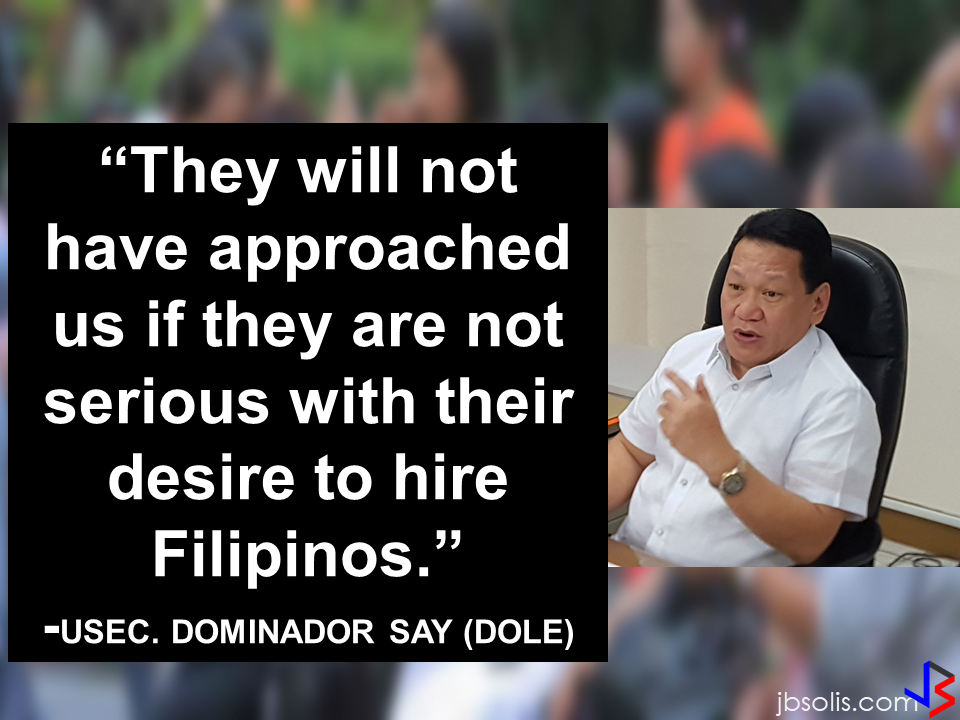
China's plans to hire Filipino household workers to their five major cities including Beijing and Shanghai, was reported at a local newspaper Philippine Star. it could be a big break for the household workers who are trying their luck in finding greener pastures by working overseas  China is offering up to P100,000  a month, or about HK$15,000. The existing minimum allowable wage for a foreign domestic helper in Hong Kong is  around HK$4,310 per month.  Dominador Say, undersecretary of the Department of Labor and Employment (DOLE), said that talks are underway with Chinese embassy officials on this possibility. China’s five major cities, including Beijing, Shanghai and Xiamen will soon be the haven for Filipino domestic workers who are seeking higher income.  DOLE is expected to have further negotiations on the launch date with a delegation from China in September.   according to Usec Say, Chinese employers favor Filipino domestic workers for their English proficiency, which allows them to teach their employers’ children.    Chinese embassy officials also mentioned that improving ties with the leadership of President Rodrigo Duterte has paved the way for the new policy to materialize.  There is presently a strict work visa system for foreign workers who want to enter mainland China. But according Usec. Say, China is serious about the proposal.   Philippine Labor Secretary Silvestre Bello said an estimated 200,000 Filipino domestic helpers are  presently working illegally in China. With a great demand for skilled domestic workers, Filipino OFWs would have an option to apply using legal processes on their desired higher salary for their sector. Source: ejinsight.com, PhilStar Read More:  The effectivity of the Nationwide Smoking Ban or  E.O. 26 (Providing for the Establishment of Smoke-free Environment in Public and Enclosed Places) started today, July 23, but only a few seems to be aware of it.  President Rodrigo Duterte signed the Executive Order 26 with the citizens health in mind. Presidential Spokesperson Ernesto Abella said the executive order is a milestone where the government prioritize public health protection.    The smoking ban includes smoking in places such as  schools, universities and colleges, playgrounds, restaurants and food preparation areas, basketball courts, stairwells, health centers, clinics, public and private hospitals, hotels, malls, elevators, taxis, buses, public utility jeepneys, ships, tricycles, trains, airplanes, and  gas stations which are prone to combustion. The Department of Health  urges all the establishments to post "no smoking" signs in compliance with the new executive order. They also appeal to the public to report any violation against the nationwide ban on smoking in public places.   Read More:          ©2017 THOUGHTSKOTO www.jbsolis.com SEARCH JBSOLIS, TYPE KEYWORDS and TITLE OF ARTICLE at the box below Smoking is only allowed in designated smoking areas to be provided by the owner of the establishment. Smoking in private vehicles parked in public areas is also prohibited. What Do You Need To know About The Nationwide Smoking Ban Violators will be fined P500 to P10,000, depending on their number of offenses, while owners of establishments caught violating the EO will face a fine of P5,000 or imprisonment of not more than 30 days. The Department of Health  urges all the establishments to post "no smoking" signs in compliance with the new executive order. They also appeal to the public to report any violation against the nationwide ban on smoking in public places.          ©2017 THOUGHTSKOTO

Dominador Say, undersecretary of the Department of Labor and Employment (DOLE), said that talks are underway with Chinese embassy officials on this possibility. China’s five major cities, including Beijing, Shanghai and Xiamen will soon be the destination for Filipino domestic workers who are seeking higher income.

©2016 THOUGHTSKOTO