Carousel

Sponsored Links

Looking for House and Lot Within Tagaytay Area? CONTACT US!

Name

Email *

Message *

Showing posts with label Inspection. Show all posts

Friday, December 07, 2018

No More Opening Of Bags In The Airport—Duterte

"You know if there is an improvement in public service in the airport, one is that there will be no more inspection for bags that come in." It is a statement from President Rodrigo Duterte following another incident of the alleged baggage pilferage at the Ninoy Aquino International Airport (NAIA) that victimizes the passengers especially the overseas Filipino workers (OFW).
The president said that he would prefer minimizing human contacts in checking and screening of the baggage.


"You know if there is an improvement in public service in the airport, one is that there will be no more inspection for bags that come in." It is a statement from President Rodrigo Duterte following another incident of the alleged baggage pilferage at the Ninoy Aquino International Airport (NAIA) that victimizes the passengers especially the overseas Filipino workers (OFW).  The president said that he would prefer minimizing human contacts in checking and screening of the baggage.         Ads  Sponsored Links      President Rodrigo Duterte said Thursday bags of travelers will no longer be opened during airport screening and "human contact" would be minimized.  The President then made a joke about how bringing in contraband like dynamite, bullets, and marijuana would be okay, but that the police and the members of the Philippine Drug Enforcement Agency (PDEA) would be waiting for them outside the airport.  He also said that there would be no more human contact in airport immigration. By this, he was most probably referring about the newly installed eGates at the airport which is now operational.   he said.  Duterte said that in his years as a  public servant, he has seen how poorly the overseas Filipino workers are being been treated. He recalled one instance where he witnessed an OFW who arrived from Hong Kong with a small TV being charged a fee the worker could not afford.  The President said he nearly got into a fight with the airport personnel over the way the OFW was treated. The president also reiterated that he does not like any form of oppression among the Filipino people, especially on his presence.  Filed under the category of public service, inspection, President Rodrigo Duterte, Ninoy Aquino International Airport, overseas Filipino workers

Ads

Sponsored Links


President Rodrigo Duterte said Thursday bags of travelers will no longer be opened during airport screening and "human contact" would be minimized.

The President then made a joke about how bringing in contraband like dynamite, bullets, and marijuana would be okay, but that the police and the members of the Philippine Drug Enforcement Agency (PDEA) would be waiting for them outside the airport.

He also said that there would be no more human contact in airport immigration. By this, he was most probably referring about the newly installed eGates at the airport which is now operational.
 he said.

Duterte said that in his years as a  public servant, he has seen how poorly the overseas Filipino workers are being been treated. He recalled one instance where he witnessed an OFW who arrived from Hong Kong with a small TV being charged a fee the OFW could not afford.

The President said he nearly got into a fight with the airport personnel over the way the OFW was treated.
The president also reiterated that he does not like any form of oppression among the Filipino people, especially on his presence.

Filed under the category of public service, inspection, President Rodrigo Duterte, Ninoy Aquino International Airport, overseas Filipino workers

Ads

Read More:
Sometimes, OFWs and families are getting into inevitable situations like a loss of loved ones who work abroad. If your OFW family or relative died overseas, here is the procedure provided by the DFA. Take note that this procedure is only applied to documented overseas Filipino workers in Saudi Arabia only. Whether they died a natural cause or under unfavorable circumstances, it is very important that their remains be repatriated immediately       Ads  Sponsored Links     Should such a thing happen, according to the Philippine Embassy in Riyadh, here is the procedure to be followed:       1. The sponsor should inform the family of the deceased of the death and secure a Letter of Acceptance for remains.     2. The sponsor should secure the medical report and death notification of the deceased from the hospital where the Filipino died or where his remains were brought to.     3. The sponsor should report the death to the Police station having jurisdiction over the case to obtain its endorsement for the issuance of the death certificate of the deceased.    4. The sponsor should submit to the Embassy four (4) copies each of the following documents:   the death certificate;  the medical report;  the Police Report (if the Filipino died of unnatural causes, such as work-related or road traffic accidents, or cases wherein there was foul play)  photocopy of the passport of the deceased; and  list of the personal belongings of the deceased.   5. After completion of these requirements, the Embassy will then issue its No Objection Certificate. The fee for the Certificate is SAR 100.00.   6. The sponsor of the deceased will then present the Embassy’s No Objection Certificate to the concerned Police authorities to the secure the following letters from the said office:   the Saudi Passport Office;  the hospital morgue;  the airport;  the Immigration Office;  the Customs Office; and  the cargo company.  7. The sponsor must go to the Passport Office for the issuance of the exit visa of the deceased.   8. The sponsor should proceed to the airline and the cargo company to secure the flight booking and to arrange the shipment of the personal belongings of the deceased to the Philippines.    9. The sponsor should then inform the Embassy of the confirmed flight details of the shipment of the remains of the deceased.      10. The sponsor will proceed to the Hospital morgue for the release of the human remains of the deceased for transport to the airport.   For further inquiries, please contact telephone number (009661) 480-3662 or send an email to atn-remains@riyadhpe.com or sor@philembassy-riyadh.org.    Please note that it is the employer who is primarily responsible to process the above-stated documents.   The Saudi Labor Law, Article 40, states that :  The employer shall bear the costs of the foreign workman’s recruitment, the fees for issuance and renewal of his residence and work permits, as well as the attendant delay fines, profession change fees, exit and re-entry visa fees, and return ticket to the workman’s homeland upon termination of the relationship between the two parties.  The workman shall bear the costs of his return to his homeland if he is found unfit for work or if he wishes to return home in the absence of a legitimate reason.  The employer shall bear the cost of transferring the services of the workman he wishes to employ.    The employer shall bear the cost of repatriating the dead body of the workman to the location where the contract has been concluded or the workman recruited, except where the dead workman’s body is buried in the Kingdom with the approval of his family. The employer shall be relieved of this duty if the General Organization for Social Insurance assumes this obligation.  Filed under the category of  OFW, work abroad.work abroad, DFA, documented, repatriated,Saudi Arabia

©2018 THOUGHTSKOTO

Thursday, July 27, 2017

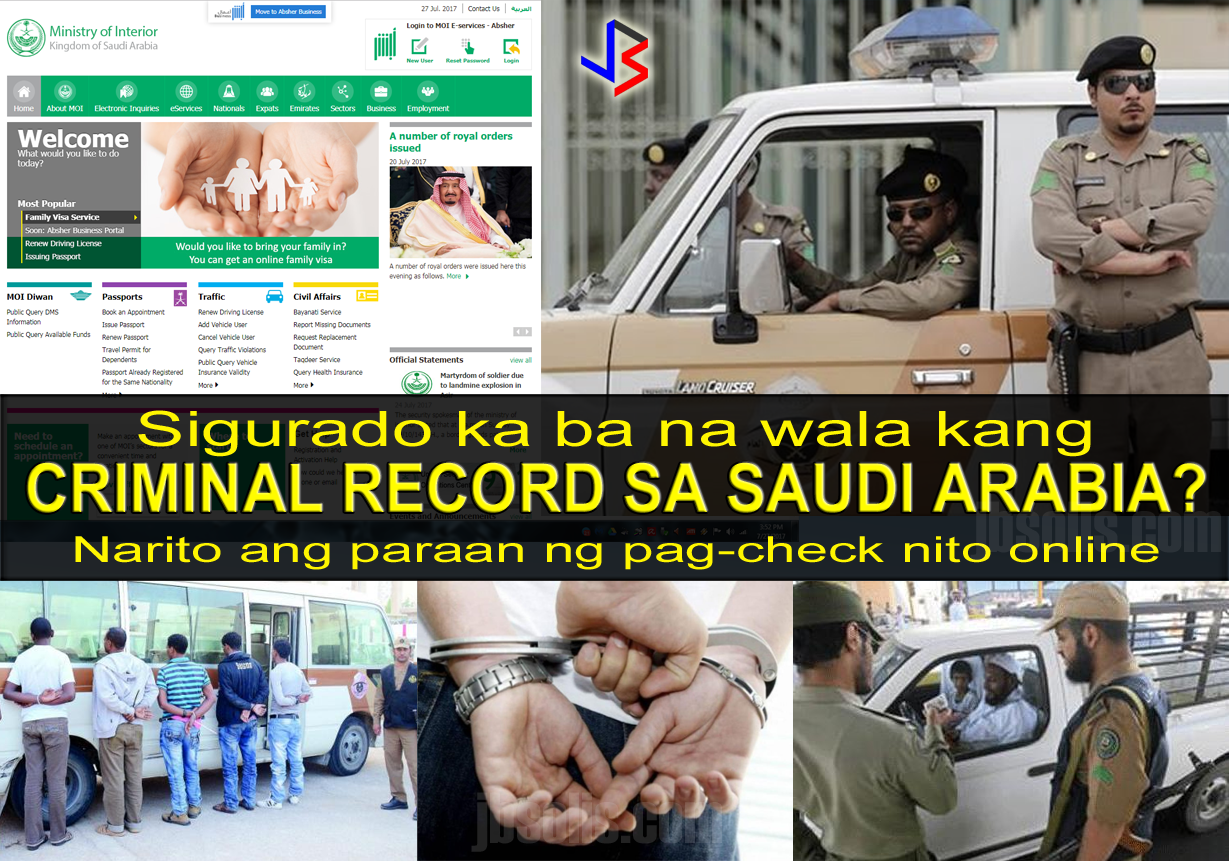
Saudi Arabia: How To Check ONLINE If You Have a Criminal Record

In Saudi Arabia, it is not surprising for an expat to discover that there is a criminal record or complaint lodged against him. This is due to the fact that a complained filed against you may actually be due to mistaken identity. Several reasons could be blamed, such as similarities in the names (due to translations) or even clerical error. In the latter case, if a complaint is entered in the government database, a mistake is made in the most important detail about the person - the iqama number. One number is all it takes for you to have a criminal complained or record filed against you. That is why it it important for you to check the Interior Ministry page for criminal records.  Using the (MOI) Ministry of Interior's Electronic Service called Absher, you can check any Criminal Case record on your Iqama number. Here are the steps:  1. Go to the MOI website to login to your Absher account. If you don't have one, create an account first by clicking "New User". You will need a mobile number associated with your account.  2. In the login page, enter you user name, password and the random numbers generated. Click login.  3. You will get a verification code in your mobile phone registered with MOI. Enter the number here in the box provided and click enter.  4. Once you are logged in, go to eServices > MOI Diwan > Generalization Report Query. (See numbers 1-2-3 below.  5. If you are checking for criminal records for the first time, you will get a message description of the service. Just click proceed. The result will be displayed similar to the one below:  6. If your records are clear, you will get the message: "There are no Generalization report registered against you."   7. If you get a report against you, seek advise from your employer or your embassy.  It is best to check for any records lodged against you. While you may have a valid Iqama, it is still possible that there is an erroneous record or criminal complaint filed under your Iqama number. If so, it is best to settle it before you get caught in a checkpoint. Note that, in the video above, Saudi Police and the Jawazat - the Passport Office, are intensifying their crackdown on illegal residents and violators.  Also, if you are planning to go on vacation, or renew your Iqama, it is best to check for records before doing any of these things to make sure you will not have any problem with the Saudi Authorities in the future.


In Saudi Arabia, it is not surprising for an expat to discover that there is a criminal record or complaint lodged against him. This is due to the fact that a complained filed against you may actually be due to mistaken identity. Several reasons could be blamed, such as similarities in the names (due to translations) or even clerical error. In the latter case, if a complaint is entered in the government database, a mistake is made in the most important detail about the person - the iqama number. One number is all it takes for you to have a criminal complained or record filed against you. That is why it it important for you to check the Interior Ministry page for criminal records.

Using the (MOI) Ministry of Interior's Electronic Service called Absher, you can check any Criminal Case record on your Iqama number. Here are the steps:

1. Go to the MOI website to login to your Absher account. If you don't have one, create an account first by clicking "New User". You will need a mobile number associated with your account.
In Saudi Arabia, it is not surprising for an expat to discover that there is a criminal record or complaint lodged against him. This is due to the fact that a complained filed against you may actually be due to mistaken identity. Several reasons could be blamed, such as similarities in the names (due to translations) or even clerical error. In the latter case, if a complaint is entered in the government database, a mistake is made in the most important detail about the person - the iqama number. One number is all it takes for you to have a criminal complained or record filed against you. That is why it it important for you to check the Interior Ministry page for criminal records.  Using the (MOI) Ministry of Interior's Electronic Service called Absher, you can check any Criminal Case record on your Iqama number. Here are the steps:  1. Go to the MOI website to login to your Absher account. If you don't have one, create an account first by clicking "New User". You will need a mobile number associated with your account.  2. In the login page, enter you user name, password and the random numbers generated. Click login.  3. You will get a verification code in your mobile phone registered with MOI. Enter the number here in the box provided and click enter.  4. Once you are logged in, go to eServices > MOI Diwan > Generalization Report Query. (See numbers 1-2-3 below.  5. If you are checking for criminal records for the first time, you will get a message description of the service. Just click proceed. The result will be displayed similar to the one below:  6. If your records are clear, you will get the message: "There are no Generalization report registered against you."   7. If you get a report against you, seek advise from your employer or your embassy.  It is best to check for any records lodged against you. While you may have a valid Iqama, it is still possible that there is an erroneous record or criminal complaint filed under your Iqama number. If so, it is best to settle it before you get caught in a checkpoint. Note that, in the video above, Saudi Police and the Jawazat - the Passport Office, are intensifying their crackdown on illegal residents and violators.  Also, if you are planning to go on vacation, or renew your Iqama, it is best to check for records before doing any of these things to make sure you will not have any problem with the Saudi Authorities in the future.


2. In the login page, enter you user name, password and the random numbers generated. Click login.
In Saudi Arabia, it is not surprising for an expat to discover that there is a criminal record or complaint lodged against him. This is due to the fact that a complained filed against you may actually be due to mistaken identity. Several reasons could be blamed, such as similarities in the names (due to translations) or even clerical error. In the latter case, if a complaint is entered in the government database, a mistake is made in the most important detail about the person - the iqama number. One number is all it takes for you to have a criminal complained or record filed against you. That is why it it important for you to check the Interior Ministry page for criminal records.  Using the (MOI) Ministry of Interior's Electronic Service called Absher, you can check any Criminal Case record on your Iqama number. Here are the steps:  1. Go to the MOI website to login to your Absher account. If you don't have one, create an account first by clicking "New User". You will need a mobile number associated with your account.  2. In the login page, enter you user name, password and the random numbers generated. Click login.  3. You will get a verification code in your mobile phone registered with MOI. Enter the number here in the box provided and click enter.  4. Once you are logged in, go to eServices > MOI Diwan > Generalization Report Query. (See numbers 1-2-3 below.  5. If you are checking for criminal records for the first time, you will get a message description of the service. Just click proceed. The result will be displayed similar to the one below:  6. If your records are clear, you will get the message: "There are no Generalization report registered against you."   7. If you get a report against you, seek advise from your employer or your embassy.  It is best to check for any records lodged against you. While you may have a valid Iqama, it is still possible that there is an erroneous record or criminal complaint filed under your Iqama number. If so, it is best to settle it before you get caught in a checkpoint. Note that, in the video above, Saudi Police and the Jawazat - the Passport Office, are intensifying their crackdown on illegal residents and violators.  Also, if you are planning to go on vacation, or renew your Iqama, it is best to check for records before doing any of these things to make sure you will not have any problem with the Saudi Authorities in the future.


3. You will get a verification code in your mobile phone registered with MOI. Enter the number here in the box provided and click enter.
In Saudi Arabia, it is not surprising for an expat to discover that there is a criminal record or complaint lodged against him. This is due to the fact that a complained filed against you may actually be due to mistaken identity. Several reasons could be blamed, such as similarities in the names (due to translations) or even clerical error. In the latter case, if a complaint is entered in the government database, a mistake is made in the most important detail about the person - the iqama number. One number is all it takes for you to have a criminal complained or record filed against you. That is why it it important for you to check the Interior Ministry page for criminal records.  Using the (MOI) Ministry of Interior's Electronic Service called Absher, you can check any Criminal Case record on your Iqama number. Here are the steps:  1. Go to the MOI website to login to your Absher account. If you don't have one, create an account first by clicking "New User". You will need a mobile number associated with your account.  2. In the login page, enter you user name, password and the random numbers generated. Click login.  3. You will get a verification code in your mobile phone registered with MOI. Enter the number here in the box provided and click enter.  4. Once you are logged in, go to eServices > MOI Diwan > Generalization Report Query. (See numbers 1-2-3 below.  5. If you are checking for criminal records for the first time, you will get a message description of the service. Just click proceed. The result will be displayed similar to the one below:  6. If your records are clear, you will get the message: "There are no Generalization report registered against you."   7. If you get a report against you, seek advise from your employer or your embassy.  It is best to check for any records lodged against you. While you may have a valid Iqama, it is still possible that there is an erroneous record or criminal complaint filed under your Iqama number. If so, it is best to settle it before you get caught in a checkpoint. Note that, in the video above, Saudi Police and the Jawazat - the Passport Office, are intensifying their crackdown on illegal residents and violators.  Also, if you are planning to go on vacation, or renew your Iqama, it is best to check for records before doing any of these things to make sure you will not have any problem with the Saudi Authorities in the future.


4. Once you are logged in, go to eServices > MOI Diwan > Generalization Report Query. (See numbers 1-2-3 below.
In Saudi Arabia, it is not surprising for an expat to discover that there is a criminal record or complaint lodged against him. This is due to the fact that a complained filed against you may actually be due to mistaken identity. Several reasons could be blamed, such as similarities in the names (due to translations) or even clerical error. In the latter case, if a complaint is entered in the government database, a mistake is made in the most important detail about the person - the iqama number. One number is all it takes for you to have a criminal complained or record filed against you. That is why it it important for you to check the Interior Ministry page for criminal records.  Using the (MOI) Ministry of Interior's Electronic Service called Absher, you can check any Criminal Case record on your Iqama number. Here are the steps:  1. Go to the MOI website to login to your Absher account. If you don't have one, create an account first by clicking "New User". You will need a mobile number associated with your account.  2. In the login page, enter you user name, password and the random numbers generated. Click login.  3. You will get a verification code in your mobile phone registered with MOI. Enter the number here in the box provided and click enter.  4. Once you are logged in, go to eServices > MOI Diwan > Generalization Report Query. (See numbers 1-2-3 below.  5. If you are checking for criminal records for the first time, you will get a message description of the service. Just click proceed. The result will be displayed similar to the one below:  6. If your records are clear, you will get the message: "There are no Generalization report registered against you."   7. If you get a report against you, seek advise from your employer or your embassy.  It is best to check for any records lodged against you. While you may have a valid Iqama, it is still possible that there is an erroneous record or criminal complaint filed under your Iqama number. If so, it is best to settle it before you get caught in a checkpoint. Note that, in the video above, Saudi Police and the Jawazat - the Passport Office, are intensifying their crackdown on illegal residents and violators.  Also, if you are planning to go on vacation, or renew your Iqama, it is best to check for records before doing any of these things to make sure you will not have any problem with the Saudi Authorities in the future.


5. If you are checking for criminal records for the first time, you will get a message description of the service. Just click proceed. The result will be displayed similar to the one below:
In Saudi Arabia, it is not surprising for an expat to discover that there is a criminal record or complaint lodged against him. This is due to the fact that a complained filed against you may actually be due to mistaken identity. Several reasons could be blamed, such as similarities in the names (due to translations) or even clerical error. In the latter case, if a complaint is entered in the government database, a mistake is made in the most important detail about the person - the iqama number. One number is all it takes for you to have a criminal complained or record filed against you. That is why it it important for you to check the Interior Ministry page for criminal records.  Using the (MOI) Ministry of Interior's Electronic Service called Absher, you can check any Criminal Case record on your Iqama number. Here are the steps:  1. Go to the MOI website to login to your Absher account. If you don't have one, create an account first by clicking "New User". You will need a mobile number associated with your account.  2. In the login page, enter you user name, password and the random numbers generated. Click login.  3. You will get a verification code in your mobile phone registered with MOI. Enter the number here in the box provided and click enter.  4. Once you are logged in, go to eServices > MOI Diwan > Generalization Report Query. (See numbers 1-2-3 below.  5. If you are checking for criminal records for the first time, you will get a message description of the service. Just click proceed. The result will be displayed similar to the one below:  6. If your records are clear, you will get the message: "There are no Generalization report registered against you."   7. If you get a report against you, seek advise from your employer or your embassy.  It is best to check for any records lodged against you. While you may have a valid Iqama, it is still possible that there is an erroneous record or criminal complaint filed under your Iqama number. If so, it is best to settle it before you get caught in a checkpoint. Note that, in the video above, Saudi Police and the Jawazat - the Passport Office, are intensifying their crackdown on illegal residents and violators.  Also, if you are planning to go on vacation, or renew your Iqama, it is best to check for records before doing any of these things to make sure you will not have any problem with the Saudi Authorities in the future.


6. If your records are clear, you will get the message: "There are no Generalization report registered against you."

7. If you get a report against you, seek advise from your employer or your embassy.


It is best to check for any records lodged against you. While you may have a valid Iqama, it is still possible that there is an erroneous record or criminal complaint filed under your Iqama number. If so, it is best to settle it before you get caught in a checkpoint. Note that, in the video above, Saudi Police and the Jawazat - the Passport Office, are intensifying their crackdown on illegal residents and violators.

Also, if you are planning to go on vacation, or renew your Iqama, it is best to check for records before doing any of these things to make sure you will not have any problem with the Saudi Authorities in the future.


OFW Remittance Will Not Be Taxed Under Duterte's Tax Reform Plan

If you are an OFW, or your family relies on OFW remittance, then here's some good news for you! If you are aware of President Duterte's Tax Reform Plan, many OFWs were wondering if their remittances are going to be taxed as some people have speculated on social media. The good news is that Finance Undersecretary Karl Kendrick Chua has confirmed that the proposed Comprehensive Tax Reform Program (CTRP) does not cover remittances from Overseas Filipino Workers since these are money coming from outside the country.  Simply put, the Philippine government has no jurisdiction over such inbound funds. Just to stress, the laws apply only to remittances sent from within the country and, even then, the principal amount itself is not taxed. Only the domestic remittance fees are being charged with value-added tax (VAT).  Economists agree, that the continuing growth of OFW remittances, as well as the local BPO Industry, are a big help in achieving the 6-7% target growth of the Philippines' GDP. Last year, overseas Filipino workers had remitted a total of $28 Billion. Remittances came mainly from the United States, Saudi Arabia, the United Arab Emirates and Singapore.  Finance Secretary Carlos Dominguez III said the CTRP was expected to help reduce the poverty rate in the Philippines from 21.6 percent in 2015 to 14 percent by 2022.  Dominguez said that meant lifting some six million Filipinos out of poverty and helping the country achieve upper middle-income status.


If you are a woman and you are in Saudi Arabia, showing an inch of flesh is a criminal act.   Saudi Arabia is one of few countries in the world with the extremely strict dress code. In the Kingdom, it does not matter whether you are a local citizen or a foreigner because both of you must follow the Saudi Arabia's dress code that is governed by Sharia Law.  For Saudi, it is unacceptable for their locals to disregard the dress code and while expats are given an amount of freedom especially within their compounds, they are expected to follow the dress code when out in public.


It's been three weeks since the Dependent Fee has been implemented for Saudi Arabia Expatriate workers who brought their families to live with them. Now it is becoming clearer on who are supposed to pay, and who are exempted from paying the dependent fee. Remember that the fees amount to SR100 per family member per month, but the payment must be done annually and in full. Once paid, it cannot be refunded as well, in case your family members go out of the country. Finally, the amount increases by SR 100 every year, up to 2020 where it will be SR 400 per dependent member per month.   This has caused many expats sending their families back home. But hope emerges for a certain few expats as more details emerge. A tweet in arabic has shown a list of expats exempted from paying the dependent fees. See it below. Here are the confirmed lists of expatriates exempted from paying dependent fees: An expatriate who is married to a Saudi Citizen: A citizen's wife and children are exempted from the dependent fee. Widows and divorced women who were married to a Saudi Citizen are also exempted. However, it is not clear if this remains true if the woman married an expat after her Saudi husband dies or is divorced.  In case where the Saudi citizen is the mother, the child is still exempted.   Long-term Residents Expatriate dependents who have stayed in Saudi Arabia for most of their lives are also listed as exempted from the dependent fees. The requirement is that they must not have traveled to any country outside the kingdom for the last 40 years!   Foreign Students Foreign students who are currently studying in Saudi Arabia are exempted from paying dependent fees. To clarify, these are students whose visa states that they are in the kingdom as students. These do not include children sponsored by their parents and are merely studying as well.   Expatriates Working in the Government Sector Expats whose sponsors are a part of government are not required to pay the dependent fees. This is most welcome news for many OFWs since many Filipinos are working in the different Saudi government hospitals, schools and offices.  To further verify the news, we asked some OFWs to check their banking information - if it indeed shows no requirements for dependent fees. See the screenshots after the video.  Also, employees who are working in the government sector, but were supplied through a private contractor are not exempted.  While the Saudi Government has full rights to craft and implement their own policy, the effects of these policies cannot be easily controlled. The dependent levy is expected to enrich the kingdom's coffers, but what about the effect to the local market. Some economists argue that the gross outcome of the move will not be beneficial at all for the national economy because in the first year after the imposition of the new tax at least 1 million expats, 75 percent of them dependents, are likely to leave the Kingdom. These 1 million foreigners used to spend their money inside the Kingdom to purchase goods and services, pay rent as well as some ministry fees like exit/reentry visas. Now, they will send 50-80% of their salaries back home, reducing liquidity in the local market.  Whatever the policy may be, both Saudi nationals and expats hope for a brighter future for the Kingdom of Saudi Arabia.


©2017 THOUGHTSKOTO

SEARCH JBSOLIS, TYPE KEYWORDS and TITLE OF ARTICLE at the box below