Carousel

Sponsored Links

Looking for House and Lot Within Tagaytay Area? CONTACT US!

Name

Email *

Message *

Showing posts with label absher. Show all posts

Thursday, July 27, 2017

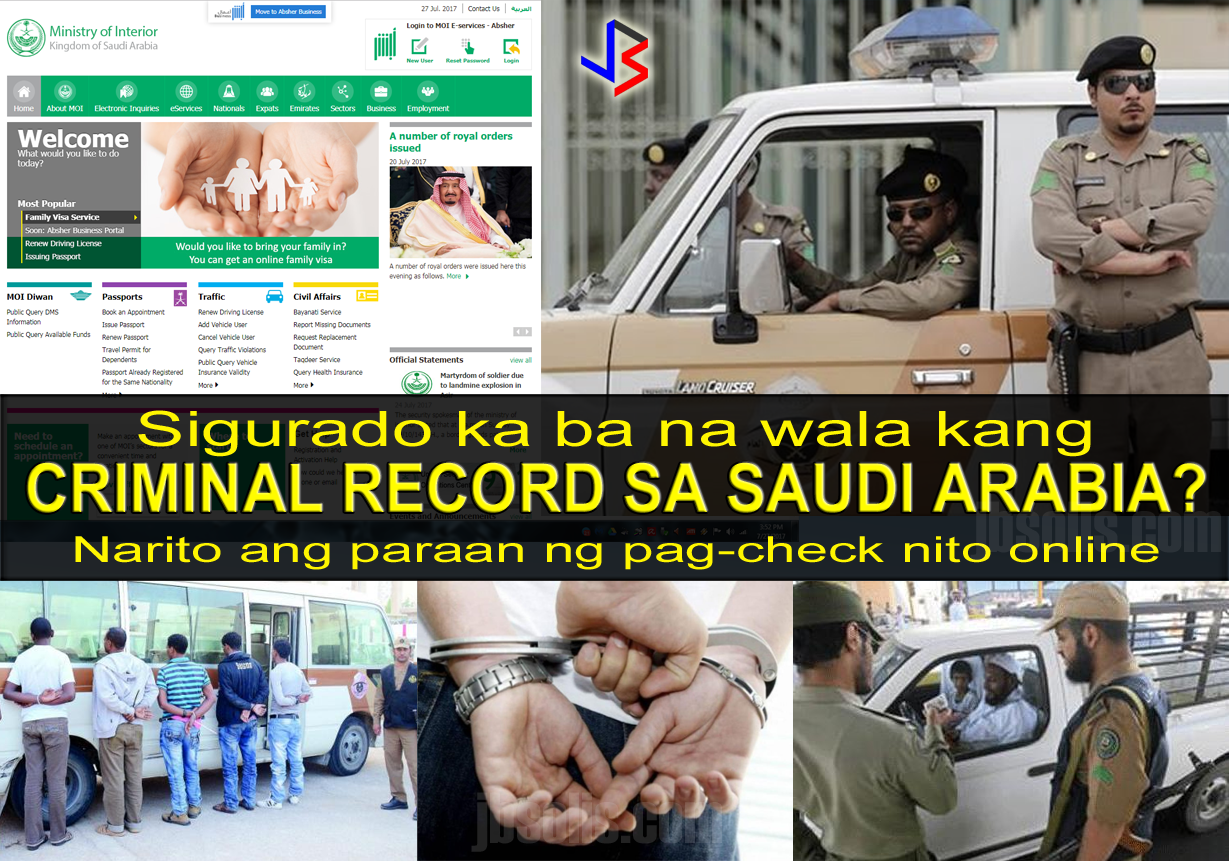
Saudi Arabia: How To Check ONLINE If You Have a Criminal Record

In Saudi Arabia, it is not surprising for an expat to discover that there is a criminal record or complaint lodged against him. This is due to the fact that a complained filed against you may actually be due to mistaken identity. Several reasons could be blamed, such as similarities in the names (due to translations) or even clerical error. In the latter case, if a complaint is entered in the government database, a mistake is made in the most important detail about the person - the iqama number. One number is all it takes for you to have a criminal complained or record filed against you. That is why it it important for you to check the Interior Ministry page for criminal records.  Using the (MOI) Ministry of Interior's Electronic Service called Absher, you can check any Criminal Case record on your Iqama number. Here are the steps:  1. Go to the MOI website to login to your Absher account. If you don't have one, create an account first by clicking "New User". You will need a mobile number associated with your account.  2. In the login page, enter you user name, password and the random numbers generated. Click login.  3. You will get a verification code in your mobile phone registered with MOI. Enter the number here in the box provided and click enter.  4. Once you are logged in, go to eServices > MOI Diwan > Generalization Report Query. (See numbers 1-2-3 below.  5. If you are checking for criminal records for the first time, you will get a message description of the service. Just click proceed. The result will be displayed similar to the one below:  6. If your records are clear, you will get the message: "There are no Generalization report registered against you."   7. If you get a report against you, seek advise from your employer or your embassy.  It is best to check for any records lodged against you. While you may have a valid Iqama, it is still possible that there is an erroneous record or criminal complaint filed under your Iqama number. If so, it is best to settle it before you get caught in a checkpoint. Note that, in the video above, Saudi Police and the Jawazat - the Passport Office, are intensifying their crackdown on illegal residents and violators.  Also, if you are planning to go on vacation, or renew your Iqama, it is best to check for records before doing any of these things to make sure you will not have any problem with the Saudi Authorities in the future.


In Saudi Arabia, it is not surprising for an expat to discover that there is a criminal record or complaint lodged against him. This is due to the fact that a complained filed against you may actually be due to mistaken identity. Several reasons could be blamed, such as similarities in the names (due to translations) or even clerical error. In the latter case, if a complaint is entered in the government database, a mistake is made in the most important detail about the person - the iqama number. One number is all it takes for you to have a criminal complained or record filed against you. That is why it it important for you to check the Interior Ministry page for criminal records.

Using the (MOI) Ministry of Interior's Electronic Service called Absher, you can check any Criminal Case record on your Iqama number. Here are the steps:

1. Go to the MOI website to login to your Absher account. If you don't have one, create an account first by clicking "New User". You will need a mobile number associated with your account.
In Saudi Arabia, it is not surprising for an expat to discover that there is a criminal record or complaint lodged against him. This is due to the fact that a complained filed against you may actually be due to mistaken identity. Several reasons could be blamed, such as similarities in the names (due to translations) or even clerical error. In the latter case, if a complaint is entered in the government database, a mistake is made in the most important detail about the person - the iqama number. One number is all it takes for you to have a criminal complained or record filed against you. That is why it it important for you to check the Interior Ministry page for criminal records.  Using the (MOI) Ministry of Interior's Electronic Service called Absher, you can check any Criminal Case record on your Iqama number. Here are the steps:  1. Go to the MOI website to login to your Absher account. If you don't have one, create an account first by clicking "New User". You will need a mobile number associated with your account.  2. In the login page, enter you user name, password and the random numbers generated. Click login.  3. You will get a verification code in your mobile phone registered with MOI. Enter the number here in the box provided and click enter.  4. Once you are logged in, go to eServices > MOI Diwan > Generalization Report Query. (See numbers 1-2-3 below.  5. If you are checking for criminal records for the first time, you will get a message description of the service. Just click proceed. The result will be displayed similar to the one below:  6. If your records are clear, you will get the message: "There are no Generalization report registered against you."   7. If you get a report against you, seek advise from your employer or your embassy.  It is best to check for any records lodged against you. While you may have a valid Iqama, it is still possible that there is an erroneous record or criminal complaint filed under your Iqama number. If so, it is best to settle it before you get caught in a checkpoint. Note that, in the video above, Saudi Police and the Jawazat - the Passport Office, are intensifying their crackdown on illegal residents and violators.  Also, if you are planning to go on vacation, or renew your Iqama, it is best to check for records before doing any of these things to make sure you will not have any problem with the Saudi Authorities in the future.


2. In the login page, enter you user name, password and the random numbers generated. Click login.
In Saudi Arabia, it is not surprising for an expat to discover that there is a criminal record or complaint lodged against him. This is due to the fact that a complained filed against you may actually be due to mistaken identity. Several reasons could be blamed, such as similarities in the names (due to translations) or even clerical error. In the latter case, if a complaint is entered in the government database, a mistake is made in the most important detail about the person - the iqama number. One number is all it takes for you to have a criminal complained or record filed against you. That is why it it important for you to check the Interior Ministry page for criminal records.  Using the (MOI) Ministry of Interior's Electronic Service called Absher, you can check any Criminal Case record on your Iqama number. Here are the steps:  1. Go to the MOI website to login to your Absher account. If you don't have one, create an account first by clicking "New User". You will need a mobile number associated with your account.  2. In the login page, enter you user name, password and the random numbers generated. Click login.  3. You will get a verification code in your mobile phone registered with MOI. Enter the number here in the box provided and click enter.  4. Once you are logged in, go to eServices > MOI Diwan > Generalization Report Query. (See numbers 1-2-3 below.  5. If you are checking for criminal records for the first time, you will get a message description of the service. Just click proceed. The result will be displayed similar to the one below:  6. If your records are clear, you will get the message: "There are no Generalization report registered against you."   7. If you get a report against you, seek advise from your employer or your embassy.  It is best to check for any records lodged against you. While you may have a valid Iqama, it is still possible that there is an erroneous record or criminal complaint filed under your Iqama number. If so, it is best to settle it before you get caught in a checkpoint. Note that, in the video above, Saudi Police and the Jawazat - the Passport Office, are intensifying their crackdown on illegal residents and violators.  Also, if you are planning to go on vacation, or renew your Iqama, it is best to check for records before doing any of these things to make sure you will not have any problem with the Saudi Authorities in the future.


3. You will get a verification code in your mobile phone registered with MOI. Enter the number here in the box provided and click enter.
In Saudi Arabia, it is not surprising for an expat to discover that there is a criminal record or complaint lodged against him. This is due to the fact that a complained filed against you may actually be due to mistaken identity. Several reasons could be blamed, such as similarities in the names (due to translations) or even clerical error. In the latter case, if a complaint is entered in the government database, a mistake is made in the most important detail about the person - the iqama number. One number is all it takes for you to have a criminal complained or record filed against you. That is why it it important for you to check the Interior Ministry page for criminal records.  Using the (MOI) Ministry of Interior's Electronic Service called Absher, you can check any Criminal Case record on your Iqama number. Here are the steps:  1. Go to the MOI website to login to your Absher account. If you don't have one, create an account first by clicking "New User". You will need a mobile number associated with your account.  2. In the login page, enter you user name, password and the random numbers generated. Click login.  3. You will get a verification code in your mobile phone registered with MOI. Enter the number here in the box provided and click enter.  4. Once you are logged in, go to eServices > MOI Diwan > Generalization Report Query. (See numbers 1-2-3 below.  5. If you are checking for criminal records for the first time, you will get a message description of the service. Just click proceed. The result will be displayed similar to the one below:  6. If your records are clear, you will get the message: "There are no Generalization report registered against you."   7. If you get a report against you, seek advise from your employer or your embassy.  It is best to check for any records lodged against you. While you may have a valid Iqama, it is still possible that there is an erroneous record or criminal complaint filed under your Iqama number. If so, it is best to settle it before you get caught in a checkpoint. Note that, in the video above, Saudi Police and the Jawazat - the Passport Office, are intensifying their crackdown on illegal residents and violators.  Also, if you are planning to go on vacation, or renew your Iqama, it is best to check for records before doing any of these things to make sure you will not have any problem with the Saudi Authorities in the future.


4. Once you are logged in, go to eServices > MOI Diwan > Generalization Report Query. (See numbers 1-2-3 below.
In Saudi Arabia, it is not surprising for an expat to discover that there is a criminal record or complaint lodged against him. This is due to the fact that a complained filed against you may actually be due to mistaken identity. Several reasons could be blamed, such as similarities in the names (due to translations) or even clerical error. In the latter case, if a complaint is entered in the government database, a mistake is made in the most important detail about the person - the iqama number. One number is all it takes for you to have a criminal complained or record filed against you. That is why it it important for you to check the Interior Ministry page for criminal records.  Using the (MOI) Ministry of Interior's Electronic Service called Absher, you can check any Criminal Case record on your Iqama number. Here are the steps:  1. Go to the MOI website to login to your Absher account. If you don't have one, create an account first by clicking "New User". You will need a mobile number associated with your account.  2. In the login page, enter you user name, password and the random numbers generated. Click login.  3. You will get a verification code in your mobile phone registered with MOI. Enter the number here in the box provided and click enter.  4. Once you are logged in, go to eServices > MOI Diwan > Generalization Report Query. (See numbers 1-2-3 below.  5. If you are checking for criminal records for the first time, you will get a message description of the service. Just click proceed. The result will be displayed similar to the one below:  6. If your records are clear, you will get the message: "There are no Generalization report registered against you."   7. If you get a report against you, seek advise from your employer or your embassy.  It is best to check for any records lodged against you. While you may have a valid Iqama, it is still possible that there is an erroneous record or criminal complaint filed under your Iqama number. If so, it is best to settle it before you get caught in a checkpoint. Note that, in the video above, Saudi Police and the Jawazat - the Passport Office, are intensifying their crackdown on illegal residents and violators.  Also, if you are planning to go on vacation, or renew your Iqama, it is best to check for records before doing any of these things to make sure you will not have any problem with the Saudi Authorities in the future.


5. If you are checking for criminal records for the first time, you will get a message description of the service. Just click proceed. The result will be displayed similar to the one below:
In Saudi Arabia, it is not surprising for an expat to discover that there is a criminal record or complaint lodged against him. This is due to the fact that a complained filed against you may actually be due to mistaken identity. Several reasons could be blamed, such as similarities in the names (due to translations) or even clerical error. In the latter case, if a complaint is entered in the government database, a mistake is made in the most important detail about the person - the iqama number. One number is all it takes for you to have a criminal complained or record filed against you. That is why it it important for you to check the Interior Ministry page for criminal records.  Using the (MOI) Ministry of Interior's Electronic Service called Absher, you can check any Criminal Case record on your Iqama number. Here are the steps:  1. Go to the MOI website to login to your Absher account. If you don't have one, create an account first by clicking "New User". You will need a mobile number associated with your account.  2. In the login page, enter you user name, password and the random numbers generated. Click login.  3. You will get a verification code in your mobile phone registered with MOI. Enter the number here in the box provided and click enter.  4. Once you are logged in, go to eServices > MOI Diwan > Generalization Report Query. (See numbers 1-2-3 below.  5. If you are checking for criminal records for the first time, you will get a message description of the service. Just click proceed. The result will be displayed similar to the one below:  6. If your records are clear, you will get the message: "There are no Generalization report registered against you."   7. If you get a report against you, seek advise from your employer or your embassy.  It is best to check for any records lodged against you. While you may have a valid Iqama, it is still possible that there is an erroneous record or criminal complaint filed under your Iqama number. If so, it is best to settle it before you get caught in a checkpoint. Note that, in the video above, Saudi Police and the Jawazat - the Passport Office, are intensifying their crackdown on illegal residents and violators.  Also, if you are planning to go on vacation, or renew your Iqama, it is best to check for records before doing any of these things to make sure you will not have any problem with the Saudi Authorities in the future.


6. If your records are clear, you will get the message: "There are no Generalization report registered against you."

7. If you get a report against you, seek advise from your employer or your embassy.


It is best to check for any records lodged against you. While you may have a valid Iqama, it is still possible that there is an erroneous record or criminal complaint filed under your Iqama number. If so, it is best to settle it before you get caught in a checkpoint. Note that, in the video above, Saudi Police and the Jawazat - the Passport Office, are intensifying their crackdown on illegal residents and violators.

Also, if you are planning to go on vacation, or renew your Iqama, it is best to check for records before doing any of these things to make sure you will not have any problem with the Saudi Authorities in the future.


OFW Remittance Will Not Be Taxed Under Duterte's Tax Reform Plan

If you are an OFW, or your family relies on OFW remittance, then here's some good news for you! If you are aware of President Duterte's Tax Reform Plan, many OFWs were wondering if their remittances are going to be taxed as some people have speculated on social media. The good news is that Finance Undersecretary Karl Kendrick Chua has confirmed that the proposed Comprehensive Tax Reform Program (CTRP) does not cover remittances from Overseas Filipino Workers since these are money coming from outside the country.  Simply put, the Philippine government has no jurisdiction over such inbound funds. Just to stress, the laws apply only to remittances sent from within the country and, even then, the principal amount itself is not taxed. Only the domestic remittance fees are being charged with value-added tax (VAT).  Economists agree, that the continuing growth of OFW remittances, as well as the local BPO Industry, are a big help in achieving the 6-7% target growth of the Philippines' GDP. Last year, overseas Filipino workers had remitted a total of $28 Billion. Remittances came mainly from the United States, Saudi Arabia, the United Arab Emirates and Singapore.  Finance Secretary Carlos Dominguez III said the CTRP was expected to help reduce the poverty rate in the Philippines from 21.6 percent in 2015 to 14 percent by 2022.  Dominguez said that meant lifting some six million Filipinos out of poverty and helping the country achieve upper middle-income status.


If you are a woman and you are in Saudi Arabia, showing an inch of flesh is a criminal act.   Saudi Arabia is one of few countries in the world with the extremely strict dress code. In the Kingdom, it does not matter whether you are a local citizen or a foreigner because both of you must follow the Saudi Arabia's dress code that is governed by Sharia Law.  For Saudi, it is unacceptable for their locals to disregard the dress code and while expats are given an amount of freedom especially within their compounds, they are expected to follow the dress code when out in public.


It's been three weeks since the Dependent Fee has been implemented for Saudi Arabia Expatriate workers who brought their families to live with them. Now it is becoming clearer on who are supposed to pay, and who are exempted from paying the dependent fee. Remember that the fees amount to SR100 per family member per month, but the payment must be done annually and in full. Once paid, it cannot be refunded as well, in case your family members go out of the country. Finally, the amount increases by SR 100 every year, up to 2020 where it will be SR 400 per dependent member per month.   This has caused many expats sending their families back home. But hope emerges for a certain few expats as more details emerge. A tweet in arabic has shown a list of expats exempted from paying the dependent fees. See it below. Here are the confirmed lists of expatriates exempted from paying dependent fees: An expatriate who is married to a Saudi Citizen: A citizen's wife and children are exempted from the dependent fee. Widows and divorced women who were married to a Saudi Citizen are also exempted. However, it is not clear if this remains true if the woman married an expat after her Saudi husband dies or is divorced.  In case where the Saudi citizen is the mother, the child is still exempted.   Long-term Residents Expatriate dependents who have stayed in Saudi Arabia for most of their lives are also listed as exempted from the dependent fees. The requirement is that they must not have traveled to any country outside the kingdom for the last 40 years!   Foreign Students Foreign students who are currently studying in Saudi Arabia are exempted from paying dependent fees. To clarify, these are students whose visa states that they are in the kingdom as students. These do not include children sponsored by their parents and are merely studying as well.   Expatriates Working in the Government Sector Expats whose sponsors are a part of government are not required to pay the dependent fees. This is most welcome news for many OFWs since many Filipinos are working in the different Saudi government hospitals, schools and offices.  To further verify the news, we asked some OFWs to check their banking information - if it indeed shows no requirements for dependent fees. See the screenshots after the video.  Also, employees who are working in the government sector, but were supplied through a private contractor are not exempted.  While the Saudi Government has full rights to craft and implement their own policy, the effects of these policies cannot be easily controlled. The dependent levy is expected to enrich the kingdom's coffers, but what about the effect to the local market. Some economists argue that the gross outcome of the move will not be beneficial at all for the national economy because in the first year after the imposition of the new tax at least 1 million expats, 75 percent of them dependents, are likely to leave the Kingdom. These 1 million foreigners used to spend their money inside the Kingdom to purchase goods and services, pay rent as well as some ministry fees like exit/reentry visas. Now, they will send 50-80% of their salaries back home, reducing liquidity in the local market.  Whatever the policy may be, both Saudi nationals and expats hope for a brighter future for the Kingdom of Saudi Arabia.


©2017 THOUGHTSKOTO

SEARCH JBSOLIS, TYPE KEYWORDS and TITLE OF ARTICLE at the box below

Sunday, April 02, 2017

How To Avail - Duterte Admin To Provide Free Tickets For OFWs

The Philippine government has pledged to repatriate some 5,000 overseas Filipino workers from Saudi Arabia. This comes days after the Saudi Government launched a new initiative to rid the country of illegal workers and residents. See 90-Day Amnesty For Illegal Workers In Saudi Arabia Starts. Read To See If You Are Qualified. In a press statement, DOLE Secretary Silvestre Bello III said: "This is our top priority. We will do our best to process their travel documents as soon as possible.”  A team of labor officials is on process to be deployed to Saudi Arabia as soon as possible. They will set-up three processing centers where OFWs can go to facilitate their repatriation while the 90-day amnesty is still in effect. These will be in Riyadh, Al Khobar and Jeddah.  The group will be headed by POEA OIC Dominador Say, who is also the DOLE Undersecretary. As for the cost of repatriation, the Saudi Government made it clear that they will not shoulder the cost this time, unlike the amnesty program that was implemented in 2016.  As such, the Duterte administration has pledged to pay for the plane tickets of OFWs who are qualified under the amnesty program. Anyone who wants to get a free ride home should register with the processing centers stated above.   Also, DOLE and OWWA, along with the Local Employment Bureau, will provide livelihood assistance for the repatriated OFWs. The 90-day amnesty, which began March 28, covers undocumented workers with no or expired  iqamas or residence permits; and those who escaped from or were abandoned by employers. Overstaying individuals of Hajj, Umrah, or those with expired visit-visa holders are also included in the amnesty.  The amnesty applications are free and there will be no jail sentences or monetary penalties to be paid. No objection certificates will also be waived and those who are approved will be given exit visas.  To avail of amnesty, holders of valid Passports and Travel Documents and know their Iqama numbers must apply for appointment online via the Ministry of Interior’s website. Those without travel documents or expired travel documents must go the the embassy first to secure a valid travel document before registering with the Ministry of Interior.  The expatriate must leave the country before the deadline. They will be exempted from the effects of the "Deportee Fingerprint System" which is a database of deported individuals. Persons listed in the database are banned from entering GCC Countries for a given amount of time. However, undocumented OFWs who have pending police cases or warrants, unpaid traffic violations, and bank obligations cannot avail of the amnesty.Those who will be caught after the 90-day amnesty will be subject to prison sentence, a fine of up to SR100,000 and deportation.

UPDATE:
OWWA NEWS RELEASE 

 06 April 2017

The Philippine government has pledged to repatriate some 5,000 overseas Filipino workers from Saudi Arabia. This comes days after the Saudi Government launched a new initiative to rid the country of illegal workers and residents. See 
90-Day Amnesty For Illegal Workers In Saudi Arabia Starts. Read To See If You Are Qualified.


In a press statement, DOLE Secretary Silvestre Bello III said: "This is our top priority. We will do our best to process their travel documents as soon as possible.”
The Philippine government has pledged to repatriate some 5,000 overseas Filipino workers from Saudi Arabia. This comes days after the Saudi Government launched a new initiative to rid the country of illegal workers and residents. See 90-Day Amnesty For Illegal Workers In Saudi Arabia Starts. Read To See If You Are Qualified. In a press statement, DOLE Secretary Silvestre Bello III said: "This is our top priority. We will do our best to process their travel documents as soon as possible.”  A team of labor officials is on process to be deployed to Saudi Arabia as soon as possible. They will set-up three processing centers where OFWs can go to facilitate their repatriation while the 90-day amnesty is still in effect. These will be in Riyadh, Al Khobar and Jeddah.  The group will be headed by POEA OIC Dominador Say, who is also the DOLE Undersecretary. As for the cost of repatriation, the Saudi Government made it clear that they will not shoulder the cost this time, unlike the amnesty program that was implemented in 2016.  As such, the Duterte administration has pledged to pay for the plane tickets of OFWs who are qualified under the amnesty program. Anyone who wants to get a free ride home should register with the processing centers stated above.   Also, DOLE and OWWA, along with the Local Employment Bureau, will provide livelihood assistance for the repatriated OFWs. The 90-day amnesty, which began March 28, covers undocumented workers with no or expired  iqamas or residence permits; and those who escaped from or were abandoned by employers. Overstaying individuals of Hajj, Umrah, or those with expired visit-visa holders are also included in the amnesty.  The amnesty applications are free and there will be no jail sentences or monetary penalties to be paid. No objection certificates will also be waived and those who are approved will be given exit visas.  To avail of amnesty, holders of valid Passports and Travel Documents and know their Iqama numbers must apply for appointment online via the Ministry of Interior’s website. Those without travel documents or expired travel documents must go the the embassy first to secure a valid travel document before registering with the Ministry of Interior.  The expatriate must leave the country before the deadline. They will be exempted from the effects of the "Deportee Fingerprint System" which is a database of deported individuals. Persons listed in the database are banned from entering GCC Countries for a given amount of time. However, undocumented OFWs who have pending police cases or warrants, unpaid traffic violations, and bank obligations cannot avail of the amnesty.Those who will be caught after the 90-day amnesty will be subject to prison sentence, a fine of up to SR100,000 and deportation.

A team of labor officials is on process to be deployed to Saudi Arabia as soon as possible. They will set-up three processing centers where OFWs can go to facilitate their repatriation while the 90-day amnesty is still in effect. These will be in Riyadh, Al Khobar and Jeddah.
The Philippine government has pledged to repatriate some 5,000 overseas Filipino workers from Saudi Arabia. This comes days after the Saudi Government launched a new initiative to rid the country of illegal workers and residents. See 90-Day Amnesty For Illegal Workers In Saudi Arabia Starts. Read To See If You Are Qualified. In a press statement, DOLE Secretary Silvestre Bello III said: "This is our top priority. We will do our best to process their travel documents as soon as possible.”  A team of labor officials is on process to be deployed to Saudi Arabia as soon as possible. They will set-up three processing centers where OFWs can go to facilitate their repatriation while the 90-day amnesty is still in effect. These will be in Riyadh, Al Khobar and Jeddah.  The group will be headed by POEA OIC Dominador Say, who is also the DOLE Undersecretary. As for the cost of repatriation, the Saudi Government made it clear that they will not shoulder the cost this time, unlike the amnesty program that was implemented in 2016.  As such, the Duterte administration has pledged to pay for the plane tickets of OFWs who are qualified under the amnesty program. Anyone who wants to get a free ride home should register with the processing centers stated above.   Also, DOLE and OWWA, along with the Local Employment Bureau, will provide livelihood assistance for the repatriated OFWs. The 90-day amnesty, which began March 28, covers undocumented workers with no or expired  iqamas or residence permits; and those who escaped from or were abandoned by employers. Overstaying individuals of Hajj, Umrah, or those with expired visit-visa holders are also included in the amnesty.  The amnesty applications are free and there will be no jail sentences or monetary penalties to be paid. No objection certificates will also be waived and those who are approved will be given exit visas.  To avail of amnesty, holders of valid Passports and Travel Documents and know their Iqama numbers must apply for appointment online via the Ministry of Interior’s website. Those without travel documents or expired travel documents must go the the embassy first to secure a valid travel document before registering with the Ministry of Interior.  The expatriate must leave the country before the deadline. They will be exempted from the effects of the "Deportee Fingerprint System" which is a database of deported individuals. Persons listed in the database are banned from entering GCC Countries for a given amount of time. However, undocumented OFWs who have pending police cases or warrants, unpaid traffic violations, and bank obligations cannot avail of the amnesty.Those who will be caught after the 90-day amnesty will be subject to prison sentence, a fine of up to SR100,000 and deportation.

The group will be headed by POEA OIC Dominador Say, who is also the DOLE Undersecretary.

As for the cost of repatriation, the Saudi Government made it clear that they will not shoulder the cost this time, unlike the amnesty program that was implemented in 2013.
The Philippine government has pledged to repatriate some 5,000 overseas Filipino workers from Saudi Arabia. This comes days after the Saudi Government launched a new initiative to rid the country of illegal workers and residents. See 90-Day Amnesty For Illegal Workers In Saudi Arabia Starts. Read To See If You Are Qualified. In a press statement, DOLE Secretary Silvestre Bello III said: "This is our top priority. We will do our best to process their travel documents as soon as possible.”  A team of labor officials is on process to be deployed to Saudi Arabia as soon as possible. They will set-up three processing centers where OFWs can go to facilitate their repatriation while the 90-day amnesty is still in effect. These will be in Riyadh, Al Khobar and Jeddah.  The group will be headed by POEA OIC Dominador Say, who is also the DOLE Undersecretary. As for the cost of repatriation, the Saudi Government made it clear that they will not shoulder the cost this time, unlike the amnesty program that was implemented in 2016.  As such, the Duterte administration has pledged to pay for the plane tickets of OFWs who are qualified under the amnesty program. Anyone who wants to get a free ride home should register with the processing centers stated above.   Also, DOLE and OWWA, along with the Local Employment Bureau, will provide livelihood assistance for the repatriated OFWs. The 90-day amnesty, which began March 28, covers undocumented workers with no or expired  iqamas or residence permits; and those who escaped from or were abandoned by employers. Overstaying individuals of Hajj, Umrah, or those with expired visit-visa holders are also included in the amnesty.  The amnesty applications are free and there will be no jail sentences or monetary penalties to be paid. No objection certificates will also be waived and those who are approved will be given exit visas.  To avail of amnesty, holders of valid Passports and Travel Documents and know their Iqama numbers must apply for appointment online via the Ministry of Interior’s website. Those without travel documents or expired travel documents must go the the embassy first to secure a valid travel document before registering with the Ministry of Interior.  The expatriate must leave the country before the deadline. They will be exempted from the effects of the "Deportee Fingerprint System" which is a database of deported individuals. Persons listed in the database are banned from entering GCC Countries for a given amount of time. However, undocumented OFWs who have pending police cases or warrants, unpaid traffic violations, and bank obligations cannot avail of the amnesty.Those who will be caught after the 90-day amnesty will be subject to prison sentence, a fine of up to SR100,000 and deportation.

As such, the Duterte administration has pledged to pay for the plane tickets of OFWs who are qualified under the amnesty program. Anyone who wants to get a free ride home should register with the processing centers stated above.


Also, DOLE and OWWA, along with the Local Employment Bureau, will provide livelihood assistance for the repatriated OFWs.


The 90-day amnesty, which began March 29, covers undocumented workers with no or expired  iqamas or residence permits; and those who escaped from or were abandoned by employers. Overstaying individuals of Hajj, Umrah, or those with expired visit-visa holders are also included in the amnesty.
The Philippine government has pledged to repatriate some 5,000 overseas Filipino workers from Saudi Arabia. This comes days after the Saudi Government launched a new initiative to rid the country of illegal workers and residents. See 90-Day Amnesty For Illegal Workers In Saudi Arabia Starts. Read To See If You Are Qualified. In a press statement, DOLE Secretary Silvestre Bello III said: "This is our top priority. We will do our best to process their travel documents as soon as possible.”  A team of labor officials is on process to be deployed to Saudi Arabia as soon as possible. They will set-up three processing centers where OFWs can go to facilitate their repatriation while the 90-day amnesty is still in effect. These will be in Riyadh, Al Khobar and Jeddah.  The group will be headed by POEA OIC Dominador Say, who is also the DOLE Undersecretary. As for the cost of repatriation, the Saudi Government made it clear that they will not shoulder the cost this time, unlike the amnesty program that was implemented in 2016.  As such, the Duterte administration has pledged to pay for the plane tickets of OFWs who are qualified under the amnesty program. Anyone who wants to get a free ride home should register with the processing centers stated above.   Also, DOLE and OWWA, along with the Local Employment Bureau, will provide livelihood assistance for the repatriated OFWs. The 90-day amnesty, which began March 28, covers undocumented workers with no or expired  iqamas or residence permits; and those who escaped from or were abandoned by employers. Overstaying individuals of Hajj, Umrah, or those with expired visit-visa holders are also included in the amnesty.  The amnesty applications are free and there will be no jail sentences or monetary penalties to be paid. No objection certificates will also be waived and those who are approved will be given exit visas.  To avail of amnesty, holders of valid Passports and Travel Documents and know their Iqama numbers must apply for appointment online via the Ministry of Interior’s website. Those without travel documents or expired travel documents must go the the embassy first to secure a valid travel document before registering with the Ministry of Interior.  The expatriate must leave the country before the deadline. They will be exempted from the effects of the "Deportee Fingerprint System" which is a database of deported individuals. Persons listed in the database are banned from entering GCC Countries for a given amount of time. However, undocumented OFWs who have pending police cases or warrants, unpaid traffic violations, and bank obligations cannot avail of the amnesty.Those who will be caught after the 90-day amnesty will be subject to prison sentence, a fine of up to SR100,000 and deportation.

The amnesty applications are free and there will be no jail sentences or monetary penalties to be paid. No objection certificates will also be waived and those who are approved will be given exit visas.
The Philippine government has pledged to repatriate some 5,000 overseas Filipino workers from Saudi Arabia. This comes days after the Saudi Government launched a new initiative to rid the country of illegal workers and residents. See 90-Day Amnesty For Illegal Workers In Saudi Arabia Starts. Read To See If You Are Qualified. In a press statement, DOLE Secretary Silvestre Bello III said: "This is our top priority. We will do our best to process their travel documents as soon as possible.”  A team of labor officials is on process to be deployed to Saudi Arabia as soon as possible. They will set-up three processing centers where OFWs can go to facilitate their repatriation while the 90-day amnesty is still in effect. These will be in Riyadh, Al Khobar and Jeddah.  The group will be headed by POEA OIC Dominador Say, who is also the DOLE Undersecretary. As for the cost of repatriation, the Saudi Government made it clear that they will not shoulder the cost this time, unlike the amnesty program that was implemented in 2016.  As such, the Duterte administration has pledged to pay for the plane tickets of OFWs who are qualified under the amnesty program. Anyone who wants to get a free ride home should register with the processing centers stated above.   Also, DOLE and OWWA, along with the Local Employment Bureau, will provide livelihood assistance for the repatriated OFWs. The 90-day amnesty, which began March 28, covers undocumented workers with no or expired  iqamas or residence permits; and those who escaped from or were abandoned by employers. Overstaying individuals of Hajj, Umrah, or those with expired visit-visa holders are also included in the amnesty.  The amnesty applications are free and there will be no jail sentences or monetary penalties to be paid. No objection certificates will also be waived and those who are approved will be given exit visas.  To avail of amnesty, holders of valid Passports and Travel Documents and know their Iqama numbers must apply for appointment online via the Ministry of Interior’s website. Those without travel documents or expired travel documents must go the the embassy first to secure a valid travel document before registering with the Ministry of Interior.  The expatriate must leave the country before the deadline. They will be exempted from the effects of the "Deportee Fingerprint System" which is a database of deported individuals. Persons listed in the database are banned from entering GCC Countries for a given amount of time. However, undocumented OFWs who have pending police cases or warrants, unpaid traffic violations, and bank obligations cannot avail of the amnesty.Those who will be caught after the 90-day amnesty will be subject to prison sentence, a fine of up to SR100,000 and deportation.


To avail of amnesty, holders of valid Passports and Travel Documents and know their Iqama numbers must apply for appointment online via the Ministry of Interior’s website.   
The Philippine government has pledged to repatriate some 5,000 overseas Filipino workers from Saudi Arabia. This comes days after the Saudi Government launched a new initiative to rid the country of illegal workers and residents. See 90-Day Amnesty For Illegal Workers In Saudi Arabia Starts. Read To See If You Are Qualified. In a press statement, DOLE Secretary Silvestre Bello III said: "This is our top priority. We will do our best to process their travel documents as soon as possible.”  A team of labor officials is on process to be deployed to Saudi Arabia as soon as possible. They will set-up three processing centers where OFWs can go to facilitate their repatriation while the 90-day amnesty is still in effect. These will be in Riyadh, Al Khobar and Jeddah.  The group will be headed by POEA OIC Dominador Say, who is also the DOLE Undersecretary. As for the cost of repatriation, the Saudi Government made it clear that they will not shoulder the cost this time, unlike the amnesty program that was implemented in 2016.  As such, the Duterte administration has pledged to pay for the plane tickets of OFWs who are qualified under the amnesty program. Anyone who wants to get a free ride home should register with the processing centers stated above.   Also, DOLE and OWWA, along with the Local Employment Bureau, will provide livelihood assistance for the repatriated OFWs. The 90-day amnesty, which began March 28, covers undocumented workers with no or expired  iqamas or residence permits; and those who escaped from or were abandoned by employers. Overstaying individuals of Hajj, Umrah, or those with expired visit-visa holders are also included in the amnesty.  The amnesty applications are free and there will be no jail sentences or monetary penalties to be paid. No objection certificates will also be waived and those who are approved will be given exit visas.  To avail of amnesty, holders of valid Passports and Travel Documents and know their Iqama numbers must apply for appointment online via the Ministry of Interior’s website. Those without travel documents or expired travel documents must go the the embassy first to secure a valid travel document before registering with the Ministry of Interior.  The expatriate must leave the country before the deadline. They will be exempted from the effects of the "Deportee Fingerprint System" which is a database of deported individuals. Persons listed in the database are banned from entering GCC Countries for a given amount of time. However, undocumented OFWs who have pending police cases or warrants, unpaid traffic violations, and bank obligations cannot avail of the amnesty. Those who will be caught after the 90-day amnesty will be subject to prison sentence, a fine of up to SR100,000 and deportation.

Those without travel documents or expired travel documents must go the the embassy first to secure a valid travel document before registering with the Ministry of Interior.

The expatriate must leave the country before the deadline. They will be exempted from the effects of the "Deportee Fingerprint System" which is a database of deported individuals. Persons listed in the database are banned from entering GCC Countries for a given amount of time.

According to the campaign, workers can return to the Kingdom on condition they pursue legal methods to gain entry.

However, undocumented OFWs who have pending police cases or warrants, unpaid traffic violations, and bank obligations cannot avail of the amnesty.
The Philippine government has pledged to repatriate some 5,000 overseas Filipino workers from Saudi Arabia. This comes days after the Saudi Government launched a new initiative to rid the country of illegal workers and residents. See 90-Day Amnesty For Illegal Workers In Saudi Arabia Starts. Read To See If You Are Qualified. In a press statement, DOLE Secretary Silvestre Bello III said: "This is our top priority. We will do our best to process their travel documents as soon as possible.”  A team of labor officials is on process to be deployed to Saudi Arabia as soon as possible. They will set-up three processing centers where OFWs can go to facilitate their repatriation while the 90-day amnesty is still in effect. These will be in Riyadh, Al Khobar and Jeddah.  The group will be headed by POEA OIC Dominador Say, who is also the DOLE Undersecretary. As for the cost of repatriation, the Saudi Government made it clear that they will not shoulder the cost this time, unlike the amnesty program that was implemented in 2016.  As such, the Duterte administration has pledged to pay for the plane tickets of OFWs who are qualified under the amnesty program. Anyone who wants to get a free ride home should register with the processing centers stated above.   Also, DOLE and OWWA, along with the Local Employment Bureau, will provide livelihood assistance for the repatriated OFWs. The 90-day amnesty, which began March 28, covers undocumented workers with no or expired  iqamas or residence permits; and those who escaped from or were abandoned by employers. Overstaying individuals of Hajj, Umrah, or those with expired visit-visa holders are also included in the amnesty.  The amnesty applications are free and there will be no jail sentences or monetary penalties to be paid. No objection certificates will also be waived and those who are approved will be given exit visas.  To avail of amnesty, holders of valid Passports and Travel Documents and know their Iqama numbers must apply for appointment online via the Ministry of Interior’s website. Those without travel documents or expired travel documents must go the the embassy first to secure a valid travel document before registering with the Ministry of Interior.  The expatriate must leave the country before the deadline. They will be exempted from the effects of the "Deportee Fingerprint System" which is a database of deported individuals. Persons listed in the database are banned from entering GCC Countries for a given amount of time. However, undocumented OFWs who have pending police cases or warrants, unpaid traffic violations, and bank obligations cannot avail of the amnesty.Those who will be caught after the 90-day amnesty will be subject to prison sentence, a fine of up to SR100,000 and deportation.

Those who will be caught after the 90-day amnesty will be subject to prison sentence, a fine of up to SR100,000 and deportation.


TAGALOG: 10 Steps on How to Avail Online Appointment of Saudi Arabia Amnesty Program

The 90 day amnesty period is ongoing in Saudi Arabia after it started last March 29. In line with this, the Consulate General of the Republic of the Philippines in Jeddah has issued a Public Advisory Number 11 Series of 2017.  The public advisory outlined the procedures and requirements on how to avail the Amnesty Program of the Saudi Government.  The following are the requirement and procedures for Filipinos on how to avail amnesty program of the Saudi Government.


90-Day Amnesty For Illegal Workers In Saudi Arabia Starts. Read To See If You Are Qualified

The Saudi Arabian government has begun implementing the “A Nation Without Illegal Expatriates” national campaign, a program launched through the General Directorate for Passports of the Ministry for Interior. Starting yesterday, 29th of March, undocumented workers in Saudi Arabia can go to their city branch of the Passport Department, locally known as "Jawazat," to finalize their departure procedures. A special section has been designated for amnesty seekers at the General Services Center that will implement the 90-day campaign, which will include all provinces.  The initiative was granted by the Interior Ministry for undocumented workers to correct their status and leave the country without risk of detention or penalty. Beneficiaries of the 90-day grace period include:  over-stayers who came to the Kingdom for a Haj or Umrah visit or transit residents with expired iqamas before March 29 pilgrims without Haj permits workers with a work permit but no iqama ID or residence card before March 29 infiltrators into the Kingdom’s territory runaway workers (huroob) who have a regular residence permit or iqama ID workers who want to take advantage of the grace period but do not know their employer According to Lt. Col. Talal Al-Shalhoub, spokesman of the General Directorate of Passports (GDP), overstayers caught after the 90-day grace period will risk paying fines. “Violators who don’t initiate correcting their status and get detained will be subject to enforcing the rules and regulations of the labor law and residency system.” To take advantage of the campaign, the violating expatriate must leave the country before the 90-day deadline is over. Penalties for violating the residency system includes a prison sentence and fines that can range from SR15,000 to SR100,000, plus deportation after serving prison sentence. Immigration officials also said that this amnesty may be the last opportunity for illegals to gain amnesty since the objective of the campaign is to rid the country of illegal residents completely. A similar campaign took place in 2013 to legalize the status of undocumented workers. A 90-day amnesty was announced in April 2013 before the late King Abdullah extended the grace period to November 2013. More than 2.5 million violators left the country under that campaign. According to the campaign, workers can return to the Kingdom on condition they pursue legal methods to gain entry.

WHO WILL BENEFIT WITH THE AMNESTY NOW IN KSA?

Who will benefit the amnesty now in KSA?  "Nation without violation", a statement made with the announcement of the Ministry of Interior thru Crown Prince Mohammed Bin Naif Al saud, who is also the Deputy Minister the mentioned. Their campaign of amnesty  will start March 29, 2017.  Please be reminded that the amnesty is applicable to those expats with following situation without police cases.  Who are considered illegal workers?  1. Those expats who overstayed their Hajj and Umrah visit  2. Those expats who took pilgrims without permit.  3. Those expats who entered the KSA border illegally.  4. Expats who has expired visa.  5. Expats who has work permit but without iqama.  6. Those expats who ran away from their company.  Most likely you may go to deportation department (Al wafideen ) Present any kind of documents available such as copy of passport with  border number, copy of iqama. Those who do not have passport with them you may go to the embassy and apply for a travel permit. Do not bring your  luggage's. You will only process the procedure.   Read more from the link for more information.


©2017 THOUGHTSKOTO

SEARCH JBSOLIS