Carousel

Sponsored Links

Looking for House and Lot Within Tagaytay Area? CONTACT US!

Name

Email *

Message *

Showing posts with label revised penal code. Show all posts

Monday, September 04, 2017

Spreading Fake News Can Land You 6 Months Jail-time and ₱200K Penalty

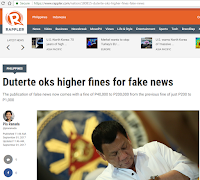
President Duterte signed into law this week Republic Act 10951, or the Amendment to the Revised Penal Code. The new law includes a provision imposing penalties on a person found guilty of spreading fake news that might affect public order.  With the prevalence of fake news from all sides of the political and social spectrum, Duterte signed the law that amended the 87-year-old Revised Penal Code that also placed penalties on unlawful use of publication and unlawful spoken statements.  Article 154, Section 18 of the act provides a penalty of arresto mayor - that's one month and one day up to six months in prison. Included in the penalty is a fine ranging from P40,000 to P200,000. The penalty used to be only ₱200 to ₱1,000 only.  The punishment may be imposed against any person who by means of print, lithography or any other methods of publication shall publish or cause to be published as news any "false report that might endanger public order or damage the interest or credit of the state."  The statement "other methods of publication" could also mean online publications. A majority of fake news nowadays is spread online via social media sites, web pages and video streaming.  The law also covers any person who shall maliciously publish, or cause to be published any official resolution or document without proper authority or before they have been published officially. This means leaking of government documents will merit penalties of prison sentence and fine.  The printing, or causing to print, and the distribution of published or distributed books, pamphlets, periodicals or leaflets which do not bear the real printer’s name, or which are classified as anonymous is also punishable under RA 10951.  The measure will take effect 15 days after its publication in at least two major newspapers. It will be applicable to pending cases before the courts where trial has already started.   sources: Rappler, PhilStar
Sponsored Links


President Duterte signed into law this week Republic Act 10951, or the Amendment to the Revised Penal Code. The new law includes a provision imposing penalties on a person found guilty of spreading fake news that might affect public order.
President Duterte signed into law this week Republic Act 10951, or the Amendment to the Revised Penal Code. The new law includes a provision imposing penalties on a person found guilty of spreading fake news that might affect public order.  With the prevalence of fake news from all sides of the political and social spectrum, Duterte signed the law that amended the 87-year-old Revised Penal Code that also placed penalties on unlawful use of publication and unlawful spoken statements.  Article 154, Section 18 of the act provides a penalty of arresto mayor - that's one month and one day up to six months in prison. Included in the penalty is a fine ranging from P40,000 to P200,000. The penalty used to be only ₱200 to ₱1,000 only.  The punishment may be imposed against any person who by means of print, lithography or any other methods of publication shall publish or cause to be published as news any "false report that might endanger public order or damage the interest or credit of the state."  The statement "other methods of publication" could also mean online publications. A majority of fake news nowadays is spread online via social media sites, web pages and video streaming.  The law also covers any person who shall maliciously publish, or cause to be published any official resolution or document without proper authority or before they have been published officially. This means leaking of government documents will merit penalties of prison sentence and fine.  The printing, or causing to print, and the distribution of published or distributed books, pamphlets, periodicals or leaflets which do not bear the real printer’s name, or which are classified as anonymous is also punishable under RA 10951.  The measure will take effect 15 days after its publication in at least two major newspapers. It will be applicable to pending cases before the courts where trial has already started.   sources: Rappler, PhilStar
With the prevalence of fake news from all sides of the political and social spectrum, Duterte signed the law that amended the 87-year-old Revised Penal Code that also placed penalties on unlawful use of publication and unlawful spoken statements.
Advertisements

Article 154, Section 18 of the act provides a penalty of arresto mayor - that's one month and one day up to six months in prison. Included in the penalty is a fine ranging from P40,000 to P200,000. The penalty used to be only ₱200 to ₱1,000 only.
President Duterte signed into law this week Republic Act 10951, or the Amendment to the Revised Penal Code. The new law includes a provision imposing penalties on a person found guilty of spreading fake news that might affect public order.  With the prevalence of fake news from all sides of the political and social spectrum, Duterte signed the law that amended the 87-year-old Revised Penal Code that also placed penalties on unlawful use of publication and unlawful spoken statements.  Article 154, Section 18 of the act provides a penalty of arresto mayor - that's one month and one day up to six months in prison. Included in the penalty is a fine ranging from P40,000 to P200,000. The penalty used to be only ₱200 to ₱1,000 only.  The punishment may be imposed against any person who by means of print, lithography or any other methods of publication shall publish or cause to be published as news any "false report that might endanger public order or damage the interest or credit of the state."  The statement "other methods of publication" could also mean online publications. A majority of fake news nowadays is spread online via social media sites, web pages and video streaming.  The law also covers any person who shall maliciously publish, or cause to be published any official resolution or document without proper authority or before they have been published officially. This means leaking of government documents will merit penalties of prison sentence and fine.  The printing, or causing to print, and the distribution of published or distributed books, pamphlets, periodicals or leaflets which do not bear the real printer’s name, or which are classified as anonymous is also punishable under RA 10951.  The measure will take effect 15 days after its publication in at least two major newspapers. It will be applicable to pending cases before the courts where trial has already started.   sources: Rappler, PhilStar

The punishment may be imposed against any person who by means of print, lithography or any other methods of publication shall publish or cause to be published as news any "false report that might endanger public order or damage the interest or credit of the state."
President Duterte signed into law this week Republic Act 10951, or the Amendment to the Revised Penal Code. The new law includes a provision imposing penalties on a person found guilty of spreading fake news that might affect public order.  With the prevalence of fake news from all sides of the political and social spectrum, Duterte signed the law that amended the 87-year-old Revised Penal Code that also placed penalties on unlawful use of publication and unlawful spoken statements.  Article 154, Section 18 of the act provides a penalty of arresto mayor - that's one month and one day up to six months in prison. Included in the penalty is a fine ranging from P40,000 to P200,000. The penalty used to be only ₱200 to ₱1,000 only.  The punishment may be imposed against any person who by means of print, lithography or any other methods of publication shall publish or cause to be published as news any "false report that might endanger public order or damage the interest or credit of the state."  The statement "other methods of publication" could also mean online publications. A majority of fake news nowadays is spread online via social media sites, web pages and video streaming.  The law also covers any person who shall maliciously publish, or cause to be published any official resolution or document without proper authority or before they have been published officially. This means leaking of government documents will merit penalties of prison sentence and fine.  The printing, or causing to print, and the distribution of published or distributed books, pamphlets, periodicals or leaflets which do not bear the real printer’s name, or which are classified as anonymous is also punishable under RA 10951.  The measure will take effect 15 days after its publication in at least two major newspapers. It will be applicable to pending cases before the courts where trial has already started.   sources: Rappler, PhilStar
The statement "other methods of publication" could also mean online publications. A majority of fake news nowadays is spread online via social media sites, web pages and video streaming.

The law also covers any person who shall maliciously publish, or cause to be published any official resolution or document without proper authority or before they have been published officially. This means leaking of government documents will merit penalties of prison sentence and fine.

President Duterte signed into law this week Republic Act 10951, or the Amendment to the Revised Penal Code. The new law includes a provision imposing penalties on a person found guilty of spreading fake news that might affect public order.  With the prevalence of fake news from all sides of the political and social spectrum, Duterte signed the law that amended the 87-year-old Revised Penal Code that also placed penalties on unlawful use of publication and unlawful spoken statements.  Article 154, Section 18 of the act provides a penalty of arresto mayor - that's one month and one day up to six months in prison. Included in the penalty is a fine ranging from P40,000 to P200,000. The penalty used to be only ₱200 to ₱1,000 only.  The punishment may be imposed against any person who by means of print, lithography or any other methods of publication shall publish or cause to be published as news any "false report that might endanger public order or damage the interest or credit of the state."  The statement "other methods of publication" could also mean online publications. A majority of fake news nowadays is spread online via social media sites, web pages and video streaming.  The law also covers any person who shall maliciously publish, or cause to be published any official resolution or document without proper authority or before they have been published officially. This means leaking of government documents will merit penalties of prison sentence and fine.  The printing, or causing to print, and the distribution of published or distributed books, pamphlets, periodicals or leaflets which do not bear the real printer’s name, or which are classified as anonymous is also punishable under RA 10951.  The measure will take effect 15 days after its publication in at least two major newspapers. It will be applicable to pending cases before the courts where trial has already started.   sources: Rappler, PhilStar
The printing, or causing to print, and the distribution of published or distributed books, pamphlets, periodicals or leaflets which do not bear the real printer’s name, or which are classified as anonymous is also punishable under RA 10951.

Sponsored Links

The measure will take effect 15 days after its publication in at least two major newspapers. It will be applicable to pending cases before the courts where trial has already started.

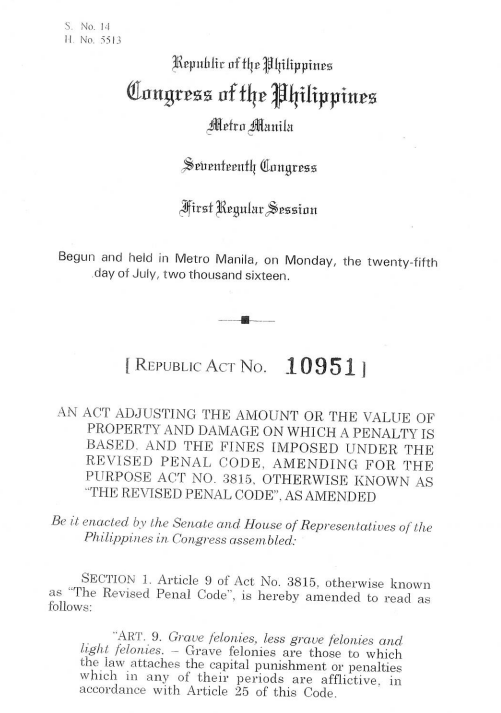
See the full law, click here or the image below:
President Duterte signed into law this week Republic Act 10951, or the Amendment to the Revised Penal Code. The new law includes a provision imposing penalties on a person found guilty of spreading fake news that might affect public order.  With the prevalence of fake news from all sides of the political and social spectrum, Duterte signed the law that amended the 87-year-old Revised Penal Code that also placed penalties on unlawful use of publication and unlawful spoken statements.  Article 154, Section 18 of the act provides a penalty of arresto mayor - that's one month and one day up to six months in prison. Included in the penalty is a fine ranging from P40,000 to P200,000. The penalty used to be only ₱200 to ₱1,000 only.  The punishment may be imposed against any person who by means of print, lithography or any other methods of publication shall publish or cause to be published as news any "false report that might endanger public order or damage the interest or credit of the state."  The statement "other methods of publication" could also mean online publications. A majority of fake news nowadays is spread online via social media sites, web pages and video streaming.  The law also covers any person who shall maliciously publish, or cause to be published any official resolution or document without proper authority or before they have been published officially. This means leaking of government documents will merit penalties of prison sentence and fine.  The printing, or causing to print, and the distribution of published or distributed books, pamphlets, periodicals or leaflets which do not bear the real printer’s name, or which are classified as anonymous is also punishable under RA 10951.  The measure will take effect 15 days after its publication in at least two major newspapers. It will be applicable to pending cases before the courts where trial has already started.   sources: Rappler, PhilStar


sources: Rappler, PhilStar
President Duterte signed into law this week Republic Act 10951, or the Amendment to the Revised Penal Code. The new law includes a provision imposing penalties on a person found guilty of spreading fake news that might affect public order.  With the prevalence of fake news from all sides of the political and social spectrum, Duterte signed the law that amended the 87-year-old Revised Penal Code that also placed penalties on unlawful use of publication and unlawful spoken statements.  Article 154, Section 18 of the act provides a penalty of arresto mayor - that's one month and one day up to six months in prison. Included in the penalty is a fine ranging from P40,000 to P200,000. The penalty used to be only ₱200 to ₱1,000 only.  The punishment may be imposed against any person who by means of print, lithography or any other methods of publication shall publish or cause to be published as news any "false report that might endanger public order or damage the interest or credit of the state."  The statement "other methods of publication" could also mean online publications. A majority of fake news nowadays is spread online via social media sites, web pages and video streaming.  The law also covers any person who shall maliciously publish, or cause to be published any official resolution or document without proper authority or before they have been published officially. This means leaking of government documents will merit penalties of prison sentence and fine.  The printing, or causing to print, and the distribution of published or distributed books, pamphlets, periodicals or leaflets which do not bear the real printer’s name, or which are classified as anonymous is also punishable under RA 10951.  The measure will take effect 15 days after its publication in at least two major newspapers. It will be applicable to pending cases before the courts where trial has already started.   sources: Rappler, PhilStarPresident Duterte signed into law this week Republic Act 10951, or the Amendment to the Revised Penal Code. The new law includes a provision imposing penalties on a person found guilty of spreading fake news that might affect public order.  With the prevalence of fake news from all sides of the political and social spectrum, Duterte signed the law that amended the 87-year-old Revised Penal Code that also placed penalties on unlawful use of publication and unlawful spoken statements.  Article 154, Section 18 of the act provides a penalty of arresto mayor - that's one month and one day up to six months in prison. Included in the penalty is a fine ranging from P40,000 to P200,000. The penalty used to be only ₱200 to ₱1,000 only.  The punishment may be imposed against any person who by means of print, lithography or any other methods of publication shall publish or cause to be published as news any "false report that might endanger public order or damage the interest or credit of the state."  The statement "other methods of publication" could also mean online publications. A majority of fake news nowadays is spread online via social media sites, web pages and video streaming.  The law also covers any person who shall maliciously publish, or cause to be published any official resolution or document without proper authority or before they have been published officially. This means leaking of government documents will merit penalties of prison sentence and fine.  The printing, or causing to print, and the distribution of published or distributed books, pamphlets, periodicals or leaflets which do not bear the real printer’s name, or which are classified as anonymous is also punishable under RA 10951.  The measure will take effect 15 days after its publication in at least two major newspapers. It will be applicable to pending cases before the courts where trial has already started.   sources: Rappler, PhilStar


©2017 THOUGHTSKOTO

SEARCH JBSOLIS, TYPE KEYWORDS and TITLE OF ARTICLE at the box below

Thursday, May 04, 2017

Revised Penal Code Updated; 2 Years Penalty For P250 Worth Estafa Is Now Reduced to 4 Months Jail Term


The Senate passed  a bill on third and final reading seeking to update the penalties for certain crimes stated on Revised Penal Code which was almost 90 years old. Senate Bill No. 14 seeks to update the penalties which were based on the economic conditions in the 1930's during the effectivity of the Revised Penal Code. During that time, a person found guilty of estafa involving an amount of P250 would be imprisoned for up to two years and four months. The proposed measure will be reduced to it to only four months. There had also been adjustments to the amount of fines . High crimes, such as rebellion and treason, will be having fines of ₱4M and  ₱1.6M, respectively — which was ₱20,000 and ₱8,000 respectively on the outdated penal code. The bill as well seeks to update penalties for maltreatment of prisoners, unlawful arrest and indirect assault which was amounting to ₱500 to ₱100,000 while penalties for falsification of documents will be increased from ₱5,000 to ₱1 Million.  The bill was approved with 21 in favor, 0 against and without a single abstention. The author of the bill said the proposed measure would have a retroactive effect, and was expected to benefit about 54,189 inmates which are mostly poor. "Not that they will be immediately released, but their sentences will be equitably reduced, corresponding to today's value of the property stolen, not the values set in 1930," he stressed.   "We truly believe that the threat of injustice created by an outdated instrument of justice is real, and thus requires immediate legislative action," he added. Recommended:    Transfer to other employer   An employer can grant a written permission to his employees to work with another employer for a period of six months, renewable for a similar period.  Part time jobs are now allowed   Employees can take up part time job with another employer, with a written approval from his original employer, the Ministry of Interior said yesterday.   Staying out of Country, still can come back?  Expatriates staying out of the country for more than six months can re-enter the country with a “return visa”, within a year, if they hold a Qatari residency permit (RP) and after paying the fine.    Newborn RP possible A newborn baby can get residency permit within 90 days from the date of birth or the date of entering the country, if the parents hold a valid Qatari RP.  No medical check up Anyone who enters the country on a visit visa or for other purposes are not required to undergo the mandatory medical check-up if they stay for a period not more than 30 days. Foreigners are not allowed to stay in the country after expiry of their visa if not renewed.   E gates for all  Expatriates living in Qatar can leave and enter the country using their Qatari IDs through the e-gates.  Exit Permit Grievances Committee According to Law No 21 of 2015 regulating entry, exit and residency of expatriates, which was enforced on December 13, last year, expatriate worker can leave the country immediately after his employer inform the competent authorities about his consent for exit. In case the employer objected, the employee can lodge a complaint with the Exit Permit Grievances Committee which will take a decision within three working days.  Change job before or after contract , complete freedom  Expatriate worker can change his job before the end of his work contract with or without the consent of his employer, if the contract period ended or after five years if the contract is open ended. With approval from the competent authority, the worker also can change his job if the employer died or the company vanished for any reason.   Three months for RP process  The employer must process the RP of his employees within 90 days from the date of his entry to the country.  Expat must leave within 90 days of visa expiry The employer must return the travel document (passport) to the employee after finishing the RP formalities unless the employee makes a written request to keep it with the employer. The employer must report to the authorities concerned within 24 hours if the worker left his job, refused to leave the country after cancellation of his RP, passed three months since its expiry or his visit visa ended.  If the visa or residency permit becomes invalid the expat needs to leave the country within 90 days from the date of its expiry. The expat must not violate terms and the purpose for which he/she has been granted the residency permit and should not work with another employer without permission of his original employer. In case of a dispute the Interior Minister or his representative has the right to allow an expatriate worker to work with another employer temporarily with approval from the Ministry of Administrative Development,Labour and Social Affairs. Source:qatarday.com Recommended:      The Barangay Micro Business Enterprise Program (BMBE) or Republic Act No. 9178 of the Department of Trade and Industry (DTI) started way back 2002 which aims to help people to start their small business by providing them incentives and other benefits.  If you have a small business that belongs to manufacturing, production, processing, trading and services with assets not exceeding P3 million you can benefit from BMBE Program of the government.  Benefits include:  Income tax exemption from income arising from the operations of the enterprise;   Exemption from the coverage of the Minimum Wage Law (BMBE 1) 2) 3) 2 employees will still receive the same social security and health care benefits as other employees);   Priority to a special credit window set up specifically for the financing requirements of BMBEs; and  Technology transfer, production and management training, and marketing assistance programs for BMBE beneficiaries.  Gina Lopez Confirmation as DENR Secretary Rejected; Who Voted For Her and Who Voted Against?   ©2017 THOUGHTSKOTO www.jbsolis.com SEARCH JBSOLIS  The Barangay Micro Business Enterprise Program (BMBE) or Republic Act No. 9178 of the Department of Trade and Industry (DTI) started way back 2002 which aims to help people to start their small business by providing them incentives and other benefits.  If you have a small business that belongs to manufacturing, production, processing, trading and services with assets not exceeding P3 million you can benefit from BMBE Program of the government.  Benefits include: Income tax exemption from income arising from the operations of the enterprise;   Exemption from the coverage of the Minimum Wage Law (BMBE 1) 2) 3) 2 employees will still receive the same social security and health care benefits as other employees);   Priority to a special credit window set up specifically for the financing requirements of BMBEs; and  Technology transfer, production and management training, and marketing assistance programs for BMBE beneficiaries.  Gina Lopez Confirmation as DENR Secretary Rejected; Who Voted For Her and Who Voted Against? Transfer to other employer   An employer can grant a written permission to his employees to work with another employer for a period of six months, renewable for a similar period.  Part time jobs are now allowed   Employees can take up part time job with another employer, with a written approval from his original employer, the Ministry of Interior said yesterday.   Staying out of Country, still can come back?  Expatriates staying out of the country for more than six months can re-enter the country with a “return visa”, within a year, if they hold a Qatari residency permit (RP) and after paying the fine.    Newborn RP possible A newborn baby can get residency permit within 90 days from the date of birth or the date of entering the country, if the parents hold a valid Qatari RP.  No medical check up Anyone who enters the country on a visit visa or for other purposes are not required to undergo the mandatory medical check-up if they stay for a period not more than 30 days. Foreigners are not allowed to stay in the country after expiry of their visa if not renewed.   E gates for all  Expatriates living in Qatar can leave and enter the country using their Qatari IDs through the e-gates.  Exit Permit Grievances Committee According to Law No 21 of 2015 regulating entry, exit and residency of expatriates, which was enforced on December 13, last year, expatriate worker can leave the country immediately after his employer inform the competent authorities about his consent for exit. In case the employer objected, the employee can lodge a complaint with the Exit Permit Grievances Committee which will take a decision within three working days.  Change job before or after contract , complete freedom  Expatriate worker can change his job before the end of his work contract with or without the consent of his employer, if the contract period ended or after five years if the contract is open ended. With approval from the competent authority, the worker also can change his job if the employer died or the company vanished for any reason.   Three months for RP process  The employer must process the RP of his employees within 90 days from the date of his entry to the country.  Expat must leave within 90 days of visa expiry The employer must return the travel document (passport) to the employee after finishing the RP formalities unless the employee makes a written request to keep it with the employer. The employer must report to the authorities concerned within 24 hours if the worker left his job, refused to leave the country after cancellation of his RP, passed three months since its expiry or his visit visa ended.  If the visa or residency permit becomes invalid the expat needs to leave the country within 90 days from the date of its expiry. The expat must not violate terms and the purpose for which he/she has been granted the residency permit and should not work with another employer without permission of his original employer. In case of a dispute the Interior Minister or his representative has the right to allow an expatriate worker to work with another employer temporarily with approval from the Ministry of Administrative Development,Labour and Social Affairs. Source:qatarday.com Recommended:      The Barangay Micro Business Enterprise Program (BMBE) or Republic Act No. 9178 of the Department of Trade and Industry (DTI) started way back 2002 which aims to help people to start their small business by providing them incentives and other benefits.  If you have a small business that belongs to manufacturing, production, processing, trading and services with assets not exceeding P3 million you can benefit from BMBE Program of the government.  Benefits include:  Income tax exemption from income arising from the operations of the enterprise;   Exemption from the coverage of the Minimum Wage Law (BMBE 1) 2) 3) 2 employees will still receive the same social security and health care benefits as other employees);   Priority to a special credit window set up specifically for the financing requirements of BMBEs; and  Technology transfer, production and management training, and marketing assistance programs for BMBE beneficiaries.  Gina Lopez Confirmation as DENR Secretary Rejected; Who Voted For Her and Who Voted Against?   ©2017 THOUGHTSKOTO www.jbsolis.com SEARCH JBSOLIS SEARCH JBSOLIS ©2017 THOUGHTSKOTO www.jbsolis.com SEARCH JBSOLIS

The Senate passed  a bill on third and final reading seeking to update the penalties for certain crimes stated on Revised Penal Code which was almost 90 years old.
Senate Bill No. 14 seeks to update the penalties which were based on the economic conditions in the 1930's during the effectivity of the Revised Penal Code.
During that time, a person found guilty of estafa involving an amount of P250 would be imprisoned for up to two years and four months. The proposed measure will be reduced to it to only four months.
There had also been adjustments to the amount of fines . High crimes, such as rebellion and treason, will be having fines of ₱4M and  ₱1.6M, respectively — which was ₱20,000 and ₱8,000 respectively on the outdated penal code.
The bill as well seeks to update penalties for maltreatment of prisoners, unlawful arrest and indirect assault which was amounting to ₱500 to ₱100,000 while penalties for falsification of documents will be increased from ₱5,000 to ₱1 Million.


The bill was approved with 21 in favor, 0 against and without a single abstention.
The author of the bill said the proposed measure would have a retroactive effect, and was expected to benefit about 54,189 inmates which are mostly poor.
"Not that they will be immediately released, but their sentences will be equitably reduced, corresponding to today's value of the property stolen, not the values set in 1930," he stressed.

"We truly believe that the threat of injustice created by an outdated instrument of justice is real, and thus requires immediate legislative action," he added.

Recommended:

Transfer to other employer   An employer can grant a written permission to his employees to work with another employer for a period of six months, renewable for a similar period.  Part time jobs are now allowed   Employees can take up part time job with another employer, with a written approval from his original employer, the Ministry of Interior said yesterday.   Staying out of Country, still can come back?  Expatriates staying out of the country for more than six months can re-enter the country with a “return visa”, within a year, if they hold a Qatari residency permit (RP) and after paying the fine.    Newborn RP possible A newborn baby can get residency permit within 90 days from the date of birth or the date of entering the country, if the parents hold a valid Qatari RP.  No medical check up Anyone who enters the country on a visit visa or for other purposes are not required to undergo the mandatory medical check-up if they stay for a period not more than 30 days. Foreigners are not allowed to stay in the country after expiry of their visa if not renewed.   E gates for all  Expatriates living in Qatar can leave and enter the country using their Qatari IDs through the e-gates.  Exit Permit Grievances Committee According to Law No 21 of 2015 regulating entry, exit and residency of expatriates, which was enforced on December 13, last year, expatriate worker can leave the country immediately after his employer inform the competent authorities about his consent for exit. In case the employer objected, the employee can lodge a complaint with the Exit Permit Grievances Committee which will take a decision within three working days.  Change job before or after contract , complete freedom  Expatriate worker can change his job before the end of his work contract with or without the consent of his employer, if the contract period ended or after five years if the contract is open ended. With approval from the competent authority, the worker also can change his job if the employer died or the company vanished for any reason.   Three months for RP process  The employer must process the RP of his employees within 90 days from the date of his entry to the country.  Expat must leave within 90 days of visa expiry The employer must return the travel document (passport) to the employee after finishing the RP formalities unless the employee makes a written request to keep it with the employer. The employer must report to the authorities concerned within 24 hours if the worker left his job, refused to leave the country after cancellation of his RP, passed three months since its expiry or his visit visa ended.  If the visa or residency permit becomes invalid the expat needs to leave the country within 90 days from the date of its expiry. The expat must not violate terms and the purpose for which he/she has been granted the residency permit and should not work with another employer without permission of his original employer. In case of a dispute the Interior Minister or his representative has the right to allow an expatriate worker to work with another employer temporarily with approval from the Ministry of Administrative Development,Labour and Social Affairs. Source:qatarday.com Recommended:      The Barangay Micro Business Enterprise Program (BMBE) or Republic Act No. 9178 of the Department of Trade and Industry (DTI) started way back 2002 which aims to help people to start their small business by providing them incentives and other benefits.  If you have a small business that belongs to manufacturing, production, processing, trading and services with assets not exceeding P3 million you can benefit from BMBE Program of the government.  Benefits include:  Income tax exemption from income arising from the operations of the enterprise;   Exemption from the coverage of the Minimum Wage Law (BMBE 1) 2) 3) 2 employees will still receive the same social security and health care benefits as other employees);   Priority to a special credit window set up specifically for the financing requirements of BMBEs; and  Technology transfer, production and management training, and marketing assistance programs for BMBE beneficiaries.  Gina Lopez Confirmation as DENR Secretary Rejected; Who Voted For Her and Who Voted Against?   ©2017 THOUGHTSKOTO www.jbsolis.com SEARCH JBSOLIS

 The Barangay Micro Business Enterprise Program (BMBE) or Republic Act No. 9178 of the Department of Trade and Industry (DTI) started way back 2002 which aims to help people to start their small business by providing them incentives and other benefits. 
If you have a small business that belongs to manufacturing, production, processing, trading and services with assets not exceeding P3 million you can benefit from BMBE Program of the government.


Benefits include:

Gina Lopez Confirmation as DENR Secretary Rejected; Who Voted For Her and Who Voted Against?

Transfer to other employer   An employer can grant a written permission to his employees to work with another employer for a period of six months, renewable for a similar period.  Part time jobs are now allowed   Employees can take up part time job with another employer, with a written approval from his original employer, the Ministry of Interior said yesterday.   Staying out of Country, still can come back?  Expatriates staying out of the country for more than six months can re-enter the country with a “return visa”, within a year, if they hold a Qatari residency permit (RP) and after paying the fine.    Newborn RP possible A newborn baby can get residency permit within 90 days from the date of birth or the date of entering the country, if the parents hold a valid Qatari RP.  No medical check up Anyone who enters the country on a visit visa or for other purposes are not required to undergo the mandatory medical check-up if they stay for a period not more than 30 days. Foreigners are not allowed to stay in the country after expiry of their visa if not renewed.   E gates for all  Expatriates living in Qatar can leave and enter the country using their Qatari IDs through the e-gates.  Exit Permit Grievances Committee According to Law No 21 of 2015 regulating entry, exit and residency of expatriates, which was enforced on December 13, last year, expatriate worker can leave the country immediately after his employer inform the competent authorities about his consent for exit. In case the employer objected, the employee can lodge a complaint with the Exit Permit Grievances Committee which will take a decision within three working days.  Change job before or after contract , complete freedom  Expatriate worker can change his job before the end of his work contract with or without the consent of his employer, if the contract period ended or after five years if the contract is open ended. With approval from the competent authority, the worker also can change his job if the employer died or the company vanished for any reason.   Three months for RP process  The employer must process the RP of his employees within 90 days from the date of his entry to the country.  Expat must leave within 90 days of visa expiry The employer must return the travel document (passport) to the employee after finishing the RP formalities unless the employee makes a written request to keep it with the employer. The employer must report to the authorities concerned within 24 hours if the worker left his job, refused to leave the country after cancellation of his RP, passed three months since its expiry or his visit visa ended.  If the visa or residency permit becomes invalid the expat needs to leave the country within 90 days from the date of its expiry. The expat must not violate terms and the purpose for which he/she has been granted the residency permit and should not work with another employer without permission of his original employer. In case of a dispute the Interior Minister or his representative has the right to allow an expatriate worker to work with another employer temporarily with approval from the Ministry of Administrative Development,Labour and Social Affairs. Source:qatarday.com Recommended:      The Barangay Micro Business Enterprise Program (BMBE) or Republic Act No. 9178 of the Department of Trade and Industry (DTI) started way back 2002 which aims to help people to start their small business by providing them incentives and other benefits.  If you have a small business that belongs to manufacturing, production, processing, trading and services with assets not exceeding P3 million you can benefit from BMBE Program of the government.  Benefits include:  Income tax exemption from income arising from the operations of the enterprise;   Exemption from the coverage of the Minimum Wage Law (BMBE 1) 2) 3) 2 employees will still receive the same social security and health care benefits as other employees);   Priority to a special credit window set up specifically for the financing requirements of BMBEs; and  Technology transfer, production and management training, and marketing assistance programs for BMBE beneficiaries.  Gina Lopez Confirmation as DENR Secretary Rejected; Who Voted For Her and Who Voted Against?   ©2017 THOUGHTSKOTO www.jbsolis.com SEARCH JBSOLIS
SEARCH JBSOLIS

©2017 THOUGHTSKOTO
SEARCH JBSOLIS