Carousel

Sponsored Links

Looking for House and Lot Within Tagaytay Area? CONTACT US!

Name

Email *

Message *

Showing posts with label electricity. Show all posts

Wednesday, July 08, 2020

Meralco, Humingi ng Paumanhin sa Posibilidad na May Mali sa Komputasyon ng Electric Bill

Dahil sa ipinatutupad na community quarantine upang maiwasan ang pagkalat ng COVID-19, hindi nakapagbahay-bahay upang magbasa ng metro Manila Electric Company (Meralco) kung kaya nag-estimate na lamang ito base sa karaniwang konsumo ng isang consumer.

Ngunit ang tanong ng marami: sumobra ba ang electric company ng tantsa sa singil sa kuryente?
Ads

Sa pagdinig ng mismong Senate Committee on Energy kamakailan, mismong Meralco na ang nagsabi na posibleng may "overestimation" sa sinisingil sa kanilang customer.

Ayon sa Energy Regulatory Commission (ERC), may 47,000 na reklamo na silang natanggap na may kinalaman sa sobrang singil o magulong bill distribution utilities at electric cooperatives sa buong bansa, kung kaya maglalabas na sila ng kautusan para i-refund ng Meralco at ng iba pang distribution utilities ang sobrang singil sa kuryente.
Ads

Sponsored Links
Idinetalye rin ni ERC Chairperson Agnes Devanadera ang ilan sa mga ipinangako ng presidente ng nasabing power distribution giant.

“May maganda namang nangyari at kinalabasan dahil mismong ang presidente ng Meralco, si Atty. Rey Espinosa, ang nagsabi kung ano ang kanilang mga gagawin at ang isa diyan ay sisiguraduhin nila na may mga corrective measures sila,” ani Devanadera.

“Ang commitment ng Meralco, hindi naman sila magpuputol hanggang September 30. So by that time, corrected na ‘yan at ire-refund nila ‘yung sobrang nabayad. Ngayon pa lang ay nagko-compute na sila. ‘Yun ang maganda roon,” pagpapatuloy niya. “Kahapon naman nag-commit na ang Meralco. Sinasabi nilang ire-refund. Ang sinabi ni Mr. Rey Espinosa ay magpupunta lang sa Meralco at bibigyan na ng refund."


Mga Reklamo

Kung titingnan ang mga hinaing ng customers, makikita na may mga kaso na nagsasaad ng mga reklamo tungkol sa pagkalito nila sa natanggap na bills mula sa ginawa nilang estimate.

“Totoo na may rules ang ERC na dapat ay estimate, pero sinabi rin ng ERC, sa aming advisory, na dapat nakasaad din alin doon ang estimate. Ang pinagbabatayan nga niyan ay ‘yung average ng past three months. Alam din naman natin na naroon na ‘yung tinatawag na load profile,” wika niya.

“Maski nasa opisina, mga bahay, ay may mga lugar na walang pumapasok dahil ipinagbabawal na nga so itong guidelines o advisory ay dapat tinalima nang husto ng distribution utilities kasama ang Meralco,” pagpapatuloy niya. “Nasasaad din naman na the moment na magkaroon na ng meter reading, dapat i-correct at saka sinabi rin naman ng ERC na huwag maniningil hanggang hindi lifted. Doon sa series of advisories na sinabi at ipinag-utos ng ERC na June 15 ang kauna-unahang date o petsa na puwedeng pagbayarin ang mga tao sa installment sa mga bills covering the ECQ [enhanced community quarantine] months – March, April and May."


ERC: Pinagtutuunan ng Pansin ang mga Hinaing

Samantala, tiniyak ni Devanadera na hindi naman napupunta sa wala ang pagpapahayag ng consumers ng kanilang mga saloobin dahil lahat ng ito ay natatanggap ng ERC at pinagtutuunan ng pansin.

“Katulad ng nabanggit n’yo kanina, ang naghain ng reklamo sa ERC ay 47,000 na. Itong mga reklamo na ito, ‘yong nag-text, marami ang e-mails tapos sa Facebook page ng ERC,” wika niya. “In other words, lahat ng mga reklamo, hindi kinakailangang nakasulat o pinadala sa amin o physically pumunta sa ERC, lahat ito na hinaing ng ating mga kababayan ay pinagtutuunan namin ng pansin."


OTHER NEWS:
©2020 THOUGHTSKOTO

Wednesday, August 14, 2019

Murang Kuryente At Anti-Obstruction Of Powerlines Law, Pirmado Na Ni Pangulong Duterte

President Rodrigo Duterte has signed RA 11361 into a law on August 8 which seeks to reduce the cost of electricity as well as new law that aims to keep all power line corridors free of any obstructions that may disrupt the supply of electricity from power plants to consumers.


President Rodrigo Duterte has signed RA 11361 into a law on August 8 which seeks to reduce the cost of electricity as well as new law that aims to keep all power line corridors free of any obstructions that may disrupt the supply of electricity from power plants to consumers.        Ads    President Rodrigo Duterte has signed a law reducing electricity cost by allocating the government share from the Malampaya natural gas project in Palawan for the payment of debts of the National Power Corporation (Napocor).     The government share amounting to P208 billion  of the Malampaya funds will be allocated to pay for the stranded contract costs and stranded debts of the NPC that are being passed on to consumers.    The law’s main author Senator Sherwin Gatchalian said it will translate to a P172 worth of savings for a household consuming an average of 200 kilowatts per hour every month once implemented.    Under the law, the Department of Budget and Management (DBM) will provide a timely release of the amounts allocated and appropriated to the Power Sector Assets and Liabilities Management Corporation (PSALM) in accordance with its debt and independent power producer payment schedule.    In the event the stranded costs, stranded debts and anticipated shortfalls in the course of the payment of such liabilities are fully paid before the exhaustion of the amount allocated in the law, the remainder will be utilized to finance energy resource development and exploitation programs under Presidential Decree 910.      Ads          Sponsored Links    Duterte has also signed the Anti-Obstruction of Power Lines Act (Republic Act 11361).    The new law aims to keep all power line corridors free of any obstructions that may disrupt the supply of electricity from power plants to consumers.    It prohibits the planting of tall growing plants, the construction of hazardous improvements, and the conduct of any hazardous activities within the power line corridor.    “[W]e will now be able to put in place a mechanism that will allow for the responsive maintenance and rehabilitation of transmission, sub-transmission, and distribution lines, which would prevent outages and ensure continuous supply of electricity,” Gatchalian said in a statement.    “The measure is timely for the rainy season when powerful typhoons barrel through our country.”

Ads


President Rodrigo Duterte has signed a law reducing electricity cost by allocating the government share from the Malampaya natural gas project in Palawan for the payment of debts of the National Power Corporation (Napocor).


The government share amounting to P208 billion  of the Malampaya funds will be allocated to pay for the stranded contract costs and stranded debts of the NPC that are being passed on to consumers.

The law’s main author Senator Sherwin Gatchalian said it will translate to a P172 worth of savings for a household consuming an average of 200 kilowatts per hour every month once implemented.

Under the law, the Department of Budget and Management (DBM) will provide a timely release of the amounts allocated and appropriated to the Power Sector Assets and Liabilities Management Corporation (PSALM) in accordance with its debt and independent power producer payment schedule.

In the event the stranded costs, stranded debts and anticipated shortfalls in the course of the payment of such liabilities are fully paid before the exhaustion of the amount allocated in the law, the remainder will be utilized to finance energy resource development and exploitation programs under Presidential Decree 910.


Ads


Sponsored Links


Meanwhile, President Duterte has also signed the Anti-Obstruction of Power Lines Act (Republic Act 11361).

The new law aims to keep all power line corridors free of any obstructions that may disrupt the supply of electricity from power plants to consumers.

It prohibits the planting of tall growing plants, the construction of hazardous improvements, and the conduct of any hazardous activities within the power line corridor.

“[W]e will now be able to put in place a mechanism that will allow for the responsive maintenance and rehabilitation of transmission, sub-transmission, and distribution lines, which would prevent outages and ensure continuous supply of electricity,” Gatchalian said in a statement.

“The measure is timely for the rainy season when powerful typhoons barrel through our country.”
©2019 THOUGHTSKOTO

Wednesday, April 18, 2018

OFWs Only Seek To Earn An Average Of P30K Monthly Salary?

Personal surveys conducted on all 365 households in the study area with 1,555 individuals including minors.

The typical household ’s income is P59,990, or $1,421 average. Standard deviation is at P87,625, or $2,075. All the households have access to electricity.

In 2015, the bulk of OFWs were deployed to the Middle East (63 %) and various Asian countries (28 %). The rest (9 %) went to Europe, the Americas, Africa and others. The top 3 country destinations of Filipino workers are Saudi Arabia (406,089), the United Arab Emirates (227,076) and Singapore (141,453).

 “A Probe into the Filipino Migration Culture: What Is There to Learn for Policy Intervention?”  a study conducted by PIDS Supervising Research Specialist Aubrey D. Tabuga said about 40 percent of study respondents even said they are willing to receive even less than P20,000 to work as overseas Filipino workers (OFWs).
Advertisement


Personal surveys conducted on all 365 households in the study area with 1,555 individuals including minors.  The typical household ’s income is P59,990, or $1,421 average. Standard deviation is at P87,625, or $2,075. All the households have access to electricity.  In 2015, the bulk of OFWs were deployed to the Middle East (63 %) and various Asian countries (28 %). The rest (9 %) went to Europe, the Americas, Africa and others. The top 3 country destinations of Filipino workers are Saudi Arabia (406,089), the United Arab Emirates (227,076) and Singapore (141,453).   “A Probe into the Filipino Migration Culture: What Is There to Learn for Policy Intervention?”  a study conducted by PIDS Supervising Research Specialist Aubrey D. Tabuga said about 40 percent of study respondents even said they are willing to receive even less than P20,000 to work as overseas Filipino workers (OFWs). Advertisement        Sponsored Links     The majority of Filipinos who harbor the desire of migrating are looking for an average compensation of only P30,000 or less a month, according to the Philippine Institute for Development Studies (PIDS).  In a study titled “A Probe into the Filipino Migration Culture: What Is There to Learn for Policy Intervention?” PIDS Supervising Research Specialist Aubrey D. Tabuga said about 40 percent of study respondents even said they are willing to receive even less than P20,000 to work as overseas Filipino workers (OFWs).  When asked about the minimum amount of monthly pay or wage that they seek in overseas work, Tabuga said the respondents replied they expect to receive compensation from as low as P3,000 to around P280,000 or $67 to $6,000.  “The key motivation for wanting to migrate is economic in nature. Seven out of the 10 aspirants cited their need to improve their living condition as the main reason for wanting to emigrate,” Tabuga said.  These economic reasons are based on the underlying dissatisfaction of workers with their current incomes or salaries. The majority, or 50.2 percent, of respondents, also expressed discontent with their incomes.  Further, the study found 43 percent of migration aspirants do not feel satisfied with their current living condition. Only around 30 percent of the non-aspirants expressed the same dissatisfaction.  The findings also showed that the majority, or 55 percent, of the prospective migrants, expressed dissatisfaction at varying levels; only over a third or 36 percent of those who opt to stay expressed the same sentiment.  Tabuga also said that when asked about whether their household’s livelihood improved in the past five years, the proportion of those who expressed dissatisfaction in both groups is comparable but slightly higher for those wanting to migrate abroad at 34.4 percent than those who do not have any plans at 30.1 percent.  “Given more secure local job opportunities, a non-negligible proportion would opt to stay. More than a quarter, or 27 percent, of those with migration plans, reported that they would change their mind if only there were decent jobs around available for them,” Tabuga said.  “If people do have a choice, they would rather stay and be with their families and loved ones. The family-related reason is most commonly cited factor that could make would-be migrants reconsider their migration decisions,” she added.  With this, Tabuga said the government must focus on regional development to widen employment opportunities in far-flung areas in the Philippines.  She added there is a need to consider policies that care for the welfare of retirees, including those that allow migrant workers to prepare for retirement.  Tabuga said some 11 percent of respondents expressed the need to improve their career, while around 10 percent wanted to finance the education of their children and 8 percent wanted to join/reunite with their kin who are working/living abroad.  The rest of the respondents wanted to earn more and save for the future and for retirement at 7 percent; to build or repair their own house, 5 percent; and to see the world, experience life in another country.  “Many Filipino migrant workers spend so many years of their life working abroad. This finding reflects the possibility that households are not able to sustain their standard of living once they return from an overseas job, they are then encouraged to back overseas to sustain their lifestyle. They eventually retire in the place of origin but it is not clear whether they have spent enough for retirement or if that is even something that they have considered,” Tabuga said.  Tabuga, likewise, urged the government to undertake a more aggressive information campaign about migration and implement programs on financial literacy not only for current overseas Filipino workers (OFWs) but also those aspiring to work abroad.  She said based on the study, only 3 percent of former OFWs or returnees said they obtained their information from government entities. The rest obtained information from personal and social networks, which could be an indication that the lack or absence of government information on labor migration nationwide, despite the thousands who emigrate daily.  The data collection was carried out through face-to-face interviews of all the 365 households in barangay Camachile, Orion, in the province of Bataan, a migrant-sending village in the Philippines.  The main criteria for selecting the area of study are being rural, having high migration prevalence based on data from the community-based monitoring system database of the municipality and accessibility from the capital for the feasibility of field research.  The personal interviews conducted on all 365 households in the study area yield a dataset of 1,555 individuals, including minors.  The typical household’s per capita income is P59,990, or $1,421. The standard deviation is P87,625, or $2,075. Except for one, all the households have access to electricity.  Meanwhile, among the 1.4 million land-based Filipino migrants in 2015, around one-third are new-hires; while the remaining two-thirds consist of rehires.  The bulk of OFWs deployed in 2015 went to the Middle East (63 percent) and various Asian countries (28 percent). The rest (9 percent) went to Europe, the Americas, Africa and others. The top 3 country destinations of Filipino workers are Saudi Arabia (406,089), the United Arab Emirates (227,076) and Singapore (141,453).  READ MORE: Recruiters With Delisted, Banned, Suspended, Revoked And Cancelled POEA Licenses 2018    List of Philippine Embassies And Consulates Around The World     Classic Room Mates You Probably Living With   Do Not Be Fooled By Your Recruitment Agencies, Know Your  Correct Fees    Remittance Fees To Be Imposed On Kuwait Expats Expected To Bring $230 Million Income    TESDA Provides Training For Returning OFWs   Cash Aid To Be Given To Displaced OFWs From Kuwait—OWWA      Former OFW In Dubai Now Earning P25K A Week From Her Business    Top Search Engines In The Philippines For Finding Jobs Abroad    5 Signs A Person Is Going To Be Poor And 5 Signs You Are Going To Be Rich

Sponsored Links


The majority of Filipinos who are wishing of working overseas are looking for an average salary of only P30,000 or less a month, according to the Philippine Institute for Development Studies (PIDS).

When asked about the minimum amount of monthly pay or wage that they seek in overseas work, Tabuga said the respondents replied they expect to receive compensation from as low as P3,000 to around P280,000 or $67 to $6,000.

These economic reasons are based on the underlying dissatisfaction of workers with their current incomes or salaries. The majority, or 50.2 percent, of respondents, also expressed discontent with their incomes.

The study also found out that 43% of migration aspirants are not satisfied with their present living condition. Only around 30%of the non-aspirants expressed the same dissatisfaction.

With this, Tabuga said the government must focus on regional development to increase employment opportunities in remote areas in the Philippines.

She added there is a need to consider policies that care for the welfare of retirees, including those that allow migrant workers to prepare for retirement.

Tabuga said some 11% of respondents expressed the need to improve their career, while around 10% wanted to finance the education of their children and 8% wanted to join with their kin who are working/living abroad.

The rest of the respondents wanted to earn more and save for the future and for retirement at 7 percent; to build or repair their own house, 5 percent; and to see the world, experience life in another country.

Tabuga, likewise, urged the government to undertake a more aggressive information campaign about migration and implement programs on financial literacy not only for current overseas Filipino workers (OFWs) but also those aspiring to work abroad.

She said based on the study, only 3 percent of former OFWs or returnees said they obtained their information from government entities. The rest obtained information from personal and social networks, which could be an indication that the lack or absence of government information on labor migration nationwide, despite the thousands who emigrate daily.

The data collection was carried out through face-to-face interviews of all the 365 households in barangay Camachile, Orion, in the province of Bataan, a migrant-sending village in the Philippines.

The main criteria for selecting the area of study are being rural, having high migration prevalence based on data from the community-based monitoring system database of the municipality and accessibility from the capital for the feasibility of field research.

Personal surveys conducted on all 365 households in the study area with 1,555 individuals including minors.    The typical household ’s income is P59,990, or $1,421 average. Standard deviation is at P87,625, or $2,075. All the households have access to electricity.    In 2015, the bulk of OFWs were deployed to the Middle East (63 %) and various Asian countries (28 %). The rest (9 %) went to Europe, the Americas, Africa and others. The top 3 country destinations of Filipino workers are Saudi Arabia (406,089), the United Arab Emirates (227,076) and Singapore (141,453).     “A Probe into the Filipino Migration Culture: What Is There to Learn for Policy Intervention?”  a study conducted by PIDS Supervising Research Specialist Aubrey D. Tabuga said about 40 percent of study respondents even said they are willing to receive even less than P20,000 to work as overseas Filipino workers (OFWs).  Advertisement    Personal surveys conducted on all 365 households in the study area with 1,555 individuals including minors.  The typical household ’s income is P59,990, or $1,421 average. Standard deviation is at P87,625, or $2,075. All the households have access to electricity.  In 2015, the bulk of OFWs were deployed to the Middle East (63 %) and various Asian countries (28 %). The rest (9 %) went to Europe, the Americas, Africa and others. The top 3 country destinations of Filipino workers are Saudi Arabia (406,089), the United Arab Emirates (227,076) and Singapore (141,453).   “A Probe into the Filipino Migration Culture: What Is There to Learn for Policy Intervention?”  a study conducted by PIDS Supervising Research Specialist Aubrey D. Tabuga said about 40 percent of study respondents even said they are willing to receive even less than P20,000 to work as overseas Filipino workers (OFWs). Advertisement        Sponsored Links     The majority of Filipinos who harbor the desire of migrating are looking for an average compensation of only P30,000 or less a month, according to the Philippine Institute for Development Studies (PIDS).  In a study titled “A Probe into the Filipino Migration Culture: What Is There to Learn for Policy Intervention?” PIDS Supervising Research Specialist Aubrey D. Tabuga said about 40 percent of study respondents even said they are willing to receive even less than P20,000 to work as overseas Filipino workers (OFWs).  When asked about the minimum amount of monthly pay or wage that they seek in overseas work, Tabuga said the respondents replied they expect to receive compensation from as low as P3,000 to around P280,000 or $67 to $6,000.  “The key motivation for wanting to migrate is economic in nature. Seven out of the 10 aspirants cited their need to improve their living condition as the main reason for wanting to emigrate,” Tabuga said.  These economic reasons are based on the underlying dissatisfaction of workers with their current incomes or salaries. The majority, or 50.2 percent, of respondents, also expressed discontent with their incomes.  Further, the study found 43 percent of migration aspirants do not feel satisfied with their current living condition. Only around 30 percent of the non-aspirants expressed the same dissatisfaction.  The findings also showed that the majority, or 55 percent, of the prospective migrants, expressed dissatisfaction at varying levels; only over a third or 36 percent of those who opt to stay expressed the same sentiment.  Tabuga also said that when asked about whether their household’s livelihood improved in the past five years, the proportion of those who expressed dissatisfaction in both groups is comparable but slightly higher for those wanting to migrate abroad at 34.4 percent than those who do not have any plans at 30.1 percent.  “Given more secure local job opportunities, a non-negligible proportion would opt to stay. More than a quarter, or 27 percent, of those with migration plans, reported that they would change their mind if only there were decent jobs around available for them,” Tabuga said.  “If people do have a choice, they would rather stay and be with their families and loved ones. The family-related reason is most commonly cited factor that could make would-be migrants reconsider their migration decisions,” she added.  With this, Tabuga said the government must focus on regional development to widen employment opportunities in far-flung areas in the Philippines.  She added there is a need to consider policies that care for the welfare of retirees, including those that allow migrant workers to prepare for retirement.  Tabuga said some 11 percent of respondents expressed the need to improve their career, while around 10 percent wanted to finance the education of their children and 8 percent wanted to join/reunite with their kin who are working/living abroad.  The rest of the respondents wanted to earn more and save for the future and for retirement at 7 percent; to build or repair their own house, 5 percent; and to see the world, experience life in another country.  “Many Filipino migrant workers spend so many years of their life working abroad. This finding reflects the possibility that households are not able to sustain their standard of living once they return from an overseas job, they are then encouraged to back overseas to sustain their lifestyle. They eventually retire in the place of origin but it is not clear whether they have spent enough for retirement or if that is even something that they have considered,” Tabuga said.  Tabuga, likewise, urged the government to undertake a more aggressive information campaign about migration and implement programs on financial literacy not only for current overseas Filipino workers (OFWs) but also those aspiring to work abroad.  She said based on the study, only 3 percent of former OFWs or returnees said they obtained their information from government entities. The rest obtained information from personal and social networks, which could be an indication that the lack or absence of government information on labor migration nationwide, despite the thousands who emigrate daily.  The data collection was carried out through face-to-face interviews of all the 365 households in barangay Camachile, Orion, in the province of Bataan, a migrant-sending village in the Philippines.  The main criteria for selecting the area of study are being rural, having high migration prevalence based on data from the community-based monitoring system database of the municipality and accessibility from the capital for the feasibility of field research.  The personal interviews conducted on all 365 households in the study area yield a dataset of 1,555 individuals, including minors.  The typical household’s per capita income is P59,990, or $1,421. The standard deviation is P87,625, or $2,075. Except for one, all the households have access to electricity.  Meanwhile, among the 1.4 million land-based Filipino migrants in 2015, around one-third are new-hires; while the remaining two-thirds consist of rehires.  The bulk of OFWs deployed in 2015 went to the Middle East (63 percent) and various Asian countries (28 percent). The rest (9 percent) went to Europe, the Americas, Africa and others. The top 3 country destinations of Filipino workers are Saudi Arabia (406,089), the United Arab Emirates (227,076) and Singapore (141,453).  READ MORE: Recruiters With Delisted, Banned, Suspended, Revoked And Cancelled POEA Licenses 2018    List of Philippine Embassies And Consulates Around The World     Classic Room Mates You Probably Living With   Do Not Be Fooled By Your Recruitment Agencies, Know Your  Correct Fees    Remittance Fees To Be Imposed On Kuwait Expats Expected To Bring $230 Million Income    TESDA Provides Training For Returning OFWs   Cash Aid To Be Given To Displaced OFWs From Kuwait—OWWA      Former OFW In Dubai Now Earning P25K A Week From Her Business    Top Search Engines In The Philippines For Finding Jobs Abroad    5 Signs A Person Is Going To Be Poor And 5 Signs You Are Going To Be Rich     Sponsored Links     The majority of Filipinos who harbor the desire of migrating are looking for an average compensation of only P30,000 or less a month, according to the Philippine Institute for Development Studies (PIDS).  In a study titled “A Probe into the Filipino Migration Culture: What Is There to Learn for Policy Intervention?” PIDS Supervising Research Specialist Aubrey D. Tabuga said about 40 percent of study respondents even said they are willing to receive even less than P20,000 to work as overseas Filipino workers (OFWs).  When asked about the minimum amount of monthly pay or wage that they seek in overseas work, Tabuga said the respondents replied they expect to receive compensation from as low as P3,000 to around P280,000 or $67 to $6,000.  “The key motivation for wanting to migrate is economic in nature. Seven out of the 10 aspirants cited their need to improve their living condition as the main reason for wanting to emigrate,” Tabuga said.  These economic reasons are based on the underlying dissatisfaction of workers with their current incomes or salaries. The majority, or 50.2 percent, of respondents, also expressed discontent with their incomes.  Further, the study found 43 percent of migration aspirants do not feel satisfied with their current living condition. Only around 30 percent of the non-aspirants expressed the same dissatisfaction.  The findings also showed that the majority, or 55 percent, of the prospective migrants, expressed dissatisfaction at varying levels; only over a third or 36 percent of those who opt to stay expressed the same sentiment.  Tabuga also said that when asked about whether their household’s livelihood improved in the past five years, the proportion of those who expressed dissatisfaction in both groups is comparable but slightly higher for those wanting to migrate abroad at 34.4 percent than those who do not have any plans at 30.1 percent.  “Given more secure local job opportunities, a non-negligible proportion would opt to stay. More than a quarter, or 27 percent, of those with migration plans, reported that they would change their mind if only there were decent jobs around available for them,” Tabuga said.  “If people do have a choice, they would rather stay and be with their families and loved ones. The family-related reason is most commonly cited factor that could make would-be migrants reconsider their migration decisions,” she added.  With this, Tabuga said the government must focus on regional development to widen employment opportunities in far-flung areas in the Philippines.  She added there is a need to consider policies that care for the welfare of retirees, including those that allow migrant workers to prepare for retirement.  Tabuga said some 11 percent of respondents expressed the need to improve their career, while around 10 percent wanted to finance the education of their children and 8 percent wanted to join/reunite with their kin who are working/living abroad.  The rest of the respondents wanted to earn more and save for the future and for retirement at 7 percent; to build or repair their own house, 5 percent; and to see the world, experience life in another country.  “Many Filipino migrant workers spend so many years of their life working abroad. This finding reflects the possibility that households are not able to sustain their standard of living once they return from an overseas job, they are then encouraged to back overseas to sustain their lifestyle. They eventually retire in the place of origin but it is not clear whether they have spent enough for retirement or if that is even something that they have considered,” Tabuga said.  Tabuga, likewise, urged the government to undertake a more aggressive information campaign about migration and implement programs on financial literacy not only for current overseas Filipino workers (OFWs) but also those aspiring to work abroad.  She said based on the study, only 3 percent of former OFWs or returnees said they obtained their information from government entities. The rest obtained information from personal and social networks, which could be an indication that the lack or absence of government information on labor migration nationwide, despite the thousands who emigrate daily.  The data collection was carried out through face-to-face interviews of all the 365 households in barangay Camachile, Orion, in the province of Bataan, a migrant-sending village in the Philippines.  The main criteria for selecting the area of study are being rural, having high migration prevalence based on data from the community-based monitoring system database of the municipality and accessibility from the capital for the feasibility of field research.  The personal interviews conducted on all 365 households in the study area yield a dataset of 1,555 individuals, including minors.  The typical household’s per capita income is P59,990, or $1,421. The standard deviation is P87,625, or $2,075. Except for one, all the households have access to electricity.  Meanwhile, among the 1.4 million land-based Filipino migrants in 2015, around one-third are new-hires; while the remaining two-thirds consist of rehires.  The bulk of OFWs deployed in 2015 went to the Middle East (63 percent) and various Asian countries (28 percent). The rest (9 percent) went to Europe, the Americas, Africa and others. The top 3 country destinations of Filipino workers are Saudi Arabia (406,089), the United Arab Emirates (227,076) and Singapore (141,453).      READ MORE: Recruiters With Delisted, Banned, Suspended, Revoked And Cancelled POEA Licenses 2018    List of Philippine Embassies And Consulates Around The World     Classic Room Mates You Probably Living With   Do Not Be Fooled By Your Recruitment Agencies, Know Your  Correct Fees    Remittance Fees To Be Imposed On Kuwait Expats Expected To Bring $230 Million Income    TESDA Provides Training For Returning OFWs   Cash Aid To Be Given To Displaced OFWs From Kuwait—OWWA      Former OFW In Dubai Now Earning P25K A Week From Her Business    Top Search Engines In The Philippines For Finding Jobs Abroad    5 Signs A Person Is Going To Be Poor And 5 Signs You Are Going To Be Rich


©2018 THOUGHTSKOTO

Friday, October 20, 2017

ERC Wants Bill Deposit To Appear In The Consumers Electric Bill


The energy Regulatory Commission (ERC) wanted that the bill deposit amount will be included in the consumers electric bill including interests from previews years.  All electricity consumers must pay the deposit equivalent to the average monthly electricity consumption which is called  the "bill deposit". In the case of  Meralco, because the consumers deposit gain interests over the years, it is being updated every year in order to refund the excess payment or collect additional deposit should the customer consumption increase. But the ERC wants that the interest of the bill deposit be "compounded". For example, if the deposit will be P1,000 and the interest is 1%, it has to be P1,010 in the first year and P1,020 for the succeeding year due to interest. The ERC also requires that the bill would reflect the exact bill deposit of every consumer. The bill deposit of consumers who religiously pay their bill on time for the period of 3 consecutive years could also be refunded. Sponsored Links  Atty. Rexie Baldo-Digal, ERC spokesperson said that they require that the bill deposit summary must be submitted within 60 days. Meralco said, through their spokesperson Joe Zaldarriaga, that they will comply and follow the final rules The ERC also wanted to find out if the cooperatives has secured records of consumer deposits and how much are the interests earned from it. The ERC will wait for the statement from the stake holders including consumers, various groups and cooperatives until October 31 before the new rule will be finally released. Source: ABS-CBN The energy Regulatory Commission (ERC) wanted that the bill deposit amount will be included in the consumers electric bill including interests from previews years.  All electricity consumers must pay the deposit equivalent to the average monthly electricity consumption which is called  the "bill deposit". In the case of  Meralco, because the consumers deposit gain interests over the years, it is being updated every year in order to refund the excess payment or collect additional deposit should the customer consumption increase. But the ERC wants that the interest of the bill deposit be "compounded". For example, if the deposit will be P1,000 and the interest is 1%, it has to be P1,010 in the first year and P1,020 for the succeeding year due to interest. The ERC also requires that the bill would reflect the exact bill deposit of every consumer. The bill deposit of consumers who religiously pay their bill on time for the period of 3 consecutive years could also be refunded. Sponsored Links  Atty. Rexie Baldo-Digal, ERC spokesperson said that they require that the bill deposit summary must be submitted within 60 days. Meralco said, through their spokesperson Joe Zaldarriaga, that they will comply and follow the final rules The ERC also wanted to find out if the cooperatives has secured records of consumer deposits and how much are the interests earned from it. The ERC will wait for the statement from the stake holders including consumers, various groups and cooperatives until October 31 before the new rule will be finally released. Source: ABS-CBN   Advertisement Read more:        ©2017 THOUGHTSKOTO  Advertisement Read more:        ©2017 THOUGHTSKOTO
Advertisements


The energy Regulatory Commission (ERC) wanted that the bill deposit amount will be included in the consumers electric bill including interests from previews years.

All electricity consumers must pay the deposit equivalent to the average monthly electricity consumption which is called  the "bill deposit".
In the case of  Meralco, because the consumers deposit gain interests over the years, it is being updated every year in order to refund the excess payment or collect additional deposit should the customer consumption increase.
But the ERC wants that the interest of the bill deposit be "compounded".
For example, if the deposit will be P1,000 and the interest is 1%, it has to be P1,010 in the first year and P1,020 for the succeeding year due to interest.
The ERC also requires that the bill would reflect the exact bill deposit of every consumer.
The bill deposit of consumers who religiously pay their bill on time for the period of 3 consecutive years could also be refunded.

Sponsored Links

The energy Regulatory Commission (ERC) wanted that the bill deposit amount will be included in the consumers electric bill including interests from previews years.  All electricity consumers must pay the deposit equivalent to the average monthly electricity consumption which is called  the "bill deposit". In the case of  Meralco, because the consumers deposit gain interests over the years, it is being updated every year in order to refund the excess payment or collect additional deposit should the customer consumption increase. But the ERC wants that the interest of the bill deposit be "compounded". For example, if the deposit will be P1,000 and the interest is 1%, it has to be P1,010 in the first year and P1,020 for the succeeding year due to interest. The ERC also requires that the bill would reflect the exact bill deposit of every consumer. The bill deposit of consumers who religiously pay their bill on time for the period of 3 consecutive years could also be refunded. Sponsored Links  Atty. Rexie Baldo-Digal, ERC spokesperson said that they require that the bill deposit summary must be submitted within 60 days. Meralco said, through their spokesperson Joe Zaldarriaga, that they will comply and follow the final rules The ERC also wanted to find out if the cooperatives has secured records of consumer deposits and how much are the interests earned from it. The ERC will wait for the statement from the stake holders including consumers, various groups and cooperatives until October 31 before the new rule will be finally released. Source: ABS-CBN The energy Regulatory Commission (ERC) wanted that the bill deposit amount will be included in the consumers electric bill including interests from previews years.  All electricity consumers must pay the deposit equivalent to the average monthly electricity consumption which is called  the "bill deposit". In the case of  Meralco, because the consumers deposit gain interests over the years, it is being updated every year in order to refund the excess payment or collect additional deposit should the customer consumption increase. But the ERC wants that the interest of the bill deposit be "compounded". For example, if the deposit will be P1,000 and the interest is 1%, it has to be P1,010 in the first year and P1,020 for the succeeding year due to interest. The ERC also requires that the bill would reflect the exact bill deposit of every consumer. The bill deposit of consumers who religiously pay their bill on time for the period of 3 consecutive years could also be refunded. Sponsored Links  Atty. Rexie Baldo-Digal, ERC spokesperson said that they require that the bill deposit summary must be submitted within 60 days. Meralco said, through their spokesperson Joe Zaldarriaga, that they will comply and follow the final rules The ERC also wanted to find out if the cooperatives has secured records of consumer deposits and how much are the interests earned from it. The ERC will wait for the statement from the stake holders including consumers, various groups and cooperatives until October 31 before the new rule will be finally released. Source: ABS-CBN   Advertisement Read more:        ©2017 THOUGHTSKOTO  Advertisement Read more:        ©2017 THOUGHTSKOTO
Atty. Rexie Baldo-Digal, ERC spokesperson said that they require that the bill deposit summary must be submitted within 60 days.
Meralco said, through their spokesperson Joe Zaldarriaga, that they will comply and follow the final rules
The ERC also wanted to find out if the cooperatives has secured records of consumer deposits and how much are the interests earned from it.
The ERC will wait for the statement from the stake holders including consumers, various groups and cooperatives until October 31 before the new rule will be finally released.
Source: ABS-CBN
The energy Regulatory Commission (ERC) wanted that the bill deposit amount will be included in the consumers electric bill including interests from previews years.  All electricity consumers must pay the deposit equivalent to the average monthly electricity consumption which is called  the "bill deposit". In the case of  Meralco, because the consumers deposit gain interests over the years, it is being updated every year in order to refund the excess payment or collect additional deposit should the customer consumption increase. But the ERC wants that the interest of the bill deposit be "compounded". For example, if the deposit will be P1,000 and the interest is 1%, it has to be P1,010 in the first year and P1,020 for the succeeding year due to interest. The ERC also requires that the bill would reflect the exact bill deposit of every consumer. The bill deposit of consumers who religiously pay their bill on time for the period of 3 consecutive years could also be refunded. Sponsored Links  Atty. Rexie Baldo-Digal, ERC spokesperson said that they require that the bill deposit summary must be submitted within 60 days. Meralco said, through their spokesperson Joe Zaldarriaga, that they will comply and follow the final rules The ERC also wanted to find out if the cooperatives has secured records of consumer deposits and how much are the interests earned from it. The ERC will wait for the statement from the stake holders including consumers, various groups and cooperatives until October 31 before the new rule will be finally released. Source: ABS-CBN   Advertisement Read more:        ©2017 THOUGHTSKOTO

Advertisement

Read more:


©2017 THOUGHTSKOTO

SEARCH JBSOLIS, TYPE KEYWORDS and TITLE OF ARTICLE at the box below

Friday, August 11, 2017

How To Tell If The Appliances You Are Buying Are Energy Efficient


The Department of Energy (DOE) is set to impose integrating "star rating" on ordinary household electrical appliances in the coming months as a guide for the consumers to know their energy consumption. The directive will be addressed to the manufacturers of the electrical appliances. The rating will be based on the number of stars indicated. More stars mean higher energy efficiency. So the consuming public has to look for the appliances that can help them save more on energy and would provide a large cut on their electrical bills.  The DOE also confirmed that appliances with inverter  technology like refrigerators, washing machines, and air conditioning units can indeed lower a household's electrical energy consumption Inverter technology was recently introduced in the market to provide significant cuts on the electric bill although inverter technology units are more expensive compared to the conventional units.  However DOE reminded the consumers to still scrutinize the deal offered by appliances with inverter technology because they are not all the same. The consumer must know the Energy Efficiency Rating (EER) or Energy Efficiency Factor (EEF) of the appliances to be purchased. Engr. Isagani Soriano of DOE explained that higher EER also mean higher energy savings due to low operating cost. You can always find the EEF written in black on a yellow sticker.  So when buying a particular appliance, you should consider checking these yellow tag out. You can compare their ratings and prices before spending your hard-earned money. Some with higher EER  also costs higher but the benefit will be long term.  For example, in these particular brand of a refrigerator, it has a rating of 355, significantly higher than most refrigerators in the market.  Electricity giant Meralco also has been placing orange tags to provide ideas for the consumers about the energy consumption cost of electrical appliances.    Whether you want to follow the yellow, the orange tag or the upcoming star ratings, one thing is for sure, you are going to save more than you used to. Money is not easy to earn. We should wisely spend it where our toil is worthwhile.  Read More:   China's plans to hire Filipino household workers to their five major cities including Beijing and Shanghai, was reported at a local newspaper Philippine Star. it could be a big break for the household workers who are trying their luck in finding greener pastures by working overseas  China is offering up to P100,000  a month, or about HK$15,000. The existing minimum allowable wage for a foreign domestic helper in Hong Kong is  around HK$4,310 per month.  Dominador Say, undersecretary of the Department of Labor and Employment (DOLE), said that talks are underway with Chinese embassy officials on this possibility. China’s five major cities, including Beijing, Shanghai and Xiamen will soon be the haven for Filipino domestic workers who are seeking higher income.  DOLE is expected to have further negotiations on the launch date with a delegation from China in September.   according to Usec Say, Chinese employers favor Filipino domestic workers for their English proficiency, which allows them to teach their employers’ children.    Chinese embassy officials also mentioned that improving ties with the leadership of President Rodrigo Duterte has paved the way for the new policy to materialize.  There is presently a strict work visa system for foreign workers who want to enter mainland China. But according Usec. Say, China is serious about the proposal.   Philippine Labor Secretary Silvestre Bello said an estimated 200,000 Filipino domestic helpers are  presently working illegally in China. With a great demand for skilled domestic workers, Filipino OFWs would have an option to apply using legal processes on their desired higher salary for their sector. Source: ejinsight.com, PhilStar Read More:  The effectivity of the Nationwide Smoking Ban or  E.O. 26 (Providing for the Establishment of Smoke-free Environment in Public and Enclosed Places) started today, July 23, but only a few seems to be aware of it.  President Rodrigo Duterte signed the Executive Order 26 with the citizens health in mind. Presidential Spokesperson Ernesto Abella said the executive order is a milestone where the government prioritize public health protection.    The smoking ban includes smoking in places such as  schools, universities and colleges, playgrounds, restaurants and food preparation areas, basketball courts, stairwells, health centers, clinics, public and private hospitals, hotels, malls, elevators, taxis, buses, public utility jeepneys, ships, tricycles, trains, airplanes, and  gas stations which are prone to combustion. The Department of Health  urges all the establishments to post "no smoking" signs in compliance with the new executive order. They also appeal to the public to report any violation against the nationwide ban on smoking in public places.   Read More:          ©2017 THOUGHTSKOTO www.jbsolis.com SEARCH JBSOLIS, TYPE KEYWORDS and TITLE OF ARTICLE at the box below Smoking is only allowed in designated smoking areas to be provided by the owner of the establishment. Smoking in private vehicles parked in public areas is also prohibited. What Do You Need To know About The Nationwide Smoking Ban Violators will be fined P500 to P10,000, depending on their number of offenses, while owners of establishments caught violating the EO will face a fine of P5,000 or imprisonment of not more than 30 days. The Department of Health  urges all the establishments to post "no smoking" signs in compliance with the new executive order. They also appeal to the public to report any violation against the nationwide ban on smoking in public places.          ©2017 THOUGHTSKOTO  Dominador Say, undersecretary of the Department of Labor and Employment (DOLE), said that talks are underway with Chinese embassy officials on this possibility. China’s five major cities, including Beijing, Shanghai and Xiamen will soon be the destinfor Filipino domestic workers who are seeking higher income.     ©2017 THOUGHTSKOTO


The Department of Energy (DOE) is set to impose integrating "star rating" on ordinary household electrical appliances in the coming months as a guide for the consumers to know their energy consumption. The directive will be addressed to the manufacturers of the electrical appliances.
The rating will be based on the number of stars indicated. More stars mean higher energy efficiency. So the consuming public has to look for the appliances that can help them save more on energy and would provide a large cut on their electrical bills.

The DOE also confirmed that appliances with inverter  technology like refrigerators, washing machines, and air conditioning units can indeed lower a household's electrical energy consumption
Inverter technology was recently introduced in the market to provide significant cuts on the electric bill although inverter technology units are more expensive compared to the conventional units.

However DOE reminded the consumers to still scrutinize the deal offered by appliances with inverter technology because they are not all the same. The consumer must know the Energy Efficiency Rating (EER) or Energy Efficiency Factor (EEF) of the appliances to be purchased.
Engr. Isagani Soriano of DOE explained that higher EER also mean higher energy savings due to low operating cost.
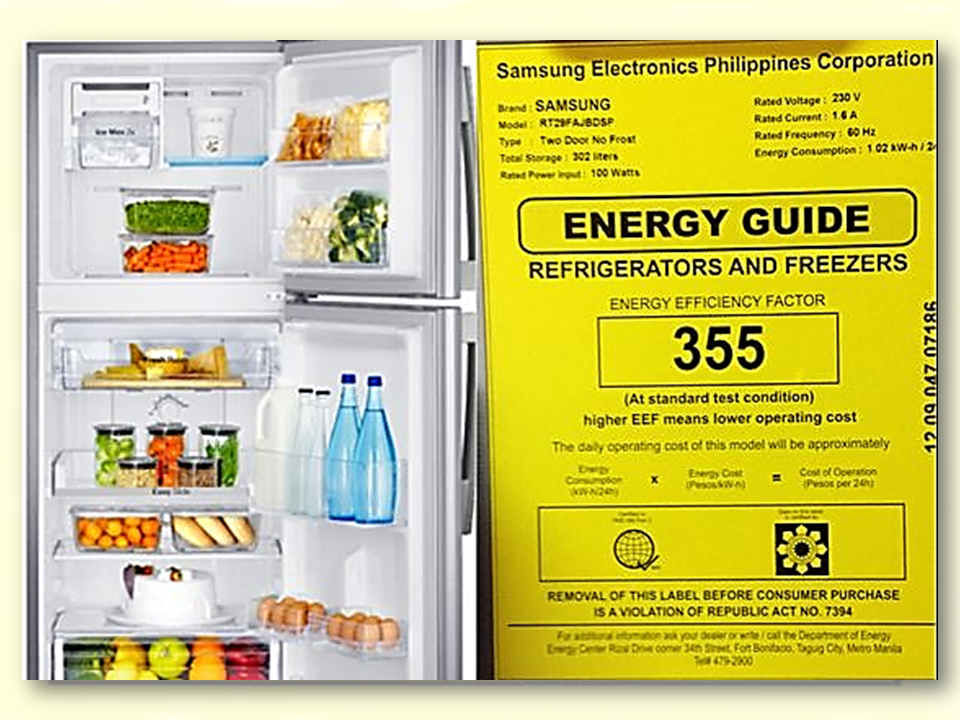
You can always find the EEF written in black on a yellow sticker.
The Department of Energy (DOE) is set to impose integrating "star rating" on ordinary household electrical appliances in the coming months as a guide for the consumers to know their energy consumption. The directive will be addressed to the manufacturers of the electrical appliances. The rating will be based on the number of stars indicated. More stars mean higher energy efficiency. So the consuming public has to look for the appliances that can help them save more on energy and would provide a large cut on their electrical bills.  The DOE also confirmed that appliances with inverter  technology like refrigerators, washing machines, and air conditioning units can indeed lower a household's electrical energy consumption Inverter technology was recently introduced in the market to provide significant cuts on the electric bill although inverter technology units are more expensive compared to the conventional units.  However DOE reminded the consumers to still scrutinize the deal offered by appliances with inverter technology because they are not all the same. The consumer must know the Energy Efficiency Rating (EER) or Energy Efficiency Factor (EEF) of the appliances to be purchased. Engr. Isagani Soriano of DOE explained that higher EER also mean higher energy savings due to low operating cost. You can always find the EEF written in black on a yellow sticker.  So when buying a particular appliance, you should consider checking these yellow tag out. You can compare their ratings and prices before spending your hard-earned money. Some with higher EER  also costs higher but the benefit will be long term.  For example, in these particular brand of a refrigerator, it has a rating of 355, significantly higher than most refrigerators in the market.  Electricity giant Meralco also has been placing orange tags to provide ideas for the consumers about the energy consumption cost of electrical appliances.    Whether you want to follow the yellow, the orange tag or the upcoming star ratings, one thing is for sure, you are going to save more than you used to. Money is not easy to earn. We should wisely spend it where our toil is worthwhile.  Read More:   China's plans to hire Filipino household workers to their five major cities including Beijing and Shanghai, was reported at a local newspaper Philippine Star. it could be a big break for the household workers who are trying their luck in finding greener pastures by working overseas  China is offering up to P100,000  a month, or about HK$15,000. The existing minimum allowable wage for a foreign domestic helper in Hong Kong is  around HK$4,310 per month.  Dominador Say, undersecretary of the Department of Labor and Employment (DOLE), said that talks are underway with Chinese embassy officials on this possibility. China’s five major cities, including Beijing, Shanghai and Xiamen will soon be the haven for Filipino domestic workers who are seeking higher income.  DOLE is expected to have further negotiations on the launch date with a delegation from China in September.   according to Usec Say, Chinese employers favor Filipino domestic workers for their English proficiency, which allows them to teach their employers’ children.    Chinese embassy officials also mentioned that improving ties with the leadership of President Rodrigo Duterte has paved the way for the new policy to materialize.  There is presently a strict work visa system for foreign workers who want to enter mainland China. But according Usec. Say, China is serious about the proposal.   Philippine Labor Secretary Silvestre Bello said an estimated 200,000 Filipino domestic helpers are  presently working illegally in China. With a great demand for skilled domestic workers, Filipino OFWs would have an option to apply using legal processes on their desired higher salary for their sector. Source: ejinsight.com, PhilStar Read More:  The effectivity of the Nationwide Smoking Ban or  E.O. 26 (Providing for the Establishment of Smoke-free Environment in Public and Enclosed Places) started today, July 23, but only a few seems to be aware of it.  President Rodrigo Duterte signed the Executive Order 26 with the citizens health in mind. Presidential Spokesperson Ernesto Abella said the executive order is a milestone where the government prioritize public health protection.    The smoking ban includes smoking in places such as  schools, universities and colleges, playgrounds, restaurants and food preparation areas, basketball courts, stairwells, health centers, clinics, public and private hospitals, hotels, malls, elevators, taxis, buses, public utility jeepneys, ships, tricycles, trains, airplanes, and  gas stations which are prone to combustion. The Department of Health  urges all the establishments to post "no smoking" signs in compliance with the new executive order. They also appeal to the public to report any violation against the nationwide ban on smoking in public places.   Read More:          ©2017 THOUGHTSKOTO www.jbsolis.com SEARCH JBSOLIS, TYPE KEYWORDS and TITLE OF ARTICLE at the box below Smoking is only allowed in designated smoking areas to be provided by the owner of the establishment. Smoking in private vehicles parked in public areas is also prohibited. What Do You Need To know About The Nationwide Smoking Ban Violators will be fined P500 to P10,000, depending on their number of offenses, while owners of establishments caught violating the EO will face a fine of P5,000 or imprisonment of not more than 30 days. The Department of Health  urges all the establishments to post "no smoking" signs in compliance with the new executive order. They also appeal to the public to report any violation against the nationwide ban on smoking in public places.          ©2017 THOUGHTSKOTO  Dominador Say, undersecretary of the Department of Labor and Employment (DOLE), said that talks are underway with Chinese embassy officials on this possibility. China’s five major cities, including Beijing, Shanghai and Xiamen will soon be the destinfor Filipino domestic workers who are seeking higher income.     ©2017 THOUGHTSKOTO
So when buying a particular appliance, you should consider checking these yellow tag out. You can compare their ratings and prices before spending your hard-earned money. Some with higher EER  also costs higher but the benefit will be long term.
The Department of Energy (DOE) is set to impose integrating "star rating" on ordinary household electrical appliances in the coming months as a guide for the consumers to know their energy consumption. The directive will be addressed to the manufacturers of the electrical appliances. The rating will be based on the number of stars indicated. More stars mean higher energy efficiency. So the consuming public has to look for the appliances that can help them save more on energy and would provide a large cut on their electrical bills.  The DOE also confirmed that appliances with inverter  technology like refrigerators, washing machines, and air conditioning units can indeed lower a household's electrical energy consumption Inverter technology was recently introduced in the market to provide significant cuts on the electric bill although inverter technology units are more expensive compared to the conventional units.  However DOE reminded the consumers to still scrutinize the deal offered by appliances with inverter technology because they are not all the same. The consumer must know the Energy Efficiency Rating (EER) or Energy Efficiency Factor (EEF) of the appliances to be purchased. Engr. Isagani Soriano of DOE explained that higher EER also mean higher energy savings due to low operating cost. You can always find the EEF written in black on a yellow sticker.  So when buying a particular appliance, you should consider checking these yellow tag out. You can compare their ratings and prices before spending your hard-earned money. Some with higher EER  also costs higher but the benefit will be long term.  For example, in these particular brand of a refrigerator, it has a rating of 355, significantly higher than most refrigerators in the market.  Electricity giant Meralco also has been placing orange tags to provide ideas for the consumers about the energy consumption cost of electrical appliances.    Whether you want to follow the yellow, the orange tag or the upcoming star ratings, one thing is for sure, you are going to save more than you used to. Money is not easy to earn. We should wisely spend it where our toil is worthwhile.  Read More:   China's plans to hire Filipino household workers to their five major cities including Beijing and Shanghai, was reported at a local newspaper Philippine Star. it could be a big break for the household workers who are trying their luck in finding greener pastures by working overseas  China is offering up to P100,000  a month, or about HK$15,000. The existing minimum allowable wage for a foreign domestic helper in Hong Kong is  around HK$4,310 per month.  Dominador Say, undersecretary of the Department of Labor and Employment (DOLE), said that talks are underway with Chinese embassy officials on this possibility. China’s five major cities, including Beijing, Shanghai and Xiamen will soon be the haven for Filipino domestic workers who are seeking higher income.  DOLE is expected to have further negotiations on the launch date with a delegation from China in September.   according to Usec Say, Chinese employers favor Filipino domestic workers for their English proficiency, which allows them to teach their employers’ children.    Chinese embassy officials also mentioned that improving ties with the leadership of President Rodrigo Duterte has paved the way for the new policy to materialize.  There is presently a strict work visa system for foreign workers who want to enter mainland China. But according Usec. Say, China is serious about the proposal.   Philippine Labor Secretary Silvestre Bello said an estimated 200,000 Filipino domestic helpers are  presently working illegally in China. With a great demand for skilled domestic workers, Filipino OFWs would have an option to apply using legal processes on their desired higher salary for their sector. Source: ejinsight.com, PhilStar Read More:  The effectivity of the Nationwide Smoking Ban or  E.O. 26 (Providing for the Establishment of Smoke-free Environment in Public and Enclosed Places) started today, July 23, but only a few seems to be aware of it.  President Rodrigo Duterte signed the Executive Order 26 with the citizens health in mind. Presidential Spokesperson Ernesto Abella said the executive order is a milestone where the government prioritize public health protection.    The smoking ban includes smoking in places such as  schools, universities and colleges, playgrounds, restaurants and food preparation areas, basketball courts, stairwells, health centers, clinics, public and private hospitals, hotels, malls, elevators, taxis, buses, public utility jeepneys, ships, tricycles, trains, airplanes, and  gas stations which are prone to combustion. The Department of Health  urges all the establishments to post "no smoking" signs in compliance with the new executive order. They also appeal to the public to report any violation against the nationwide ban on smoking in public places.   Read More:          ©2017 THOUGHTSKOTO www.jbsolis.com SEARCH JBSOLIS, TYPE KEYWORDS and TITLE OF ARTICLE at the box below Smoking is only allowed in designated smoking areas to be provided by the owner of the establishment. Smoking in private vehicles parked in public areas is also prohibited. What Do You Need To know About The Nationwide Smoking Ban Violators will be fined P500 to P10,000, depending on their number of offenses, while owners of establishments caught violating the EO will face a fine of P5,000 or imprisonment of not more than 30 days. The Department of Health  urges all the establishments to post "no smoking" signs in compliance with the new executive order. They also appeal to the public to report any violation against the nationwide ban on smoking in public places.          ©2017 THOUGHTSKOTO  Dominador Say, undersecretary of the Department of Labor and Employment (DOLE), said that talks are underway with Chinese embassy officials on this possibility. China’s five major cities, including Beijing, Shanghai and Xiamen will soon be the destinfor Filipino domestic workers who are seeking higher income.     ©2017 THOUGHTSKOTO
For example, in these particular brand of a refrigerator, it has a rating of 355, significantly higher than most refrigerators in the market.

Electricity giant Meralco also has been placing orange tags to provide ideas for the consumers about the energy consumption cost of electrical appliances.


The Department of Energy (DOE) is set to impose integrating "star rating" on ordinary household electrical appliances in the coming months as a guide for the consumers to know their energy consumption. The directive will be addressed to the manufacturers of the electrical appliances. The rating will be based on the number of stars indicated. More stars mean higher energy efficiency. So the consuming public has to look for the appliances that can help them save more on energy and would provide a large cut on their electrical bills.  The DOE also confirmed that appliances with inverter  technology like refrigerators, washing machines, and air conditioning units can indeed lower a household's electrical energy consumption Inverter technology was recently introduced in the market to provide significant cuts on the electric bill although inverter technology units are more expensive compared to the conventional units.  However DOE reminded the consumers to still scrutinize the deal offered by appliances with inverter technology because they are not all the same. The consumer must know the Energy Efficiency Rating (EER) or Energy Efficiency Factor (EEF) of the appliances to be purchased. Engr. Isagani Soriano of DOE explained that higher EER also mean higher energy savings due to low operating cost. You can always find the EEF written in black on a yellow sticker.  So when buying a particular appliance, you should consider checking these yellow tag out. You can compare their ratings and prices before spending your hard-earned money. Some with higher EER  also costs higher but the benefit will be long term.  For example, in these particular brand of a refrigerator, it has a rating of 355, significantly higher than most refrigerators in the market.  Electricity giant Meralco also has been placing orange tags to provide ideas for the consumers about the energy consumption cost of electrical appliances.    Whether you want to follow the yellow, the orange tag or the upcoming star ratings, one thing is for sure, you are going to save more than you used to. Money is not easy to earn. We should wisely spend it where our toil is worthwhile.  Read More:   China's plans to hire Filipino household workers to their five major cities including Beijing and Shanghai, was reported at a local newspaper Philippine Star. it could be a big break for the household workers who are trying their luck in finding greener pastures by working overseas  China is offering up to P100,000  a month, or about HK$15,000. The existing minimum allowable wage for a foreign domestic helper in Hong Kong is  around HK$4,310 per month.  Dominador Say, undersecretary of the Department of Labor and Employment (DOLE), said that talks are underway with Chinese embassy officials on this possibility. China’s five major cities, including Beijing, Shanghai and Xiamen will soon be the haven for Filipino domestic workers who are seeking higher income.  DOLE is expected to have further negotiations on the launch date with a delegation from China in September.   according to Usec Say, Chinese employers favor Filipino domestic workers for their English proficiency, which allows them to teach their employers’ children.    Chinese embassy officials also mentioned that improving ties with the leadership of President Rodrigo Duterte has paved the way for the new policy to materialize.  There is presently a strict work visa system for foreign workers who want to enter mainland China. But according Usec. Say, China is serious about the proposal.   Philippine Labor Secretary Silvestre Bello said an estimated 200,000 Filipino domestic helpers are  presently working illegally in China. With a great demand for skilled domestic workers, Filipino OFWs would have an option to apply using legal processes on their desired higher salary for their sector. Source: ejinsight.com, PhilStar Read More:  The effectivity of the Nationwide Smoking Ban or  E.O. 26 (Providing for the Establishment of Smoke-free Environment in Public and Enclosed Places) started today, July 23, but only a few seems to be aware of it.  President Rodrigo Duterte signed the Executive Order 26 with the citizens health in mind. Presidential Spokesperson Ernesto Abella said the executive order is a milestone where the government prioritize public health protection.    The smoking ban includes smoking in places such as  schools, universities and colleges, playgrounds, restaurants and food preparation areas, basketball courts, stairwells, health centers, clinics, public and private hospitals, hotels, malls, elevators, taxis, buses, public utility jeepneys, ships, tricycles, trains, airplanes, and  gas stations which are prone to combustion. The Department of Health  urges all the establishments to post "no smoking" signs in compliance with the new executive order. They also appeal to the public to report any violation against the nationwide ban on smoking in public places.   Read More:          ©2017 THOUGHTSKOTO www.jbsolis.com SEARCH JBSOLIS, TYPE KEYWORDS and TITLE OF ARTICLE at the box below Smoking is only allowed in designated smoking areas to be provided by the owner of the establishment. Smoking in private vehicles parked in public areas is also prohibited. What Do You Need To know About The Nationwide Smoking Ban Violators will be fined P500 to P10,000, depending on their number of offenses, while owners of establishments caught violating the EO will face a fine of P5,000 or imprisonment of not more than 30 days. The Department of Health  urges all the establishments to post "no smoking" signs in compliance with the new executive order. They also appeal to the public to report any violation against the nationwide ban on smoking in public places.          ©2017 THOUGHTSKOTO  Dominador Say, undersecretary of the Department of Labor and Employment (DOLE), said that talks are underway with Chinese embassy officials on this possibility. China’s five major cities, including Beijing, Shanghai and Xiamen will soon be the destinfor Filipino domestic workers who are seeking higher income.     ©2017 THOUGHTSKOTO
Whether you want to follow the yellow, the orange tag or the upcoming star ratings, one thing is for sure, you are going to save more than you used to. Money is not easy to earn. We should wisely spend it where our toil is worthwhile.


©2017 THOUGHTSKOTO
SEARCH JBSOLIS, TYPE KEYWORDS and TITLE OF ARTICLE at the box below