Carousel

Sponsored Links

Looking for House and Lot Within Tagaytay Area? CONTACT US!

Name

Email *

Message *

Showing posts with label DUTIES. Show all posts

Wednesday, November 22, 2017

Senate Increased Personal Income Tax Exemption To P250,000


The video above was uploaded January this year. Now, what President Duterte promised during the campaign is now approved by the senate and is ready to be implemented this coming year.  The Senate increased the personal income tax exemption to P250,000, essentially retaining the original proposal of the Department of Finance (DOF) and the House of Representatives under the first package of the tax reform bill.   The Senate ways and means committee initially reduced the personal income tax exemption, with only the first P150,000 annual income exempted from tax, however, Senator Ralph Recto proposed that the exemption be increased to P250,000.  Sponsored Links  The Senate meanwhile has so far retained the P82,000 tax exemptoion for 13th month pay and other bonuses, and the maximum P100,000 additional exemption for up to four dependents. Some 14 senators have submitted their proposed individual amendments to Angara’s committee.  The Senate version of the tax schedule to be implemented effective January 1, 2018: Over 250,000 but not over P400,000 – 20 percent of the excess over P250,000 Over P400,000 but not over P800,000 – P30,000 plus 25 percent of the excess over P400,000 Over 800,000 but not over P2 million – P130,000 plus 30 percent of the excess over P800,000 Over P2 million but not over P8 million – P490,000 plus 32 percent of the excess over P2 million Over P8 million – P2.41 million plus 35 percent of the excess over P8 million  Angara said that such tax scheme, however, will result in a P1-billion revenue loss for the government.  Meanwhile, Angara said the Senate version of the tax reform proposal has exceeded the revenue goal of the DOF. The amended Senate version, he said, would yield P159.5 billion in revenue—a hundred billion more than the previous revenue estimate of P59.9 billion.  The boost in the revenue, Angara said, was significantly sourced from the amendments to the provisions on the expansion of the value-added tax (VAT) base. From the repeal of these  VAT special laws alone, the estimated revenue gained from P14 billion to P45.5 billion.  Another major source of revenue is the doubling of the existing documentary stamp tax rates which will approximately raise P40 billion.  Documentary stamp tax is a tax on documents, instruments, loan agreements and papers evidencing the acceptance, assignment, sale or transfer of an obligation, right or property incident thereto. Source: GMA News  Advertisement Read More:       ©2017 THOUGHTSKOTO
Advertisements


The video above was uploaded January this year. Now, what President Duterte promised during the campaign is now approved by the senate and is ready to be implemented this coming year.

The Senate increased the personal income tax exemption to P250,000, essentially retaining the original proposal of the Department of Finance (DOF) and the House of Representatives under the first package of the tax reform bill.
The video above was uploaded January this year. Now, what President Duterte promised during the campaign is now approved by the senate and is ready to be implemented this coming year.  The Senate increased the personal income tax exemption to P250,000, essentially retaining the original proposal of the Department of Finance (DOF) and the House of Representatives under the first package of the tax reform bill.   The Senate ways and means committee initially reduced the personal income tax exemption, with only the first P150,000 annual income exempted from tax, however, Senator Ralph Recto proposed that the exemption be increased to P250,000.  Sponsored Links  The Senate meanwhile has so far retained the P82,000 tax exemptoion for 13th month pay and other bonuses, and the maximum P100,000 additional exemption for up to four dependents. Some 14 senators have submitted their proposed individual amendments to Angara’s committee.  The Senate version of the tax schedule to be implemented effective January 1, 2018: Over 250,000 but not over P400,000 – 20 percent of the excess over P250,000 Over P400,000 but not over P800,000 – P30,000 plus 25 percent of the excess over P400,000 Over 800,000 but not over P2 million – P130,000 plus 30 percent of the excess over P800,000 Over P2 million but not over P8 million – P490,000 plus 32 percent of the excess over P2 million Over P8 million – P2.41 million plus 35 percent of the excess over P8 million  Angara said that such tax scheme, however, will result in a P1-billion revenue loss for the government.  Meanwhile, Angara said the Senate version of the tax reform proposal has exceeded the revenue goal of the DOF. The amended Senate version, he said, would yield P159.5 billion in revenue—a hundred billion more than the previous revenue estimate of P59.9 billion.  The boost in the revenue, Angara said, was significantly sourced from the amendments to the provisions on the expansion of the value-added tax (VAT) base. From the repeal of these  VAT special laws alone, the estimated revenue gained from P14 billion to P45.5 billion.  Another major source of revenue is the doubling of the existing documentary stamp tax rates which will approximately raise P40 billion.  Documentary stamp tax is a tax on documents, instruments, loan agreements and papers evidencing the acceptance, assignment, sale or transfer of an obligation, right or property incident thereto. Source: GMA News  Advertisement Read More:       ©2017 THOUGHTSKOTO


The Senate ways and means committee initially reduced the personal income tax exemption, with only the first P150,000 annual income exempted from tax, however, Senator Ralph Recto proposed that the exemption be increased to P250,000.
Sponsored Links
The video above was uploaded January this year. Now, what President Duterte promised during the campaign is now approved by the senate and is ready to be implemented this coming year.  The Senate increased the personal income tax exemption to P250,000, essentially retaining the original proposal of the Department of Finance (DOF) and the House of Representatives under the first package of the tax reform bill.   The Senate ways and means committee initially reduced the personal income tax exemption, with only the first P150,000 annual income exempted from tax, however, Senator Ralph Recto proposed that the exemption be increased to P250,000.  Sponsored Links  The Senate meanwhile has so far retained the P82,000 tax exemptoion for 13th month pay and other bonuses, and the maximum P100,000 additional exemption for up to four dependents. Some 14 senators have submitted their proposed individual amendments to Angara’s committee.  The Senate version of the tax schedule to be implemented effective January 1, 2018: Over 250,000 but not over P400,000 – 20 percent of the excess over P250,000 Over P400,000 but not over P800,000 – P30,000 plus 25 percent of the excess over P400,000 Over 800,000 but not over P2 million – P130,000 plus 30 percent of the excess over P800,000 Over P2 million but not over P8 million – P490,000 plus 32 percent of the excess over P2 million Over P8 million – P2.41 million plus 35 percent of the excess over P8 million  Angara said that such tax scheme, however, will result in a P1-billion revenue loss for the government.  Meanwhile, Angara said the Senate version of the tax reform proposal has exceeded the revenue goal of the DOF. The amended Senate version, he said, would yield P159.5 billion in revenue—a hundred billion more than the previous revenue estimate of P59.9 billion.  The boost in the revenue, Angara said, was significantly sourced from the amendments to the provisions on the expansion of the value-added tax (VAT) base. From the repeal of these  VAT special laws alone, the estimated revenue gained from P14 billion to P45.5 billion.  Another major source of revenue is the doubling of the existing documentary stamp tax rates which will approximately raise P40 billion.  Documentary stamp tax is a tax on documents, instruments, loan agreements and papers evidencing the acceptance, assignment, sale or transfer of an obligation, right or property incident thereto. Source: GMA News  Advertisement Read More:       ©2017 THOUGHTSKOTO
The Senate meanwhile has so far retained the P82,000 tax exemptoion for 13th month pay and other bonuses, and the maximum P100,000 additional exemption for up to four dependents. Some 14 senators have submitted their proposed individual amendments to Angara’s committee.

The Senate version of the tax schedule to be implemented effective January 1, 2018:
Over 250,000 but not over P400,000 – 20 percent of the excess over P250,000
Over P400,000 but not over P800,000 – P30,000 plus 25 percent of the excess over P400,000
Over 800,000 but not over P2 million – P130,000 plus 30 percent of the excess over P800,000
Over P2 million but not over P8 million – P490,000 plus 32 percent of the excess over P2 million
Over P8 million – P2.41 million plus 35 percent of the excess over P8 million
The video above was uploaded January this year. Now, what President Duterte promised during the campaign is now approved by the senate and is ready to be implemented this coming year.  The Senate increased the personal income tax exemption to P250,000, essentially retaining the original proposal of the Department of Finance (DOF) and the House of Representatives under the first package of the tax reform bill.   The Senate ways and means committee initially reduced the personal income tax exemption, with only the first P150,000 annual income exempted from tax, however, Senator Ralph Recto proposed that the exemption be increased to P250,000.  Sponsored Links  The Senate meanwhile has so far retained the P82,000 tax exemptoion for 13th month pay and other bonuses, and the maximum P100,000 additional exemption for up to four dependents. Some 14 senators have submitted their proposed individual amendments to Angara’s committee.  The Senate version of the tax schedule to be implemented effective January 1, 2018: Over 250,000 but not over P400,000 – 20 percent of the excess over P250,000 Over P400,000 but not over P800,000 – P30,000 plus 25 percent of the excess over P400,000 Over 800,000 but not over P2 million – P130,000 plus 30 percent of the excess over P800,000 Over P2 million but not over P8 million – P490,000 plus 32 percent of the excess over P2 million Over P8 million – P2.41 million plus 35 percent of the excess over P8 million  Angara said that such tax scheme, however, will result in a P1-billion revenue loss for the government.  Meanwhile, Angara said the Senate version of the tax reform proposal has exceeded the revenue goal of the DOF. The amended Senate version, he said, would yield P159.5 billion in revenue—a hundred billion more than the previous revenue estimate of P59.9 billion.  The boost in the revenue, Angara said, was significantly sourced from the amendments to the provisions on the expansion of the value-added tax (VAT) base. From the repeal of these  VAT special laws alone, the estimated revenue gained from P14 billion to P45.5 billion.  Another major source of revenue is the doubling of the existing documentary stamp tax rates which will approximately raise P40 billion.  Documentary stamp tax is a tax on documents, instruments, loan agreements and papers evidencing the acceptance, assignment, sale or transfer of an obligation, right or property incident thereto. Source: GMA News  Advertisement Read More:       ©2017 THOUGHTSKOTO
Angara said that such tax scheme, however, will result in a P1-billion revenue loss for the government.

Meanwhile, Angara said the Senate version of the tax reform proposal has exceeded the revenue goal of the DOF. The amended Senate version, he said, would yield P159.5 billion in revenue—a hundred billion more than the previous revenue estimate of P59.9 billion.
The video above was uploaded January this year. Now, what President Duterte promised during the campaign is now approved by the senate and is ready to be implemented this coming year.  The Senate increased the personal income tax exemption to P250,000, essentially retaining the original proposal of the Department of Finance (DOF) and the House of Representatives under the first package of the tax reform bill.   The Senate ways and means committee initially reduced the personal income tax exemption, with only the first P150,000 annual income exempted from tax, however, Senator Ralph Recto proposed that the exemption be increased to P250,000.  Sponsored Links  The Senate meanwhile has so far retained the P82,000 tax exemptoion for 13th month pay and other bonuses, and the maximum P100,000 additional exemption for up to four dependents. Some 14 senators have submitted their proposed individual amendments to Angara’s committee.  The Senate version of the tax schedule to be implemented effective January 1, 2018: Over 250,000 but not over P400,000 – 20 percent of the excess over P250,000 Over P400,000 but not over P800,000 – P30,000 plus 25 percent of the excess over P400,000 Over 800,000 but not over P2 million – P130,000 plus 30 percent of the excess over P800,000 Over P2 million but not over P8 million – P490,000 plus 32 percent of the excess over P2 million Over P8 million – P2.41 million plus 35 percent of the excess over P8 million  Angara said that such tax scheme, however, will result in a P1-billion revenue loss for the government.  Meanwhile, Angara said the Senate version of the tax reform proposal has exceeded the revenue goal of the DOF. The amended Senate version, he said, would yield P159.5 billion in revenue—a hundred billion more than the previous revenue estimate of P59.9 billion.  The boost in the revenue, Angara said, was significantly sourced from the amendments to the provisions on the expansion of the value-added tax (VAT) base. From the repeal of these  VAT special laws alone, the estimated revenue gained from P14 billion to P45.5 billion.  Another major source of revenue is the doubling of the existing documentary stamp tax rates which will approximately raise P40 billion.  Documentary stamp tax is a tax on documents, instruments, loan agreements and papers evidencing the acceptance, assignment, sale or transfer of an obligation, right or property incident thereto. Source: GMA News  Advertisement Read More:       ©2017 THOUGHTSKOTO
The boost in the revenue, Angara said, was significantly sourced from the amendments to the provisions on the expansion of the value-added tax (VAT) base. From the repeal of these  VAT special laws alone, the estimated revenue gained from P14 billion to P45.5 billion.

Another major source of revenue is the doubling of the existing documentary stamp tax rates which will approximately raise P40 billion.

Documentary stamp tax is a tax on documents, instruments, loan agreements and papers evidencing the acceptance, assignment, sale or transfer of an obligation, right or property incident thereto.
Source: GMA News
The video above was uploaded January this year. Now, what President Duterte promised during the campaign is now approved by the senate and is ready to be implemented this coming year.  The Senate increased the personal income tax exemption to P250,000, essentially retaining the original proposal of the Department of Finance (DOF) and the House of Representatives under the first package of the tax reform bill.   The Senate ways and means committee initially reduced the personal income tax exemption, with only the first P150,000 annual income exempted from tax, however, Senator Ralph Recto proposed that the exemption be increased to P250,000.  Sponsored Links  The Senate meanwhile has so far retained the P82,000 tax exemptoion for 13th month pay and other bonuses, and the maximum P100,000 additional exemption for up to four dependents. Some 14 senators have submitted their proposed individual amendments to Angara’s committee.  The Senate version of the tax schedule to be implemented effective January 1, 2018: Over 250,000 but not over P400,000 – 20 percent of the excess over P250,000 Over P400,000 but not over P800,000 – P30,000 plus 25 percent of the excess over P400,000 Over 800,000 but not over P2 million – P130,000 plus 30 percent of the excess over P800,000 Over P2 million but not over P8 million – P490,000 plus 32 percent of the excess over P2 million Over P8 million – P2.41 million plus 35 percent of the excess over P8 million  Angara said that such tax scheme, however, will result in a P1-billion revenue loss for the government.  Meanwhile, Angara said the Senate version of the tax reform proposal has exceeded the revenue goal of the DOF. The amended Senate version, he said, would yield P159.5 billion in revenue—a hundred billion more than the previous revenue estimate of P59.9 billion.  The boost in the revenue, Angara said, was significantly sourced from the amendments to the provisions on the expansion of the value-added tax (VAT) base. From the repeal of these  VAT special laws alone, the estimated revenue gained from P14 billion to P45.5 billion.  Another major source of revenue is the doubling of the existing documentary stamp tax rates which will approximately raise P40 billion.  Documentary stamp tax is a tax on documents, instruments, loan agreements and papers evidencing the acceptance, assignment, sale or transfer of an obligation, right or property incident thereto. Source: GMA News  Advertisement Read More:       ©2017 THOUGHTSKOTO
Advertisement

Read More:


©2017 THOUGHTSKOTO

SEARCH JBSOLIS, TYPE KEYWORDS and TITLE OF ARTICLE at the box below

Tuesday, January 24, 2017

BOC issues Rules on Tax and/or Duty-Free Importation of Returning Residents, OFWs

The Bureau of Customs has issued Customs Administrative Order (CAO) No. 06-2016, which covers the provisions of Republic Act No. 10863 (or the Customs Modernization and Tariff Act) on conditionally tax and/or duty–exempt importation of personal and household effects of “Returning Residents" and Returning Overseas Filipino Workers (OFWs).  The said CAO was published in the Official Gazette on 9 January and will take effect 15 days days after its publication, or on 24 January.  Below is a summary of the guidelines provided in the Customs Administrative Order:     A. Who can avail of this privilege?  1. "Returning Resident" – a Filipino national, including his/her spouse and dependent children, who has stayed abroad for a period of at least 6 months and is returning to the Philippines.   2. Returning Overseas Filipino Worker (OFW) – holder of a valid passport issued by the Department of Foreign Affairs (DFA) and certified by Department of Labor and Employment (DOLE) or Philippine Overseas Employment Administration (POEA) for overseas employment purposes. This covers all Filipinos working in a foreign country under employment contracts, regardless of their professions, skills or employment status.    To avail of this privilege, the personal and household goods must accompany the Returning Residents or Returning OFWs upon their return from abroad or must arrive within a reasonable time, which shall not exceed sixty (60) days after the owner’s return.    B. What are the beneficiaries allowed to bring in?    1. “Personal and Household Effects”, such as wearing apparel, personal adornments, electronic gadgets, toiletries, or similar items; furniture, dishes, linens, libraries, and similar household furnishing for personal use; and instruments related to one’s profession and analogous personal or household effects whether new or used, that are for personal use or consumption and not for commercial purposes, not intended for barter, sale or hire;   2. “Durables” such as household appliances, machinery, or sports equipment that may be used repeatedly or continuously over a period of a year or more, assuming a normal or average rate of physical usage.   Note: Household appliances, jewelry, precious stones, and other goods of luxury that were previously exported from the Philippines are also exempt from the payment of duties and taxes if these are covered by a Certificate of Identification (CI) that was issued by an authorized Customs Officer before these goods were brought out or exported from the Philippines.   Excisable items such as, but not limited to, distilled spirits, wines, cigars and cigarettes, perfumes, toilet waters, in excess of the allowable quantity to be prescribed by the Bureau shall be subject to payment of duties, taxes and other charges.     C. How to avail of this privilege?   For efficient cargo clearance, Returning Residents and Returning OFWs or their authorized representative must comply with the following:    1. Sign and submit in advance to BOC a “Personal and Household Effect Declaration Form,” which will be issued by the Bureau in a separate order;   In case of accompanied baggage, submit the accomplished form upon arrival to a Customs Officer;    2. Secure a Duty and Tax Free Exemption Certificate (TEC) from the Revenue Office of the Department of Finance (DOF).     D. Amount of Exemption:  Exemption from payment of duties and taxes on personal and household effects of “Returning Residents” and Returning OFWs must not exceed the following values: 1. P350,000.00 for those who have stayed in a foreign country for at least ten (10) years and have not availed of this privilege within ten (10) years prior to the Returning Resident's or OFW's arrival;  2. P250,000.00 for those who have stayed in a foreign country for a period of at least five (5) years but not more than ten (10) years and have not availed of this privilege within five (5) years prior to the Returning Residents of OFW's arrival; or  3. P150,000.00 for those who have stayed in a foreign country for a period of less than five (5) years and have not availed for this privilege within six (6) months prior to the Returning Resident's or OFW's arrival.  In addition to the privilege stated above, Returning OFWs are allowed to bring in, tax and duty-free, home appliances and other durables limited to one (1) of a kind, the total amount of which shall NOT exceed P150,000.00.  Any amount in excess shall be subject to corresponding duties and taxes.  E. Goods/Items EXCLUDED from these privileges:  1. Luxury items, unless covered by a pre – departure Certificate of Identification;  2. Vehicles;  3. Watercrafts;  4. Aircrafts;  5. Animals;  6. Donations;  7. Goods intended for barter, sale or hire;  8. Goods in commercial quantity;  9. Regulated goods in excess of the limits allowed by regulations; and  10. Prohibited and restricted goods.   See original post here:              Add caption                          Source: https://www.facebook.com/notes/bureau-of-customs-ph/boc-issues-rules-on-tax-andor-duty-free-importation-of-returning-residents-ofws/1863848377196270       RECOMMENDED:  PRESIDENT DUTERTE VISITS ADMIRAL TRIBUTS    DTI ACCREDITED CARGO FORWARDERS FOR 2017   NO MORE PHYSICAL INSPECTION FOR BALIKBAYAN BOXES    BOC DELISTED CARGO FORWARDERS AND BROKERS   BALIKBAYAN BOXES SHOULD BE PROTECTED  DOLE ENCOURAGES OFW TEACHERS TO TEACH IN THE PHILIPPINES ©2017 THOUGHTSKOTO
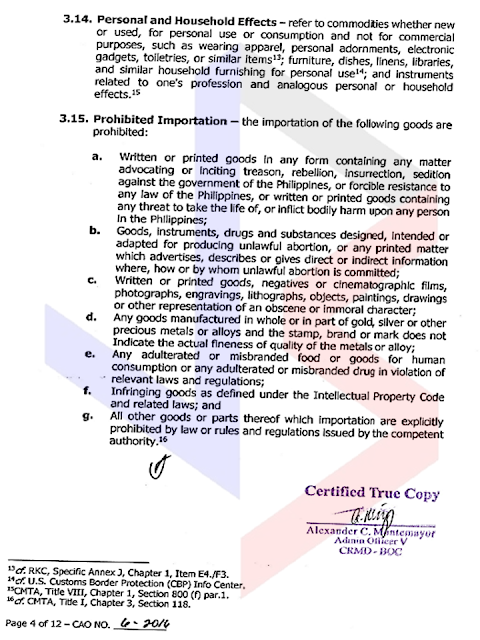


The Bureau of Customs has issued Customs Administrative Order (CAO) No. 06-2016, which covers the provisions of Republic Act No. 10863 (or the Customs Modernization and Tariff Act) on conditionally tax and/or duty–exempt importation of personal and household effects of “Returning Residents" and Returning Overseas Filipino Workers (OFWs).

The said CAO was published in the Official Gazette on 9 January and will take effect 15 days days after its publication, or on 24 January.

Below is a summary of the guidelines provided in the Customs Administrative Order:


A. Who can avail of this privilege?

1. "Returning Resident" – a Filipino national, including his/her spouse and dependent children, who has stayed abroad for a period of at least 6 months and is returning to the Philippines. 

2. Returning Overseas Filipino Worker (OFW) – holder of a valid passport issued by the Department of Foreign Affairs (DFA) and certified by Department of Labor and Employment (DOLE) or Philippine Overseas Employment Administration (POEA) for overseas employment purposes. This covers all Filipinos working in a foreign country under employment contracts, regardless of their professions, skills or employment status. 


To avail of this privilege, the personal and household goods must accompany the Returning Residents or Returning OFWs upon their return from abroad or must arrive within a reasonable time, which shall not exceed sixty (60) days after the owner’s return. 


B. What are the beneficiaries allowed to bring in? 


1. “Personal and Household Effects”, such as wearing apparel, personal adornments, electronic gadgets, toiletries, or similar items; furniture, dishes, linens, libraries, and similar household furnishing for personal use; and instruments related to one’s profession and analogous personal or household effects whether new or used, that are for personal use or consumption and not for commercial purposes, not intended for barter, sale or hire; 

2. “Durables” such as household appliances, machinery, or sports equipment that may be used repeatedly or continuously over a period of a year or more, assuming a normal or average rate of physical usage. 

Note: Household appliances, jewelry, precious stones, and other goods of luxury that were previously exported from the Philippines are also exempt from the payment of duties and taxes if these are covered by a Certificate of Identification (CI) that was issued by an authorized Customs Officer before these goods were brought out or exported from the Philippines. 

Excisable items such as, but not limited to, distilled spirits, wines, cigars and cigarettes, perfumes, toilet waters, in excess of the allowable quantity to be prescribed by the Bureau shall be subject to payment of duties, taxes and other charges. 


C. How to avail of this privilege? 

For efficient cargo clearance, Returning Residents and Returning OFWs or their authorized representative must comply with the following: 


1. Sign and submit in advance to BOC a “Personal and Household Effect Declaration Form,” which will be issued by the Bureau in a separate order; 

In case of accompanied baggage, submit the accomplished form upon arrival to a Customs Officer; 


2. Secure a Duty and Tax Free Exemption Certificate (TEC) from the Revenue Office of the Department of Finance (DOF). 


D. Amount of Exemption:


Exemption from payment of duties and taxes on personal and household effects of “Returning Residents” and Returning OFWs must not exceed the following values:

1. P350,000.00 for those who have stayed in a foreign country for at least ten (10) years and have not availed of this privilege within ten (10) years prior to the Returning Resident's or OFW's arrival;

2. P250,000.00 for those who have stayed in a foreign country for a period of at least five (5) years but not more than ten (10) years and have not availed of this privilege within five (5) years prior to the Returning Residents of OFW's arrival; or

3. P150,000.00 for those who have stayed in a foreign country for a period of less than five (5) years and have not availed for this privilege within six (6) months prior to the Returning Resident's or OFW's arrival.

In addition to the privilege stated above, Returning OFWs are allowed to bring in, tax and duty-free, home appliances and other durables limited to one (1) of a kind, the total amount of which shall NOT exceed P150,000.00. 
Any amount in excess shall be subject to corresponding duties and taxes.

E. Goods/Items EXCLUDED from these privileges:

1. Luxury items, unless covered by a pre – departure Certificate of Identification;

2. Vehicles;

3. Watercrafts;

4. Aircrafts;

5. Animals;

6. Donations;

7. Goods intended for barter, sale or hire;

8. Goods in commercial quantity;

9. Regulated goods in excess of the limits allowed by regulations; and

10. Prohibited and restricted goods.


See original post here:


The Bureau of Customs has issued Customs Administrative Order (CAO) No. 06-2016, which covers the provisions of Republic Act No. 10863 (or the Customs Modernization and Tariff Act) on conditionally tax and/or duty–exempt importation of personal and household effects of “Returning Residents" and Returning Overseas Filipino Workers (OFWs).  The said CAO was published in the Official Gazette on 9 January and will take effect 15 days days after its publication, or on 24 January.  Below is a summary of the guidelines provided in the Customs Administrative Order:     A. Who can avail of this privilege?  1. "Returning Resident" – a Filipino national, including his/her spouse and dependent children, who has stayed abroad for a period of at least 6 months and is returning to the Philippines.   2. Returning Overseas Filipino Worker (OFW) – holder of a valid passport issued by the Department of Foreign Affairs (DFA) and certified by Department of Labor and Employment (DOLE) or Philippine Overseas Employment Administration (POEA) for overseas employment purposes. This covers all Filipinos working in a foreign country under employment contracts, regardless of their professions, skills or employment status.    To avail of this privilege, the personal and household goods must accompany the Returning Residents or Returning OFWs upon their return from abroad or must arrive within a reasonable time, which shall not exceed sixty (60) days after the owner’s return.    B. What are the beneficiaries allowed to bring in?    1. “Personal and Household Effects”, such as wearing apparel, personal adornments, electronic gadgets, toiletries, or similar items; furniture, dishes, linens, libraries, and similar household furnishing for personal use; and instruments related to one’s profession and analogous personal or household effects whether new or used, that are for personal use or consumption and not for commercial purposes, not intended for barter, sale or hire;   2. “Durables” such as household appliances, machinery, or sports equipment that may be used repeatedly or continuously over a period of a year or more, assuming a normal or average rate of physical usage.   Note: Household appliances, jewelry, precious stones, and other goods of luxury that were previously exported from the Philippines are also exempt from the payment of duties and taxes if these are covered by a Certificate of Identification (CI) that was issued by an authorized Customs Officer before these goods were brought out or exported from the Philippines.   Excisable items such as, but not limited to, distilled spirits, wines, cigars and cigarettes, perfumes, toilet waters, in excess of the allowable quantity to be prescribed by the Bureau shall be subject to payment of duties, taxes and other charges.     C. How to avail of this privilege?   For efficient cargo clearance, Returning Residents and Returning OFWs or their authorized representative must comply with the following:    1. Sign and submit in advance to BOC a “Personal and Household Effect Declaration Form,” which will be issued by the Bureau in a separate order;   In case of accompanied baggage, submit the accomplished form upon arrival to a Customs Officer;    2. Secure a Duty and Tax Free Exemption Certificate (TEC) from the Revenue Office of the Department of Finance (DOF).     D. Amount of Exemption:  Exemption from payment of duties and taxes on personal and household effects of “Returning Residents” and Returning OFWs must not exceed the following values: 1. P350,000.00 for those who have stayed in a foreign country for at least ten (10) years and have not availed of this privilege within ten (10) years prior to the Returning Resident's or OFW's arrival;  2. P250,000.00 for those who have stayed in a foreign country for a period of at least five (5) years but not more than ten (10) years and have not availed of this privilege within five (5) years prior to the Returning Residents of OFW's arrival; or  3. P150,000.00 for those who have stayed in a foreign country for a period of less than five (5) years and have not availed for this privilege within six (6) months prior to the Returning Resident's or OFW's arrival.  In addition to the privilege stated above, Returning OFWs are allowed to bring in, tax and duty-free, home appliances and other durables limited to one (1) of a kind, the total amount of which shall NOT exceed P150,000.00.  Any amount in excess shall be subject to corresponding duties and taxes.  E. Goods/Items EXCLUDED from these privileges:  1. Luxury items, unless covered by a pre – departure Certificate of Identification;  2. Vehicles;  3. Watercrafts;  4. Aircrafts;  5. Animals;  6. Donations;  7. Goods intended for barter, sale or hire;  8. Goods in commercial quantity;  9. Regulated goods in excess of the limits allowed by regulations; and  10. Prohibited and restricted goods.   See original post here:              Add caption                          Source: https://www.facebook.com/notes/bureau-of-customs-ph/boc-issues-rules-on-tax-andor-duty-free-importation-of-returning-residents-ofws/1863848377196270       RECOMMENDED:  PRESIDENT DUTERTE VISITS ADMIRAL TRIBUTS    DTI ACCREDITED CARGO FORWARDERS FOR 2017   NO MORE PHYSICAL INSPECTION FOR BALIKBAYAN BOXES    BOC DELISTED CARGO FORWARDERS AND BROKERS   BALIKBAYAN BOXES SHOULD BE PROTECTED  DOLE ENCOURAGES OFW TEACHERS TO TEACH IN THE PHILIPPINES ©2017 THOUGHTSKOTO
The Bureau of Customs has issued Customs Administrative Order (CAO) No. 06-2016, which covers the provisions of Republic Act No. 10863 (or the Customs Modernization and Tariff Act) on conditionally tax and/or duty–exempt importation of personal and household effects of “Returning Residents" and Returning Overseas Filipino Workers (OFWs).  The said CAO was published in the Official Gazette on 9 January and will take effect 15 days days after its publication, or on 24 January.  Below is a summary of the guidelines provided in the Customs Administrative Order:     A. Who can avail of this privilege?  1. "Returning Resident" – a Filipino national, including his/her spouse and dependent children, who has stayed abroad for a period of at least 6 months and is returning to the Philippines.   2. Returning Overseas Filipino Worker (OFW) – holder of a valid passport issued by the Department of Foreign Affairs (DFA) and certified by Department of Labor and Employment (DOLE) or Philippine Overseas Employment Administration (POEA) for overseas employment purposes. This covers all Filipinos working in a foreign country under employment contracts, regardless of their professions, skills or employment status.    To avail of this privilege, the personal and household goods must accompany the Returning Residents or Returning OFWs upon their return from abroad or must arrive within a reasonable time, which shall not exceed sixty (60) days after the owner’s return.    B. What are the beneficiaries allowed to bring in?    1. “Personal and Household Effects”, such as wearing apparel, personal adornments, electronic gadgets, toiletries, or similar items; furniture, dishes, linens, libraries, and similar household furnishing for personal use; and instruments related to one’s profession and analogous personal or household effects whether new or used, that are for personal use or consumption and not for commercial purposes, not intended for barter, sale or hire;   2. “Durables” such as household appliances, machinery, or sports equipment that may be used repeatedly or continuously over a period of a year or more, assuming a normal or average rate of physical usage.   Note: Household appliances, jewelry, precious stones, and other goods of luxury that were previously exported from the Philippines are also exempt from the payment of duties and taxes if these are covered by a Certificate of Identification (CI) that was issued by an authorized Customs Officer before these goods were brought out or exported from the Philippines.   Excisable items such as, but not limited to, distilled spirits, wines, cigars and cigarettes, perfumes, toilet waters, in excess of the allowable quantity to be prescribed by the Bureau shall be subject to payment of duties, taxes and other charges.     C. How to avail of this privilege?   For efficient cargo clearance, Returning Residents and Returning OFWs or their authorized representative must comply with the following:    1. Sign and submit in advance to BOC a “Personal and Household Effect Declaration Form,” which will be issued by the Bureau in a separate order;   In case of accompanied baggage, submit the accomplished form upon arrival to a Customs Officer;    2. Secure a Duty and Tax Free Exemption Certificate (TEC) from the Revenue Office of the Department of Finance (DOF).     D. Amount of Exemption:  Exemption from payment of duties and taxes on personal and household effects of “Returning Residents” and Returning OFWs must not exceed the following values: 1. P350,000.00 for those who have stayed in a foreign country for at least ten (10) years and have not availed of this privilege within ten (10) years prior to the Returning Resident's or OFW's arrival;  2. P250,000.00 for those who have stayed in a foreign country for a period of at least five (5) years but not more than ten (10) years and have not availed of this privilege within five (5) years prior to the Returning Residents of OFW's arrival; or  3. P150,000.00 for those who have stayed in a foreign country for a period of less than five (5) years and have not availed for this privilege within six (6) months prior to the Returning Resident's or OFW's arrival.  In addition to the privilege stated above, Returning OFWs are allowed to bring in, tax and duty-free, home appliances and other durables limited to one (1) of a kind, the total amount of which shall NOT exceed P150,000.00.  Any amount in excess shall be subject to corresponding duties and taxes.  E. Goods/Items EXCLUDED from these privileges:  1. Luxury items, unless covered by a pre – departure Certificate of Identification;  2. Vehicles;  3. Watercrafts;  4. Aircrafts;  5. Animals;  6. Donations;  7. Goods intended for barter, sale or hire;  8. Goods in commercial quantity;  9. Regulated goods in excess of the limits allowed by regulations; and  10. Prohibited and restricted goods.   See original post here:              Add caption                          Source: https://www.facebook.com/notes/bureau-of-customs-ph/boc-issues-rules-on-tax-andor-duty-free-importation-of-returning-residents-ofws/1863848377196270       RECOMMENDED:  PRESIDENT DUTERTE VISITS ADMIRAL TRIBUTS    DTI ACCREDITED CARGO FORWARDERS FOR 2017   NO MORE PHYSICAL INSPECTION FOR BALIKBAYAN BOXES    BOC DELISTED CARGO FORWARDERS AND BROKERS   BALIKBAYAN BOXES SHOULD BE PROTECTED  DOLE ENCOURAGES OFW TEACHERS TO TEACH IN THE PHILIPPINES ©2017 THOUGHTSKOTO

The Bureau of Customs has issued Customs Administrative Order (CAO) No. 06-2016, which covers the provisions of Republic Act No. 10863 (or the Customs Modernization and Tariff Act) on conditionally tax and/or duty–exempt importation of personal and household effects of “Returning Residents" and Returning Overseas Filipino Workers (OFWs).  The said CAO was published in the Official Gazette on 9 January and will take effect 15 days days after its publication, or on 24 January.  Below is a summary of the guidelines provided in the Customs Administrative Order:     A. Who can avail of this privilege?  1. "Returning Resident" – a Filipino national, including his/her spouse and dependent children, who has stayed abroad for a period of at least 6 months and is returning to the Philippines.   2. Returning Overseas Filipino Worker (OFW) – holder of a valid passport issued by the Department of Foreign Affairs (DFA) and certified by Department of Labor and Employment (DOLE) or Philippine Overseas Employment Administration (POEA) for overseas employment purposes. This covers all Filipinos working in a foreign country under employment contracts, regardless of their professions, skills or employment status.    To avail of this privilege, the personal and household goods must accompany the Returning Residents or Returning OFWs upon their return from abroad or must arrive within a reasonable time, which shall not exceed sixty (60) days after the owner’s return.    B. What are the beneficiaries allowed to bring in?    1. “Personal and Household Effects”, such as wearing apparel, personal adornments, electronic gadgets, toiletries, or similar items; furniture, dishes, linens, libraries, and similar household furnishing for personal use; and instruments related to one’s profession and analogous personal or household effects whether new or used, that are for personal use or consumption and not for commercial purposes, not intended for barter, sale or hire;   2. “Durables” such as household appliances, machinery, or sports equipment that may be used repeatedly or continuously over a period of a year or more, assuming a normal or average rate of physical usage.   Note: Household appliances, jewelry, precious stones, and other goods of luxury that were previously exported from the Philippines are also exempt from the payment of duties and taxes if these are covered by a Certificate of Identification (CI) that was issued by an authorized Customs Officer before these goods were brought out or exported from the Philippines.   Excisable items such as, but not limited to, distilled spirits, wines, cigars and cigarettes, perfumes, toilet waters, in excess of the allowable quantity to be prescribed by the Bureau shall be subject to payment of duties, taxes and other charges.     C. How to avail of this privilege?   For efficient cargo clearance, Returning Residents and Returning OFWs or their authorized representative must comply with the following:    1. Sign and submit in advance to BOC a “Personal and Household Effect Declaration Form,” which will be issued by the Bureau in a separate order;   In case of accompanied baggage, submit the accomplished form upon arrival to a Customs Officer;    2. Secure a Duty and Tax Free Exemption Certificate (TEC) from the Revenue Office of the Department of Finance (DOF).     D. Amount of Exemption:  Exemption from payment of duties and taxes on personal and household effects of “Returning Residents” and Returning OFWs must not exceed the following values: 1. P350,000.00 for those who have stayed in a foreign country for at least ten (10) years and have not availed of this privilege within ten (10) years prior to the Returning Resident's or OFW's arrival;  2. P250,000.00 for those who have stayed in a foreign country for a period of at least five (5) years but not more than ten (10) years and have not availed of this privilege within five (5) years prior to the Returning Residents of OFW's arrival; or  3. P150,000.00 for those who have stayed in a foreign country for a period of less than five (5) years and have not availed for this privilege within six (6) months prior to the Returning Resident's or OFW's arrival.  In addition to the privilege stated above, Returning OFWs are allowed to bring in, tax and duty-free, home appliances and other durables limited to one (1) of a kind, the total amount of which shall NOT exceed P150,000.00.  Any amount in excess shall be subject to corresponding duties and taxes.  E. Goods/Items EXCLUDED from these privileges:  1. Luxury items, unless covered by a pre – departure Certificate of Identification;  2. Vehicles;  3. Watercrafts;  4. Aircrafts;  5. Animals;  6. Donations;  7. Goods intended for barter, sale or hire;  8. Goods in commercial quantity;  9. Regulated goods in excess of the limits allowed by regulations; and  10. Prohibited and restricted goods.   See original post here:              Add caption                          Source: https://www.facebook.com/notes/bureau-of-customs-ph/boc-issues-rules-on-tax-andor-duty-free-importation-of-returning-residents-ofws/1863848377196270       RECOMMENDED:  PRESIDENT DUTERTE VISITS ADMIRAL TRIBUTS    DTI ACCREDITED CARGO FORWARDERS FOR 2017   NO MORE PHYSICAL INSPECTION FOR BALIKBAYAN BOXES    BOC DELISTED CARGO FORWARDERS AND BROKERS   BALIKBAYAN BOXES SHOULD BE PROTECTED  DOLE ENCOURAGES OFW TEACHERS TO TEACH IN THE PHILIPPINES ©2017 THOUGHTSKOTO

The Bureau of Customs has issued Customs Administrative Order (CAO) No. 06-2016, which covers the provisions of Republic Act No. 10863 (or the Customs Modernization and Tariff Act) on conditionally tax and/or duty–exempt importation of personal and household effects of “Returning Residents" and Returning Overseas Filipino Workers (OFWs).  The said CAO was published in the Official Gazette on 9 January and will take effect 15 days days after its publication, or on 24 January.  Below is a summary of the guidelines provided in the Customs Administrative Order:     A. Who can avail of this privilege?  1. "Returning Resident" – a Filipino national, including his/her spouse and dependent children, who has stayed abroad for a period of at least 6 months and is returning to the Philippines.   2. Returning Overseas Filipino Worker (OFW) – holder of a valid passport issued by the Department of Foreign Affairs (DFA) and certified by Department of Labor and Employment (DOLE) or Philippine Overseas Employment Administration (POEA) for overseas employment purposes. This covers all Filipinos working in a foreign country under employment contracts, regardless of their professions, skills or employment status.    To avail of this privilege, the personal and household goods must accompany the Returning Residents or Returning OFWs upon their return from abroad or must arrive within a reasonable time, which shall not exceed sixty (60) days after the owner’s return.    B. What are the beneficiaries allowed to bring in?    1. “Personal and Household Effects”, such as wearing apparel, personal adornments, electronic gadgets, toiletries, or similar items; furniture, dishes, linens, libraries, and similar household furnishing for personal use; and instruments related to one’s profession and analogous personal or household effects whether new or used, that are for personal use or consumption and not for commercial purposes, not intended for barter, sale or hire;   2. “Durables” such as household appliances, machinery, or sports equipment that may be used repeatedly or continuously over a period of a year or more, assuming a normal or average rate of physical usage.   Note: Household appliances, jewelry, precious stones, and other goods of luxury that were previously exported from the Philippines are also exempt from the payment of duties and taxes if these are covered by a Certificate of Identification (CI) that was issued by an authorized Customs Officer before these goods were brought out or exported from the Philippines.   Excisable items such as, but not limited to, distilled spirits, wines, cigars and cigarettes, perfumes, toilet waters, in excess of the allowable quantity to be prescribed by the Bureau shall be subject to payment of duties, taxes and other charges.     C. How to avail of this privilege?   For efficient cargo clearance, Returning Residents and Returning OFWs or their authorized representative must comply with the following:    1. Sign and submit in advance to BOC a “Personal and Household Effect Declaration Form,” which will be issued by the Bureau in a separate order;   In case of accompanied baggage, submit the accomplished form upon arrival to a Customs Officer;    2. Secure a Duty and Tax Free Exemption Certificate (TEC) from the Revenue Office of the Department of Finance (DOF).     D. Amount of Exemption:  Exemption from payment of duties and taxes on personal and household effects of “Returning Residents” and Returning OFWs must not exceed the following values: 1. P350,000.00 for those who have stayed in a foreign country for at least ten (10) years and have not availed of this privilege within ten (10) years prior to the Returning Resident's or OFW's arrival;  2. P250,000.00 for those who have stayed in a foreign country for a period of at least five (5) years but not more than ten (10) years and have not availed of this privilege within five (5) years prior to the Returning Residents of OFW's arrival; or  3. P150,000.00 for those who have stayed in a foreign country for a period of less than five (5) years and have not availed for this privilege within six (6) months prior to the Returning Resident's or OFW's arrival.  In addition to the privilege stated above, Returning OFWs are allowed to bring in, tax and duty-free, home appliances and other durables limited to one (1) of a kind, the total amount of which shall NOT exceed P150,000.00.  Any amount in excess shall be subject to corresponding duties and taxes.  E. Goods/Items EXCLUDED from these privileges:  1. Luxury items, unless covered by a pre – departure Certificate of Identification;  2. Vehicles;  3. Watercrafts;  4. Aircrafts;  5. Animals;  6. Donations;  7. Goods intended for barter, sale or hire;  8. Goods in commercial quantity;  9. Regulated goods in excess of the limits allowed by regulations; and  10. Prohibited and restricted goods.   See original post here:              Add caption                          Source: https://www.facebook.com/notes/bureau-of-customs-ph/boc-issues-rules-on-tax-andor-duty-free-importation-of-returning-residents-ofws/1863848377196270       RECOMMENDED:  PRESIDENT DUTERTE VISITS ADMIRAL TRIBUTS    DTI ACCREDITED CARGO FORWARDERS FOR 2017   NO MORE PHYSICAL INSPECTION FOR BALIKBAYAN BOXES    BOC DELISTED CARGO FORWARDERS AND BROKERS   BALIKBAYAN BOXES SHOULD BE PROTECTED  DOLE ENCOURAGES OFW TEACHERS TO TEACH IN THE PHILIPPINES ©2017 THOUGHTSKOTO
(Images from the BOC website.)

The Bureau of Customs has issued Customs Administrative Order (CAO) No. 06-2016, which covers the provisions of Republic Act No. 10863 (or the Customs Modernization and Tariff Act) on conditionally tax and/or duty–exempt importation of personal and household effects of “Returning Residents" and Returning Overseas Filipino Workers (OFWs).  The said CAO was published in the Official Gazette on 9 January and will take effect 15 days days after its publication, or on 24 January.  Below is a summary of the guidelines provided in the Customs Administrative Order:     A. Who can avail of this privilege?  1. "Returning Resident" – a Filipino national, including his/her spouse and dependent children, who has stayed abroad for a period of at least 6 months and is returning to the Philippines.   2. Returning Overseas Filipino Worker (OFW) – holder of a valid passport issued by the Department of Foreign Affairs (DFA) and certified by Department of Labor and Employment (DOLE) or Philippine Overseas Employment Administration (POEA) for overseas employment purposes. This covers all Filipinos working in a foreign country under employment contracts, regardless of their professions, skills or employment status.    To avail of this privilege, the personal and household goods must accompany the Returning Residents or Returning OFWs upon their return from abroad or must arrive within a reasonable time, which shall not exceed sixty (60) days after the owner’s return.    B. What are the beneficiaries allowed to bring in?    1. “Personal and Household Effects”, such as wearing apparel, personal adornments, electronic gadgets, toiletries, or similar items; furniture, dishes, linens, libraries, and similar household furnishing for personal use; and instruments related to one’s profession and analogous personal or household effects whether new or used, that are for personal use or consumption and not for commercial purposes, not intended for barter, sale or hire;   2. “Durables” such as household appliances, machinery, or sports equipment that may be used repeatedly or continuously over a period of a year or more, assuming a normal or average rate of physical usage.   Note: Household appliances, jewelry, precious stones, and other goods of luxury that were previously exported from the Philippines are also exempt from the payment of duties and taxes if these are covered by a Certificate of Identification (CI) that was issued by an authorized Customs Officer before these goods were brought out or exported from the Philippines.   Excisable items such as, but not limited to, distilled spirits, wines, cigars and cigarettes, perfumes, toilet waters, in excess of the allowable quantity to be prescribed by the Bureau shall be subject to payment of duties, taxes and other charges.     C. How to avail of this privilege?   For efficient cargo clearance, Returning Residents and Returning OFWs or their authorized representative must comply with the following:    1. Sign and submit in advance to BOC a “Personal and Household Effect Declaration Form,” which will be issued by the Bureau in a separate order;   In case of accompanied baggage, submit the accomplished form upon arrival to a Customs Officer;    2. Secure a Duty and Tax Free Exemption Certificate (TEC) from the Revenue Office of the Department of Finance (DOF).     D. Amount of Exemption:  Exemption from payment of duties and taxes on personal and household effects of “Returning Residents” and Returning OFWs must not exceed the following values: 1. P350,000.00 for those who have stayed in a foreign country for at least ten (10) years and have not availed of this privilege within ten (10) years prior to the Returning Resident's or OFW's arrival;  2. P250,000.00 for those who have stayed in a foreign country for a period of at least five (5) years but not more than ten (10) years and have not availed of this privilege within five (5) years prior to the Returning Residents of OFW's arrival; or  3. P150,000.00 for those who have stayed in a foreign country for a period of less than five (5) years and have not availed for this privilege within six (6) months prior to the Returning Resident's or OFW's arrival.  In addition to the privilege stated above, Returning OFWs are allowed to bring in, tax and duty-free, home appliances and other durables limited to one (1) of a kind, the total amount of which shall NOT exceed P150,000.00.  Any amount in excess shall be subject to corresponding duties and taxes.  E. Goods/Items EXCLUDED from these privileges:  1. Luxury items, unless covered by a pre – departure Certificate of Identification;  2. Vehicles;  3. Watercrafts;  4. Aircrafts;  5. Animals;  6. Donations;  7. Goods intended for barter, sale or hire;  8. Goods in commercial quantity;  9. Regulated goods in excess of the limits allowed by regulations; and  10. Prohibited and restricted goods.   See original post here:              Add caption                          Source: https://www.facebook.com/notes/bureau-of-customs-ph/boc-issues-rules-on-tax-andor-duty-free-importation-of-returning-residents-ofws/1863848377196270       RECOMMENDED:  PRESIDENT DUTERTE VISITS ADMIRAL TRIBUTS    DTI ACCREDITED CARGO FORWARDERS FOR 2017   NO MORE PHYSICAL INSPECTION FOR BALIKBAYAN BOXES    BOC DELISTED CARGO FORWARDERS AND BROKERS   BALIKBAYAN BOXES SHOULD BE PROTECTED  DOLE ENCOURAGES OFW TEACHERS TO TEACH IN THE PHILIPPINES ©2017 THOUGHTSKOTO

The Bureau of Customs has issued Customs Administrative Order (CAO) No. 06-2016, which covers the provisions of Republic Act No. 10863 (or the Customs Modernization and Tariff Act) on conditionally tax and/or duty–exempt importation of personal and household effects of “Returning Residents" and Returning Overseas Filipino Workers (OFWs).  The said CAO was published in the Official Gazette on 9 January and will take effect 15 days days after its publication, or on 24 January.  Below is a summary of the guidelines provided in the Customs Administrative Order:     A. Who can avail of this privilege?  1. "Returning Resident" – a Filipino national, including his/her spouse and dependent children, who has stayed abroad for a period of at least 6 months and is returning to the Philippines.   2. Returning Overseas Filipino Worker (OFW) – holder of a valid passport issued by the Department of Foreign Affairs (DFA) and certified by Department of Labor and Employment (DOLE) or Philippine Overseas Employment Administration (POEA) for overseas employment purposes. This covers all Filipinos working in a foreign country under employment contracts, regardless of their professions, skills or employment status.    To avail of this privilege, the personal and household goods must accompany the Returning Residents or Returning OFWs upon their return from abroad or must arrive within a reasonable time, which shall not exceed sixty (60) days after the owner’s return.    B. What are the beneficiaries allowed to bring in?    1. “Personal and Household Effects”, such as wearing apparel, personal adornments, electronic gadgets, toiletries, or similar items; furniture, dishes, linens, libraries, and similar household furnishing for personal use; and instruments related to one’s profession and analogous personal or household effects whether new or used, that are for personal use or consumption and not for commercial purposes, not intended for barter, sale or hire;   2. “Durables” such as household appliances, machinery, or sports equipment that may be used repeatedly or continuously over a period of a year or more, assuming a normal or average rate of physical usage.   Note: Household appliances, jewelry, precious stones, and other goods of luxury that were previously exported from the Philippines are also exempt from the payment of duties and taxes if these are covered by a Certificate of Identification (CI) that was issued by an authorized Customs Officer before these goods were brought out or exported from the Philippines.   Excisable items such as, but not limited to, distilled spirits, wines, cigars and cigarettes, perfumes, toilet waters, in excess of the allowable quantity to be prescribed by the Bureau shall be subject to payment of duties, taxes and other charges.     C. How to avail of this privilege?   For efficient cargo clearance, Returning Residents and Returning OFWs or their authorized representative must comply with the following:    1. Sign and submit in advance to BOC a “Personal and Household Effect Declaration Form,” which will be issued by the Bureau in a separate order;   In case of accompanied baggage, submit the accomplished form upon arrival to a Customs Officer;    2. Secure a Duty and Tax Free Exemption Certificate (TEC) from the Revenue Office of the Department of Finance (DOF).     D. Amount of Exemption:  Exemption from payment of duties and taxes on personal and household effects of “Returning Residents” and Returning OFWs must not exceed the following values: 1. P350,000.00 for those who have stayed in a foreign country for at least ten (10) years and have not availed of this privilege within ten (10) years prior to the Returning Resident's or OFW's arrival;  2. P250,000.00 for those who have stayed in a foreign country for a period of at least five (5) years but not more than ten (10) years and have not availed of this privilege within five (5) years prior to the Returning Residents of OFW's arrival; or  3. P150,000.00 for those who have stayed in a foreign country for a period of less than five (5) years and have not availed for this privilege within six (6) months prior to the Returning Resident's or OFW's arrival.  In addition to the privilege stated above, Returning OFWs are allowed to bring in, tax and duty-free, home appliances and other durables limited to one (1) of a kind, the total amount of which shall NOT exceed P150,000.00.  Any amount in excess shall be subject to corresponding duties and taxes.  E. Goods/Items EXCLUDED from these privileges:  1. Luxury items, unless covered by a pre – departure Certificate of Identification;  2. Vehicles;  3. Watercrafts;  4. Aircrafts;  5. Animals;  6. Donations;  7. Goods intended for barter, sale or hire;  8. Goods in commercial quantity;  9. Regulated goods in excess of the limits allowed by regulations; and  10. Prohibited and restricted goods.   See original post here:              Add caption                          Source: https://www.facebook.com/notes/bureau-of-customs-ph/boc-issues-rules-on-tax-andor-duty-free-importation-of-returning-residents-ofws/1863848377196270       RECOMMENDED:  PRESIDENT DUTERTE VISITS ADMIRAL TRIBUTS    DTI ACCREDITED CARGO FORWARDERS FOR 2017   NO MORE PHYSICAL INSPECTION FOR BALIKBAYAN BOXES    BOC DELISTED CARGO FORWARDERS AND BROKERS   BALIKBAYAN BOXES SHOULD BE PROTECTED  DOLE ENCOURAGES OFW TEACHERS TO TEACH IN THE PHILIPPINES ©2017 THOUGHTSKOTO

The Bureau of Customs has issued Customs Administrative Order (CAO) No. 06-2016, which covers the provisions of Republic Act No. 10863 (or the Customs Modernization and Tariff Act) on conditionally tax and/or duty–exempt importation of personal and household effects of “Returning Residents" and Returning Overseas Filipino Workers (OFWs).  The said CAO was published in the Official Gazette on 9 January and will take effect 15 days days after its publication, or on 24 January.  Below is a summary of the guidelines provided in the Customs Administrative Order:     A. Who can avail of this privilege?  1. "Returning Resident" – a Filipino national, including his/her spouse and dependent children, who has stayed abroad for a period of at least 6 months and is returning to the Philippines.   2. Returning Overseas Filipino Worker (OFW) – holder of a valid passport issued by the Department of Foreign Affairs (DFA) and certified by Department of Labor and Employment (DOLE) or Philippine Overseas Employment Administration (POEA) for overseas employment purposes. This covers all Filipinos working in a foreign country under employment contracts, regardless of their professions, skills or employment status.    To avail of this privilege, the personal and household goods must accompany the Returning Residents or Returning OFWs upon their return from abroad or must arrive within a reasonable time, which shall not exceed sixty (60) days after the owner’s return.    B. What are the beneficiaries allowed to bring in?    1. “Personal and Household Effects”, such as wearing apparel, personal adornments, electronic gadgets, toiletries, or similar items; furniture, dishes, linens, libraries, and similar household furnishing for personal use; and instruments related to one’s profession and analogous personal or household effects whether new or used, that are for personal use or consumption and not for commercial purposes, not intended for barter, sale or hire;   2. “Durables” such as household appliances, machinery, or sports equipment that may be used repeatedly or continuously over a period of a year or more, assuming a normal or average rate of physical usage.   Note: Household appliances, jewelry, precious stones, and other goods of luxury that were previously exported from the Philippines are also exempt from the payment of duties and taxes if these are covered by a Certificate of Identification (CI) that was issued by an authorized Customs Officer before these goods were brought out or exported from the Philippines.   Excisable items such as, but not limited to, distilled spirits, wines, cigars and cigarettes, perfumes, toilet waters, in excess of the allowable quantity to be prescribed by the Bureau shall be subject to payment of duties, taxes and other charges.     C. How to avail of this privilege?   For efficient cargo clearance, Returning Residents and Returning OFWs or their authorized representative must comply with the following:    1. Sign and submit in advance to BOC a “Personal and Household Effect Declaration Form,” which will be issued by the Bureau in a separate order;   In case of accompanied baggage, submit the accomplished form upon arrival to a Customs Officer;    2. Secure a Duty and Tax Free Exemption Certificate (TEC) from the Revenue Office of the Department of Finance (DOF).     D. Amount of Exemption:  Exemption from payment of duties and taxes on personal and household effects of “Returning Residents” and Returning OFWs must not exceed the following values: 1. P350,000.00 for those who have stayed in a foreign country for at least ten (10) years and have not availed of this privilege within ten (10) years prior to the Returning Resident's or OFW's arrival;  2. P250,000.00 for those who have stayed in a foreign country for a period of at least five (5) years but not more than ten (10) years and have not availed of this privilege within five (5) years prior to the Returning Residents of OFW's arrival; or  3. P150,000.00 for those who have stayed in a foreign country for a period of less than five (5) years and have not availed for this privilege within six (6) months prior to the Returning Resident's or OFW's arrival.  In addition to the privilege stated above, Returning OFWs are allowed to bring in, tax and duty-free, home appliances and other durables limited to one (1) of a kind, the total amount of which shall NOT exceed P150,000.00.  Any amount in excess shall be subject to corresponding duties and taxes.  E. Goods/Items EXCLUDED from these privileges:  1. Luxury items, unless covered by a pre – departure Certificate of Identification;  2. Vehicles;  3. Watercrafts;  4. Aircrafts;  5. Animals;  6. Donations;  7. Goods intended for barter, sale or hire;  8. Goods in commercial quantity;  9. Regulated goods in excess of the limits allowed by regulations; and  10. Prohibited and restricted goods.   See original post here:              Add caption                          Source: https://www.facebook.com/notes/bureau-of-customs-ph/boc-issues-rules-on-tax-andor-duty-free-importation-of-returning-residents-ofws/1863848377196270       RECOMMENDED:  PRESIDENT DUTERTE VISITS ADMIRAL TRIBUTS    DTI ACCREDITED CARGO FORWARDERS FOR 2017   NO MORE PHYSICAL INSPECTION FOR BALIKBAYAN BOXES    BOC DELISTED CARGO FORWARDERS AND BROKERS   BALIKBAYAN BOXES SHOULD BE PROTECTED  DOLE ENCOURAGES OFW TEACHERS TO TEACH IN THE PHILIPPINES ©2017 THOUGHTSKOTO

The Bureau of Customs has issued Customs Administrative Order (CAO) No. 06-2016, which covers the provisions of Republic Act No. 10863 (or the Customs Modernization and Tariff Act) on conditionally tax and/or duty–exempt importation of personal and household effects of “Returning Residents" and Returning Overseas Filipino Workers (OFWs).  The said CAO was published in the Official Gazette on 9 January and will take effect 15 days days after its publication, or on 24 January.  Below is a summary of the guidelines provided in the Customs Administrative Order:     A. Who can avail of this privilege?  1. "Returning Resident" – a Filipino national, including his/her spouse and dependent children, who has stayed abroad for a period of at least 6 months and is returning to the Philippines.   2. Returning Overseas Filipino Worker (OFW) – holder of a valid passport issued by the Department of Foreign Affairs (DFA) and certified by Department of Labor and Employment (DOLE) or Philippine Overseas Employment Administration (POEA) for overseas employment purposes. This covers all Filipinos working in a foreign country under employment contracts, regardless of their professions, skills or employment status.    To avail of this privilege, the personal and household goods must accompany the Returning Residents or Returning OFWs upon their return from abroad or must arrive within a reasonable time, which shall not exceed sixty (60) days after the owner’s return.    B. What are the beneficiaries allowed to bring in?    1. “Personal and Household Effects”, such as wearing apparel, personal adornments, electronic gadgets, toiletries, or similar items; furniture, dishes, linens, libraries, and similar household furnishing for personal use; and instruments related to one’s profession and analogous personal or household effects whether new or used, that are for personal use or consumption and not for commercial purposes, not intended for barter, sale or hire;   2. “Durables” such as household appliances, machinery, or sports equipment that may be used repeatedly or continuously over a period of a year or more, assuming a normal or average rate of physical usage.   Note: Household appliances, jewelry, precious stones, and other goods of luxury that were previously exported from the Philippines are also exempt from the payment of duties and taxes if these are covered by a Certificate of Identification (CI) that was issued by an authorized Customs Officer before these goods were brought out or exported from the Philippines.   Excisable items such as, but not limited to, distilled spirits, wines, cigars and cigarettes, perfumes, toilet waters, in excess of the allowable quantity to be prescribed by the Bureau shall be subject to payment of duties, taxes and other charges.     C. How to avail of this privilege?   For efficient cargo clearance, Returning Residents and Returning OFWs or their authorized representative must comply with the following:    1. Sign and submit in advance to BOC a “Personal and Household Effect Declaration Form,” which will be issued by the Bureau in a separate order;   In case of accompanied baggage, submit the accomplished form upon arrival to a Customs Officer;    2. Secure a Duty and Tax Free Exemption Certificate (TEC) from the Revenue Office of the Department of Finance (DOF).     D. Amount of Exemption:  Exemption from payment of duties and taxes on personal and household effects of “Returning Residents” and Returning OFWs must not exceed the following values: 1. P350,000.00 for those who have stayed in a foreign country for at least ten (10) years and have not availed of this privilege within ten (10) years prior to the Returning Resident's or OFW's arrival;  2. P250,000.00 for those who have stayed in a foreign country for a period of at least five (5) years but not more than ten (10) years and have not availed of this privilege within five (5) years prior to the Returning Residents of OFW's arrival; or  3. P150,000.00 for those who have stayed in a foreign country for a period of less than five (5) years and have not availed for this privilege within six (6) months prior to the Returning Resident's or OFW's arrival.  In addition to the privilege stated above, Returning OFWs are allowed to bring in, tax and duty-free, home appliances and other durables limited to one (1) of a kind, the total amount of which shall NOT exceed P150,000.00.  Any amount in excess shall be subject to corresponding duties and taxes.  E. Goods/Items EXCLUDED from these privileges:  1. Luxury items, unless covered by a pre – departure Certificate of Identification;  2. Vehicles;  3. Watercrafts;  4. Aircrafts;  5. Animals;  6. Donations;  7. Goods intended for barter, sale or hire;  8. Goods in commercial quantity;  9. Regulated goods in excess of the limits allowed by regulations; and  10. Prohibited and restricted goods.   See original post here:              Add caption                          Source: https://www.facebook.com/notes/bureau-of-customs-ph/boc-issues-rules-on-tax-andor-duty-free-importation-of-returning-residents-ofws/1863848377196270       RECOMMENDED:  PRESIDENT DUTERTE VISITS ADMIRAL TRIBUTS    DTI ACCREDITED CARGO FORWARDERS FOR 2017   NO MORE PHYSICAL INSPECTION FOR BALIKBAYAN BOXES    BOC DELISTED CARGO FORWARDERS AND BROKERS   BALIKBAYAN BOXES SHOULD BE PROTECTED  DOLE ENCOURAGES OFW TEACHERS TO TEACH IN THE PHILIPPINES ©2017 THOUGHTSKOTO

The Bureau of Customs has issued Customs Administrative Order (CAO) No. 06-2016, which covers the provisions of Republic Act No. 10863 (or the Customs Modernization and Tariff Act) on conditionally tax and/or duty–exempt importation of personal and household effects of “Returning Residents" and Returning Overseas Filipino Workers (OFWs).  The said CAO was published in the Official Gazette on 9 January and will take effect 15 days days after its publication, or on 24 January.  Below is a summary of the guidelines provided in the Customs Administrative Order:     A. Who can avail of this privilege?  1. "Returning Resident" – a Filipino national, including his/her spouse and dependent children, who has stayed abroad for a period of at least 6 months and is returning to the Philippines.   2. Returning Overseas Filipino Worker (OFW) – holder of a valid passport issued by the Department of Foreign Affairs (DFA) and certified by Department of Labor and Employment (DOLE) or Philippine Overseas Employment Administration (POEA) for overseas employment purposes. This covers all Filipinos working in a foreign country under employment contracts, regardless of their professions, skills or employment status.    To avail of this privilege, the personal and household goods must accompany the Returning Residents or Returning OFWs upon their return from abroad or must arrive within a reasonable time, which shall not exceed sixty (60) days after the owner’s return.    B. What are the beneficiaries allowed to bring in?    1. “Personal and Household Effects”, such as wearing apparel, personal adornments, electronic gadgets, toiletries, or similar items; furniture, dishes, linens, libraries, and similar household furnishing for personal use; and instruments related to one’s profession and analogous personal or household effects whether new or used, that are for personal use or consumption and not for commercial purposes, not intended for barter, sale or hire;   2. “Durables” such as household appliances, machinery, or sports equipment that may be used repeatedly or continuously over a period of a year or more, assuming a normal or average rate of physical usage.   Note: Household appliances, jewelry, precious stones, and other goods of luxury that were previously exported from the Philippines are also exempt from the payment of duties and taxes if these are covered by a Certificate of Identification (CI) that was issued by an authorized Customs Officer before these goods were brought out or exported from the Philippines.   Excisable items such as, but not limited to, distilled spirits, wines, cigars and cigarettes, perfumes, toilet waters, in excess of the allowable quantity to be prescribed by the Bureau shall be subject to payment of duties, taxes and other charges.     C. How to avail of this privilege?   For efficient cargo clearance, Returning Residents and Returning OFWs or their authorized representative must comply with the following:    1. Sign and submit in advance to BOC a “Personal and Household Effect Declaration Form,” which will be issued by the Bureau in a separate order;   In case of accompanied baggage, submit the accomplished form upon arrival to a Customs Officer;    2. Secure a Duty and Tax Free Exemption Certificate (TEC) from the Revenue Office of the Department of Finance (DOF).     D. Amount of Exemption:  Exemption from payment of duties and taxes on personal and household effects of “Returning Residents” and Returning OFWs must not exceed the following values: 1. P350,000.00 for those who have stayed in a foreign country for at least ten (10) years and have not availed of this privilege within ten (10) years prior to the Returning Resident's or OFW's arrival;  2. P250,000.00 for those who have stayed in a foreign country for a period of at least five (5) years but not more than ten (10) years and have not availed of this privilege within five (5) years prior to the Returning Residents of OFW's arrival; or  3. P150,000.00 for those who have stayed in a foreign country for a period of less than five (5) years and have not availed for this privilege within six (6) months prior to the Returning Resident's or OFW's arrival.  In addition to the privilege stated above, Returning OFWs are allowed to bring in, tax and duty-free, home appliances and other durables limited to one (1) of a kind, the total amount of which shall NOT exceed P150,000.00.  Any amount in excess shall be subject to corresponding duties and taxes.  E. Goods/Items EXCLUDED from these privileges:  1. Luxury items, unless covered by a pre – departure Certificate of Identification;  2. Vehicles;  3. Watercrafts;  4. Aircrafts;  5. Animals;  6. Donations;  7. Goods intended for barter, sale or hire;  8. Goods in commercial quantity;  9. Regulated goods in excess of the limits allowed by regulations; and  10. Prohibited and restricted goods.   See original post here:              Add caption                          Source: https://www.facebook.com/notes/bureau-of-customs-ph/boc-issues-rules-on-tax-andor-duty-free-importation-of-returning-residents-ofws/1863848377196270       RECOMMENDED:  PRESIDENT DUTERTE VISITS ADMIRAL TRIBUTS    DTI ACCREDITED CARGO FORWARDERS FOR 2017   NO MORE PHYSICAL INSPECTION FOR BALIKBAYAN BOXES    BOC DELISTED CARGO FORWARDERS AND BROKERS   BALIKBAYAN BOXES SHOULD BE PROTECTED  DOLE ENCOURAGES OFW TEACHERS TO TEACH IN THE PHILIPPINES ©2017 THOUGHTSKOTO

The Bureau of Customs has issued Customs Administrative Order (CAO) No. 06-2016, which covers the provisions of Republic Act No. 10863 (or the Customs Modernization and Tariff Act) on conditionally tax and/or duty–exempt importation of personal and household effects of “Returning Residents" and Returning Overseas Filipino Workers (OFWs).  The said CAO was published in the Official Gazette on 9 January and will take effect 15 days days after its publication, or on 24 January.  Below is a summary of the guidelines provided in the Customs Administrative Order:     A. Who can avail of this privilege?  1. "Returning Resident" – a Filipino national, including his/her spouse and dependent children, who has stayed abroad for a period of at least 6 months and is returning to the Philippines.   2. Returning Overseas Filipino Worker (OFW) – holder of a valid passport issued by the Department of Foreign Affairs (DFA) and certified by Department of Labor and Employment (DOLE) or Philippine Overseas Employment Administration (POEA) for overseas employment purposes. This covers all Filipinos working in a foreign country under employment contracts, regardless of their professions, skills or employment status.    To avail of this privilege, the personal and household goods must accompany the Returning Residents or Returning OFWs upon their return from abroad or must arrive within a reasonable time, which shall not exceed sixty (60) days after the owner’s return.    B. What are the beneficiaries allowed to bring in?    1. “Personal and Household Effects”, such as wearing apparel, personal adornments, electronic gadgets, toiletries, or similar items; furniture, dishes, linens, libraries, and similar household furnishing for personal use; and instruments related to one’s profession and analogous personal or household effects whether new or used, that are for personal use or consumption and not for commercial purposes, not intended for barter, sale or hire;   2. “Durables” such as household appliances, machinery, or sports equipment that may be used repeatedly or continuously over a period of a year or more, assuming a normal or average rate of physical usage.   Note: Household appliances, jewelry, precious stones, and other goods of luxury that were previously exported from the Philippines are also exempt from the payment of duties and taxes if these are covered by a Certificate of Identification (CI) that was issued by an authorized Customs Officer before these goods were brought out or exported from the Philippines.   Excisable items such as, but not limited to, distilled spirits, wines, cigars and cigarettes, perfumes, toilet waters, in excess of the allowable quantity to be prescribed by the Bureau shall be subject to payment of duties, taxes and other charges.     C. How to avail of this privilege?   For efficient cargo clearance, Returning Residents and Returning OFWs or their authorized representative must comply with the following:    1. Sign and submit in advance to BOC a “Personal and Household Effect Declaration Form,” which will be issued by the Bureau in a separate order;   In case of accompanied baggage, submit the accomplished form upon arrival to a Customs Officer;    2. Secure a Duty and Tax Free Exemption Certificate (TEC) from the Revenue Office of the Department of Finance (DOF).     D. Amount of Exemption:  Exemption from payment of duties and taxes on personal and household effects of “Returning Residents” and Returning OFWs must not exceed the following values: 1. P350,000.00 for those who have stayed in a foreign country for at least ten (10) years and have not availed of this privilege within ten (10) years prior to the Returning Resident's or OFW's arrival;  2. P250,000.00 for those who have stayed in a foreign country for a period of at least five (5) years but not more than ten (10) years and have not availed of this privilege within five (5) years prior to the Returning Residents of OFW's arrival; or  3. P150,000.00 for those who have stayed in a foreign country for a period of less than five (5) years and have not availed for this privilege within six (6) months prior to the Returning Resident's or OFW's arrival.  In addition to the privilege stated above, Returning OFWs are allowed to bring in, tax and duty-free, home appliances and other durables limited to one (1) of a kind, the total amount of which shall NOT exceed P150,000.00.  Any amount in excess shall be subject to corresponding duties and taxes.  E. Goods/Items EXCLUDED from these privileges:  1. Luxury items, unless covered by a pre – departure Certificate of Identification;  2. Vehicles;  3. Watercrafts;  4. Aircrafts;  5. Animals;  6. Donations;  7. Goods intended for barter, sale or hire;  8. Goods in commercial quantity;  9. Regulated goods in excess of the limits allowed by regulations; and  10. Prohibited and restricted goods.   See original post here:              Add caption                          Source: https://www.facebook.com/notes/bureau-of-customs-ph/boc-issues-rules-on-tax-andor-duty-free-importation-of-returning-residents-ofws/1863848377196270       RECOMMENDED:  PRESIDENT DUTERTE VISITS ADMIRAL TRIBUTS    DTI ACCREDITED CARGO FORWARDERS FOR 2017   NO MORE PHYSICAL INSPECTION FOR BALIKBAYAN BOXES    BOC DELISTED CARGO FORWARDERS AND BROKERS   BALIKBAYAN BOXES SHOULD BE PROTECTED  DOLE ENCOURAGES OFW TEACHERS TO TEACH IN THE PHILIPPINES ©2017 THOUGHTSKOTO

The Bureau of Customs has issued Customs Administrative Order (CAO) No. 06-2016, which covers the provisions of Republic Act No. 10863 (or the Customs Modernization and Tariff Act) on conditionally tax and/or duty–exempt importation of personal and household effects of “Returning Residents" and Returning Overseas Filipino Workers (OFWs).  The said CAO was published in the Official Gazette on 9 January and will take effect 15 days days after its publication, or on 24 January.  Below is a summary of the guidelines provided in the Customs Administrative Order:     A. Who can avail of this privilege?  1. "Returning Resident" – a Filipino national, including his/her spouse and dependent children, who has stayed abroad for a period of at least 6 months and is returning to the Philippines.   2. Returning Overseas Filipino Worker (OFW) – holder of a valid passport issued by the Department of Foreign Affairs (DFA) and certified by Department of Labor and Employment (DOLE) or Philippine Overseas Employment Administration (POEA) for overseas employment purposes. This covers all Filipinos working in a foreign country under employment contracts, regardless of their professions, skills or employment status.    To avail of this privilege, the personal and household goods must accompany the Returning Residents or Returning OFWs upon their return from abroad or must arrive within a reasonable time, which shall not exceed sixty (60) days after the owner’s return.    B. What are the beneficiaries allowed to bring in?    1. “Personal and Household Effects”, such as wearing apparel, personal adornments, electronic gadgets, toiletries, or similar items; furniture, dishes, linens, libraries, and similar household furnishing for personal use; and instruments related to one’s profession and analogous personal or household effects whether new or used, that are for personal use or consumption and not for commercial purposes, not intended for barter, sale or hire;   2. “Durables” such as household appliances, machinery, or sports equipment that may be used repeatedly or continuously over a period of a year or more, assuming a normal or average rate of physical usage.   Note: Household appliances, jewelry, precious stones, and other goods of luxury that were previously exported from the Philippines are also exempt from the payment of duties and taxes if these are covered by a Certificate of Identification (CI) that was issued by an authorized Customs Officer before these goods were brought out or exported from the Philippines.   Excisable items such as, but not limited to, distilled spirits, wines, cigars and cigarettes, perfumes, toilet waters, in excess of the allowable quantity to be prescribed by the Bureau shall be subject to payment of duties, taxes and other charges.     C. How to avail of this privilege?   For efficient cargo clearance, Returning Residents and Returning OFWs or their authorized representative must comply with the following:    1. Sign and submit in advance to BOC a “Personal and Household Effect Declaration Form,” which will be issued by the Bureau in a separate order;   In case of accompanied baggage, submit the accomplished form upon arrival to a Customs Officer;    2. Secure a Duty and Tax Free Exemption Certificate (TEC) from the Revenue Office of the Department of Finance (DOF).     D. Amount of Exemption:  Exemption from payment of duties and taxes on personal and household effects of “Returning Residents” and Returning OFWs must not exceed the following values: 1. P350,000.00 for those who have stayed in a foreign country for at least ten (10) years and have not availed of this privilege within ten (10) years prior to the Returning Resident's or OFW's arrival;  2. P250,000.00 for those who have stayed in a foreign country for a period of at least five (5) years but not more than ten (10) years and have not availed of this privilege within five (5) years prior to the Returning Residents of OFW's arrival; or  3. P150,000.00 for those who have stayed in a foreign country for a period of less than five (5) years and have not availed for this privilege within six (6) months prior to the Returning Resident's or OFW's arrival.  In addition to the privilege stated above, Returning OFWs are allowed to bring in, tax and duty-free, home appliances and other durables limited to one (1) of a kind, the total amount of which shall NOT exceed P150,000.00.  Any amount in excess shall be subject to corresponding duties and taxes.  E. Goods/Items EXCLUDED from these privileges:  1. Luxury items, unless covered by a pre – departure Certificate of Identification;  2. Vehicles;  3. Watercrafts;  4. Aircrafts;  5. Animals;  6. Donations;  7. Goods intended for barter, sale or hire;  8. Goods in commercial quantity;  9. Regulated goods in excess of the limits allowed by regulations; and  10. Prohibited and restricted goods.   See original post here:              Add caption                          Source: https://www.facebook.com/notes/bureau-of-customs-ph/boc-issues-rules-on-tax-andor-duty-free-importation-of-returning-residents-ofws/1863848377196270       RECOMMENDED:  PRESIDENT DUTERTE VISITS ADMIRAL TRIBUTS    DTI ACCREDITED CARGO FORWARDERS FOR 2017   NO MORE PHYSICAL INSPECTION FOR BALIKBAYAN BOXES    BOC DELISTED CARGO FORWARDERS AND BROKERS   BALIKBAYAN BOXES SHOULD BE PROTECTED  DOLE ENCOURAGES OFW TEACHERS TO TEACH IN THE PHILIPPINES ©2017 THOUGHTSKOTO

The Bureau of Customs has issued Customs Administrative Order (CAO) No. 06-2016, which covers the provisions of Republic Act No. 10863 (or the Customs Modernization and Tariff Act) on conditionally tax and/or duty–exempt importation of personal and household effects of “Returning Residents" and Returning Overseas Filipino Workers (OFWs).  The said CAO was published in the Official Gazette on 9 January and will take effect 15 days days after its publication, or on 24 January.  Below is a summary of the guidelines provided in the Customs Administrative Order:     A. Who can avail of this privilege?  1. "Returning Resident" – a Filipino national, including his/her spouse and dependent children, who has stayed abroad for a period of at least 6 months and is returning to the Philippines.   2. Returning Overseas Filipino Worker (OFW) – holder of a valid passport issued by the Department of Foreign Affairs (DFA) and certified by Department of Labor and Employment (DOLE) or Philippine Overseas Employment Administration (POEA) for overseas employment purposes. This covers all Filipinos working in a foreign country under employment contracts, regardless of their professions, skills or employment status.    To avail of this privilege, the personal and household goods must accompany the Returning Residents or Returning OFWs upon their return from abroad or must arrive within a reasonable time, which shall not exceed sixty (60) days after the owner’s return.    B. What are the beneficiaries allowed to bring in?    1. “Personal and Household Effects”, such as wearing apparel, personal adornments, electronic gadgets, toiletries, or similar items; furniture, dishes, linens, libraries, and similar household furnishing for personal use; and instruments related to one’s profession and analogous personal or household effects whether new or used, that are for personal use or consumption and not for commercial purposes, not intended for barter, sale or hire;   2. “Durables” such as household appliances, machinery, or sports equipment that may be used repeatedly or continuously over a period of a year or more, assuming a normal or average rate of physical usage.   Note: Household appliances, jewelry, precious stones, and other goods of luxury that were previously exported from the Philippines are also exempt from the payment of duties and taxes if these are covered by a Certificate of Identification (CI) that was issued by an authorized Customs Officer before these goods were brought out or exported from the Philippines.   Excisable items such as, but not limited to, distilled spirits, wines, cigars and cigarettes, perfumes, toilet waters, in excess of the allowable quantity to be prescribed by the Bureau shall be subject to payment of duties, taxes and other charges.     C. How to avail of this privilege?   For efficient cargo clearance, Returning Residents and Returning OFWs or their authorized representative must comply with the following:    1. Sign and submit in advance to BOC a “Personal and Household Effect Declaration Form,” which will be issued by the Bureau in a separate order;   In case of accompanied baggage, submit the accomplished form upon arrival to a Customs Officer;    2. Secure a Duty and Tax Free Exemption Certificate (TEC) from the Revenue Office of the Department of Finance (DOF).     D. Amount of Exemption:  Exemption from payment of duties and taxes on personal and household effects of “Returning Residents” and Returning OFWs must not exceed the following values: 1. P350,000.00 for those who have stayed in a foreign country for at least ten (10) years and have not availed of this privilege within ten (10) years prior to the Returning Resident's or OFW's arrival;  2. P250,000.00 for those who have stayed in a foreign country for a period of at least five (5) years but not more than ten (10) years and have not availed of this privilege within five (5) years prior to the Returning Residents of OFW's arrival; or  3. P150,000.00 for those who have stayed in a foreign country for a period of less than five (5) years and have not availed for this privilege within six (6) months prior to the Returning Resident's or OFW's arrival.  In addition to the privilege stated above, Returning OFWs are allowed to bring in, tax and duty-free, home appliances and other durables limited to one (1) of a kind, the total amount of which shall NOT exceed P150,000.00.  Any amount in excess shall be subject to corresponding duties and taxes.  E. Goods/Items EXCLUDED from these privileges:  1. Luxury items, unless covered by a pre – departure Certificate of Identification;  2. Vehicles;  3. Watercrafts;  4. Aircrafts;  5. Animals;  6. Donations;  7. Goods intended for barter, sale or hire;  8. Goods in commercial quantity;  9. Regulated goods in excess of the limits allowed by regulations; and  10. Prohibited and restricted goods.   See original post here:              Add caption                          Source: https://www.facebook.com/notes/bureau-of-customs-ph/boc-issues-rules-on-tax-andor-duty-free-importation-of-returning-residents-ofws/1863848377196270       RECOMMENDED:  PRESIDENT DUTERTE VISITS ADMIRAL TRIBUTS    DTI ACCREDITED CARGO FORWARDERS FOR 2017   NO MORE PHYSICAL INSPECTION FOR BALIKBAYAN BOXES    BOC DELISTED CARGO FORWARDERS AND BROKERS   BALIKBAYAN BOXES SHOULD BE PROTECTED  DOLE ENCOURAGES OFW TEACHERS TO TEACH IN THE PHILIPPINES ©2017 THOUGHTSKOTO


©2017 THOUGHTSKOTO