Carousel

Sponsored Links

Looking for House and Lot Within Tagaytay Area? CONTACT US!

Name

Email *

Message *

Tuesday, September 04, 2018

A Guide on How to Apply for SSS Pension Loan Program


Good news to all retired pensioners of Social Security System (SSS). You can now apply for affordable loans under Pension Loan Program (PLP) of SSS. The PLP was launched last September 3, 2018!  According to SSS President and Chief Executive Officer Emmanuel Dooc PLP is a response to the clamor from senior citizens who wants for a more affordable loan for their short-term needs such as emergency medical expenses. Aside from this, the program aims to end the increasing number of pensioner victimized by some financial institution that offers a loan with the high-interest rate.  Who Can Apply?  Qualified retiree pensioners that are 80 years old and below at the end of the month of the loan term Pensioners with no outstanding loan balance and benefit overpayment payable to SSS Pensioners who have no advance pension under SSS Calamity Package and have been receiving their regular monthly pensions for at least six months  How much is the loanable amount?  The minimum loan amount for qualified pensioners is twice the amount equivalent to their basic monthly pension and the additional P1,000 benefit. The maximum loanable amount is six times their basic monthly pension plus the additional P1,000 benefit, not exceeding a total of P32,000  How much is the interest rate? 10% per annum until fully paid, computed on a diminishing principal balance, which shall become part of the monthly amortization  Payment Scheme  The loan repayment term of the loanable amount will be payable in three, six, or 12 months depending on the multiple of the loan amount and will be deducted from the monthly pension of the borrower.  What branches accept loan applications for PLP? 20 SSS Branches will initially accept PLP applications Diliman, Kalookan, Pasig-Pioneer (Shaw), New Panaderos (Mandaluyong), Manila, Makati-Gil Puyat, Alabang, Naga, Dagupan, Baguio, Ilagan, Bacoor, Binan, Cebu, Tacloban, Iloilo Central, Cagayan de Oro, Davao, General Santos, and Zamboanga.  How to Apply?  To apply, the borrower must apply for the PLP personally at any SSS branch and bring his Social Security Card or Unified Multi-Purpose Identification Card, or any two valid identification cards both with signature and at least one photo. Upon submission of the identification requirements, the SSS will verify the information provided by the pensioner and if he is eligible to avail of the loan program.  SSS allocate P10 billion as an initial budget for the program. According to Dooc, there are 1.5 million retirees who can avail of the program starting September 3.
Good news to all retired pensioners of the Social Security System (SSS). You can now apply for loans under the Pension Loan Program (PLP) of SSS. The PLP was launched last September 3, 2018!
Ads


Sponsored Links

According to SSS President and Chief Executive Officer Emmanuel Dooc PLP is a response to the clamor from senior citizens who wants a more affordable loan for their short-term needs such as emergency medical expenses. Aside from this, the program aims to end the increasing number of pensioner victimized by some financial institution that offers a loan with the high-interest rate.


Who Can Apply?

  • Qualified retiree pensioners that are 80 years old and below at the end of the month of the loan term
  • Pensioners with no outstanding loan balance and benefit overpayment payable to SSS
  • Pensioners who have no advance pension under SSS Calamity Package and have been receiving their regular monthly pensions for at least six months

Ads


How much is the loanable amount?

The minimum loan amount for qualified pensioners is twice the amount equivalent to their basic monthly pension and the additional P1,000 benefit.

The maximum loanable amount is six times their basic monthly pension plus the additional P1,000 benefit, not exceeding a total of P32,000

How much is the interest rate?

10% per annum until fully paid, computed on a diminishing principal balance, which shall become part of the monthly amortization

Payment Scheme

The loan repayment term of the loanable amount will be payable in three, six, or 12 months depending on the multiple of the loan amount and will be deducted from the monthly pension of the borrower.

What branches accept loan applications for PLP?
20 SSS Branches will initially accept PLP applications

  • Diliman
  • Kalookan
  • Pasig-Pioneer (Shaw)
  • New Panaderos (Mandaluyong)
  • Manila
  • Makati-Gil Puyat
  • Alabang
  • Naga
  • Dagupan
  • Baguio
  • Ilagan
  • Bacoor
  • Binan
  • Cebu
  • Tacloban
  • Iloilo Central
  • Cagayan de Oro
  • Davao
  • General Santos
  • Zamboanga


How to Apply?

To apply, the borrower must apply for the PLP personally at any SSS branch and bring his Social Security Card or Unified Multi-Purpose Identification Card, or any two valid identification cards both with signature and at least one photo.

Upon submission of the identification requirements, the SSS will verify the information provided by the pensioner and if he is eligible to avail of the loan program.

SSS allocates P10 billion as an initial budget for the program. According to Dooc, there are 1.5 million retirees who can avail of the program starting September 3.


This article is filed under loan, pensioner's loan, retiree's loan, pension loan, loan program, SSS loan, loan requirement, loan application, loan status, and loan payment.

SEE MORE:
In spite of earning big while working abroad, there are times that Overseas Filipino Workers (OFWs) fall short financially due to the many expenses they need to paid or provide for family back home. With Personal Loan from different banks in the Philippines, OFWs may have additional support for the financial needs of the family aside from their monthly salary.  OFW's personal loan may serve many purposes in life. It is a big help if you are doing some upgrades or home renovation. You can also use the money to pay for your children's tuition or education. Other's apply personal loan for a family's dream vacation or for a medical emergency.  Whatever your purpose in applying, here are five best bank in the Philippines that offers a personal loan for OFWs including seafarers.  1. BDO  OFWs can apply for BDO personal loan thru its Asenso Kabayan Program.  Qualifications:  At least 25 years old but not more than 65 years old upon the maturity of the loan At least 2 years employed abroad for skilled workers (3 years for domestic helpers/seaman/unskilled workers) Gross monthly income must be P20,000 or its US$ equivalent  Loanable Amount — P10,000 Loan Term: Minimum of 6 months Maximum of 36 months  Requirements: Photocopy of the latest BIR Form 2316 Original Certificate of Employment and Income (COEI) issued in the last three (3) months indicating status, length of service and breakdown of compensation Photocopy of last full month payslip Photocopy of at least two (2) valid IDs  How to Apply:  You may submit your application at any of BDO branches nationwide. For OFWs abroad, you may download the forms from bdo.com.ph   2.  Bank of the Philippine Island (BPI)  If you are an OFW, BPI has a Personal Loan for you!  Qualification: Must be 21 years old and above to apply and not more than 60 years old upon loan maturity Working abroad for at least two years and earning a minimum of P30,000 per month  Loanable Amount — P20,000 to P2 million Loan Term: Minimum of 12 months Maximum of 36 months  Requirements:  1. Two (2) valid government-issued photo-bearing IDs  2. Proof of income documents:  Agency-based:  - Latest and unexpired signed POEA contract; OR  - Employment contract with boarding date  For Direct Hire - Latest 3 months Proof of remittance  - Latest and Unexpired POEA Validated Information Sheet; OR  - Latest POEA Overseas Employment Certificate (OEC) AND latest Employment Contract   (In lieu of OEC print-out: OEC Exemption Screenshot with OEC BM Online Profile); OR - Consularized COE (If remitter is a permanent resident in the country)  How to Apply Completely fill out the application form Scan and email your documents to personal_loan@bpi.com.ph Wait for the email verification that the bank receives your application

Many people believe that opening and starting a sari-sari store is an easy thing to do. But have you asked yourself a question why many sari-sari stores struggle to survive and eventually closed after a few months of opening? Many of us think that all we need is a capital in starting a sari-sari store. But honestly, money is not only we need. There are many things we have to consider in starting a sari-sari store and manage it successfully. If we run it well a sari-sari store is a good additional source of income for a family.  If you are planning to open a sari-sari store, consider this 10 things that may help you in running your store successfully. If you already have a sari-sari store but struggling on it, this tips may also help you.  1. Your Store Location!  This is very important in all types of business. When starting a sari-sari store, consider first your location. Opening a sari-sari store next to or in front of your house is a good idea since you can save from paying rent. But make sure this place is located in a busy neighboorhood that can give you more potential customers. Also consider opening a sari-sari store in a place that is near in school vicinity, town plaza, public terminals o boarding houses.  2.  Start Selling With Basic Items  When starting a sari-sari store, even a mini one, start with the basic items depending on your location. If it is in front of the school, you may sell school supplies together with snacks, candies, soft drinks and varieties of chichiria. If your store is located in the middle of a residential area, you may sell, cellphone load, laundry powder, canned milk, and condiments. Many sari-sari stores start with a small capital, so the target here is to sell your product fast to roll your capital faster. In this way, you can grow your business easily and you can quickly establish a connection with your customers.   3. Set out your price carefully  Compared to supermarkets, the price of sari-sari store products is a little bit higher. To maintain your customer, try not to set a too high-price on your goods especially if you are competing with existing store nearby.  With reasonable prices, your customer will be loyal to you and patronage your business in the long run.  4.  Treat the sari-sari store as if it is not yours  Even if it is yours, but as the one who manages, you should be very careful and honest with the inventory, the cash flows, and earnings. You have to make sure that cash on hand matches the items sold for the day. You and your family members must pay for whatever items they take or consume from the store.  Consuming your goods without paying for them will not only diminish your display, but it will also shrink your capital. Remember this is business and you have to implement such things to make sure you have an income to buy supplies you need for your store.  5.  Take only the profit  Almost all the sari-sari store starts with a humble beginning. But if you want to grow your mini-store, take only the profit on your earnings. Know the "rule of thumb". Set aside the 10 percent of day's earning. For example, in a day, you sold P500 worth of goods, take away P50 as your profit. Taking only the profit ensures the rest of your capital in the inventory. With this, you can also realize how big or small is your profit is and be more motivated in slowly growing your business.  6. Maintain the quality of your products  Watch out if you are selling perishable goods or fresh products such as vegetable or meat.  Make sure they are not expired, rotten or damage when you sell it to your customers. You won't like it when a customer is asking for a refund while returning a rotten egg or decaying vegetables.  Cookies, chips, and biscuits should be displayed away from direct sunlight. Check for ant infestations on noodles, candies and chocolates and other products that may attract ants. Discard rotten vegetables that are unpleasant for the customer's eyes.  7. Watch out for seasonal items  There are products that are sold quickly during a certain period of the year so you have to take note of these items. For example, during the school opening, you have to stock-up school supplies if needed. Beer and a lot of alcoholic drinks, soft drinks,  ingredients for spaghetti or macaroni salad during fiesta or Christmas season. Candles and matches during All Souls Day and so on.   Take note also for products for the rainy season such as noodles, champurrado, and coffee while juice drinks, and ice candy, lemonade, and other refreshments on summer days.   8. "Credit is good but we need cash"  If you want your sari-sari store to survive and grow, you have to impose "No Credit Policy". Many people may not like this idea but, without money, you cannot buy new goods to sell. Credit is also one of the many reasons why many sari-sari stores in the country do not prosper or eventually closed down. All you need here is to explain to your customer that every peso counts on your daily profit and you need the money to roll out your capital.  9.  Develop a friendly attitude  In a sari-sari store, your neighbors are your most common customers. They can be loyal customers if you treat them warmly. Smile even you are tired and be ready to serve them, regardless of the number of goods they buy from you. Say thank you and make sure they get the right products and give the exact change.  10. Register your business  Registering your sari-sari store makes your small business more credible and more trustworthy. Those business certificates will tell your customers that you are complying with the laws. Good luck with your sari-sari store business!

Worrying is a part of the life of many Overseas Filipino Workers (OFWs) while working far away from their families. Being miles away from the people you love is not easy especially if you are a father or a mother to young children. Aside from missing home, worrying is one thing that keeps OFW awake every night thinking about the situation of their loved ones back home.  It is normal to be worried especially you are far away from your family, but it is also important to do some things so that you can live a worry-free life while working abroad.  1. OFWs are often worried about getting sick and not having enough savings for a medical emergency.  As an OFW we are worried that we might get sick while working abroad. Being sick far away from the family is one of the worst feelings in the world because no one will take good care of you. Aside from this, getting sick or being ill will affect the people that depend on you back home.  Avoid sickness while working abroad by eating healthy, take vitamins and get exercise or any physical activity. Get yourself checked by a doctor once in a while as important steps to lessen your worry about getting sick. Getting health insurance will also help you prepare for unforeseen medical expenses. Getting these things will help you focus on getting better while working without worrying about your health.  2. As an OFW, you should be motivated to live with a healthy lifestyle  What is the main reason why you are working abroad? Is it your family? Is it your goal to have a house or a small business for your parents? As an OFW, there are many things we want to achieve while working abroad. But we cannot do all these things if we are not healthy. Practicing a healthy lifestyle is a big help in attaining our goal. Make a specific goal for your healthy lifestyle. For example, you want to have a target weight. Focus on it and have a better diet. Always remember that healthy lifestyle reduced many diseases, such as heart disease, high blood pressure, diabetes, and stress among others.   3.  Maintain a long-distance relationship!  One of OFW's greatest challenge is how to maintain a healthy and happy long-distance relationship, whether you are a parent, a child, or a sibling. But with the use of technology nowadays, maintaining long-distance relationships is not that hard. As a family, you can set up a group chat or video calls on the agreed schedule. With this, you will not miss some important occasions back home even just on the screen of your phone.   If you are a parent OFW, talk to your children regularly and be involved in their lives even you are far away. Constant communication with your children will play a very important role while they are growing up. Talk to them and explain to them why you are working abroad. Staying connected with your family is comforting and uplifting even your are far and physically apart.  4.  Save!  One out of 10 OFWs is financially broke and eight out of 10 OFWs returned to the Philippines without savings. While earning big, it is important for OFWs to know how to save for their own retirement or for medical emergencies at home. With enough savings, you can start a small business for your family to have extra income. You can also invest your hard-earned savings into something that will return the investment after a few years. In saving money, you should not send all your salary to your family back home.   Practice the popular phrase "Pay Yourself First" which means you have to save something for yourself first from each paycheck at the time you received your salary before spending it. With enough savings, you won't worry about what to do in the Philippines if you are no longer capable of working abroad.  5. Prepare for Your Retirement  We always say this, working abroad is not forever. That is why it is important to think and prepare for your retirement even if you are just started working abroad at the age of early 20s. OFW life does not guarantee that still, you will be able to work after 10 or 20 years from now. Nowadays, there are many OFWs still working in spite of retirement age due to lack of savings or lack of retirement fund.  Prepare for your retirement by building a retirement fund if possible. If your retirement plan is at hand, you can retire earlier than expected and do the things you love for the rest of your lives.

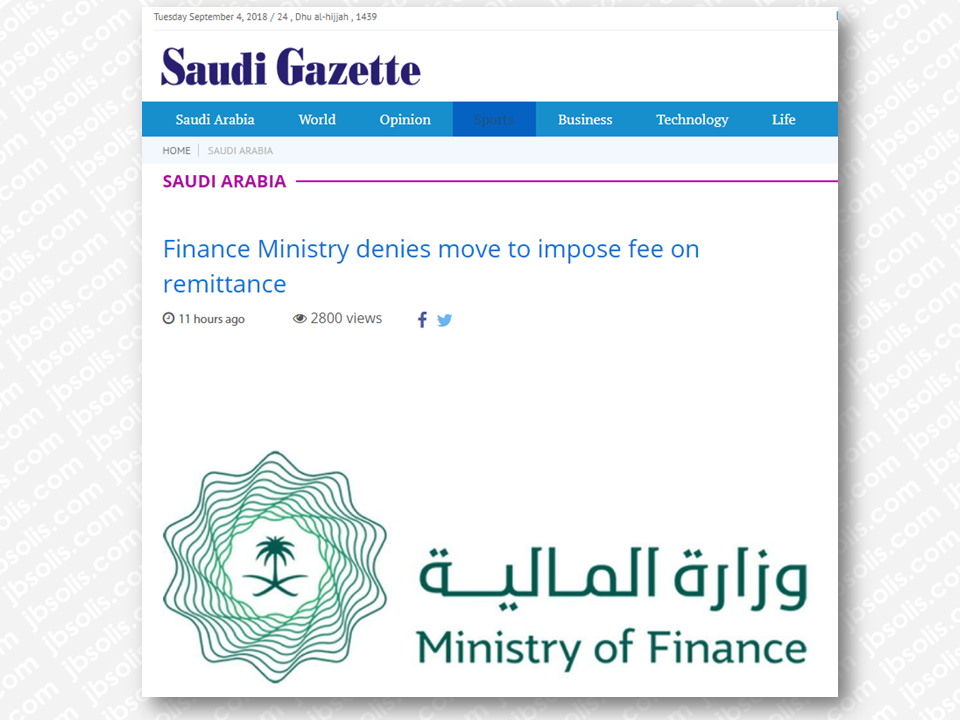
KSA Denies Imposition Of Fees To Foreign Remittances

The remittances coming from overseas Filipino workers (OFWs) helps the Philippine economy on its feet for decades. Because many Filipinos count on their relatives or family member working abroad for their monthly expenses, particularly those who are working in Saudi Arabia, was worried about a recent news that the Saudi Arabian government will impose taxes on remittances sent by expatriates including thousands of OFWs in the Gulf region.

The remittances coming from overseas Filipino workers (OFWs) helps the Philippine economy on its feet for decades. Because many Filipinos count on their relatives or family member working abroad for their monthly expenses, particularly those who are working in Saudi Arabia, was worried about a recent news that the Saudi Arabian government will impose taxes on remittances sent by expatriates including thousands of OFWs in the Gulf region.      Ads     Sponsored Links       The Ministry of Finance has denied rumors with regard to the imposition of fees on remittance by foreign workers.   “Referring to what has been circulated by some media about the proposal to impose fees on remittance by foreign workers, the Ministry of Finance categorically denies this and affirms the commitment to support the free movement of capital through official channels in accordance with the best international standards and practices,” the ministry said in a statement carried by the Saudi Press Agency.  The statement noted that the ministry aims by this to boost investor confidence in the economy and achieve further growth of the economy within the framework of the Kingdom’s Vision 2030 so as to enhance the competitiveness of the economy and its attractiveness to foreign investments.  It is to be noted that the ministry spokesman had denied in January 2017 a similar report about the move to impose a fee on foreign remittance.

Ads

The remittances coming from overseas Filipino workers (OFWs) helps the Philippine economy on its feet for decades. Because many Filipinos count on their relatives or family member working abroad for their monthly expenses, particularly those who are working in Saudi Arabia, was worried about a recent news that the Saudi Arabian government will impose taxes on remittances sent by expatriates including thousands of OFWs in the Gulf region.      Ads     Sponsored Links       The Ministry of Finance has denied rumors with regard to the imposition of fees on remittance by foreign workers.   “Referring to what has been circulated by some media about the proposal to impose fees on remittance by foreign workers, the Ministry of Finance categorically denies this and affirms the commitment to support the free movement of capital through official channels in accordance with the best international standards and practices,” the ministry said in a statement carried by the Saudi Press Agency.  The statement noted that the ministry aims by this to boost investor confidence in the economy and achieve further growth of the economy within the framework of the Kingdom’s Vision 2030 so as to enhance the competitiveness of the economy and its attractiveness to foreign investments.  It is to be noted that the ministry spokesman had denied in January 2017 a similar report about the move to impose a fee on foreign remittance.
Sponsored Links


The Ministry of Finance has denied rumors with regard to the imposition of fees on remittance by foreign workers.

“Referring to what has been circulated by some media about the proposal to impose fees on remittance by foreign workers, the Ministry of Finance categorically denies this and affirms the commitment to support the free movement of capital through official channels in accordance with the best international standards and practices,” the ministry said in a statement carried by the Saudi Press Agency.

The statement noted that the ministry aims by this to boost investor confidence in the economy and achieve further growth of the economy within the framework of the Kingdom’s Vision 2030 so as to enhance the competitiveness of the economy and its attractiveness to foreign investments.

It is to be noted that the ministry spokesman had denied in January 2017 a similar report about the move to impose a fee on foreign remittance. 
The remittances coming from overseas Filipino workers (OFWs) helps the Philippine economy on its feet for decades. Because many Filipinos count on their relatives or family member working abroad for their monthly expenses, particularly those who are working in Saudi Arabia, was worried about a recent news that the Saudi Arabian government will impose taxes on remittances sent by expatriates including thousands of OFWs in the Gulf region.      Ads     Sponsored Links       The Ministry of Finance has denied rumors with regard to the imposition of fees on remittance by foreign workers.   “Referring to what has been circulated by some media about the proposal to impose fees on remittance by foreign workers, the Ministry of Finance categorically denies this and affirms the commitment to support the free movement of capital through official channels in accordance with the best international standards and practices,” the ministry said in a statement carried by the Saudi Press Agency.  The statement noted that the ministry aims by this to boost investor confidence in the economy and achieve further growth of the economy within the framework of the Kingdom’s Vision 2030 so as to enhance the competitiveness of the economy and its attractiveness to foreign investments.  It is to be noted that the ministry spokesman had denied in January 2017 a similar report about the move to impose a fee on foreign remittance.
Filed under remittances, overseas Filipino workers, economy, Saudi Arabia, taxes on remittances, expatriates,  Gulf region
Ads

Read More:
One of the many problems encountered by overseas Filipino workers (OFW) prior to their deployment is the high placement fees collected by recruitment agencies aside from processing and medical fees and other expenses in securing various documents in applying for overseas jobs. For that reason, they are forced to sell their properties or to avail loans even on a high interest rate. But for the OFW caregivers who are applying for deployment to Israel, the placement fees will become lower as a new bilateral agreement is being forged between the two countries.     Ads  EMBED VIDEO HERE  Sponsored Links  Filipinos wanting to work as caregivers in Israel would no longer have to pay high placement fees as the governments of Israel and the Philippines are expected to forge a bilateral labor agreement during President Rodrigo R. Duterte’s state visit on September 2-5.  Philippine Ambassador to the State of Israel Nathaniel Imperial said the labor cooperation agreement will “hopefully ensure that the exploitative placement fees that are being charged to our workers would be substantially reduced, if not, eliminated.”    “It will be a government to government agreement. So private recruitment agencies will no longer be involved in the recruitment process,” Imperial said in an interview with Radio Television Malacañang at the Philippine Embassy in Tel Aviv, Israel on August 30.  Aside from the labor and business agreements, Imperial said the Philippine Embassy has identified several areas of cooperation that will be pursued during the President’s visit.  “One is in science and technology. Israel, as you know, is known as the start-up nation. It is known for its innovation and its very advanced software and technology. And this is something that we can learn from and that we can partner with Israel,” he said.  Over the last few years, he said, the Philippines has broadened the areas of labor cooperation with Israel, which is home to 29,000 Filipino workers and residents.  “Around 24,000 of them are caregivers taking care of the elderly in Israel and disabled children. And so in a way, you can say that we are helping Israel cope with an aging population,” he said.  Imperial also took pride in saying that labor conditions in Israel are some of the best in the Middle East.  “Workers here receive the highest minimum wage in all of the Middle East. And they have days off, they have the right to worship and practice their faith,” he added. “And as you know this is the Holy Land. It’s a special place for Filipino Christians and they’re having a very good time here and enjoying their work even though it’s a very difficult and demanding type of work, caregiving.”     Ads  The President, who departed Manila Sunday afternoon for Israel, is expected to meet with the Filipino community (Filcom) at Ramada Hotel in Jerusalem at around 9:30 p.m. (Manila time).  Imperial said Filipinos are looking forward to the meeting because it is a fulfillment of the President’s promise.  “He was supposed to come in May of last year. But because of the Marawi incident, he had to postpone his overseas travel,” he said.  Because of the limitations of space though, only around 1,400 Filipinos will be able to meet with President Duterte at the Filcom event venue.  Imperial said Filipinos in Israel are fortunate because President Duterte’s visit is the first by a sitting Philippine president since the formal establishment of diplomatic ties 61 years ago.  He said the enduring friendship between Israelis and Filipinos actually started in the late 1930s.  “In 2009, the Philippine embassy together with the Israeli government dedicated a monument in the city of Rishon Lezion called the Open Doors monument to commemorate the humanitarian assistance provided by the Philippines to Jewish refugees escaping the Holocaust in the late 1930s,” he said.    He added that then President Manuel Quezon allowed the entry of around 1,300 Jewish refugees and that monument has attracted a lot of attention from Israeli and Filipino tourists.
uying real property can be considered among very important investments for an overseas Filipino worker (OFW) must have. having your own house and lot is a big accomplishment in a life of OFWs regardless of how big it is or its location or if you bought it cold cash or through a mortgage loan. To own a real property, it is important that you secure proper documentation. You need to be issued a land title as a proof of ownership. But what if your title was lost or damaged no matter how safe you keep it?  That is why the Land Registration Administration urges every Filipinos to enjoy the benefit and convenience of converting their paper land titles to electronic titles also known as the eTitle.      Ads     Sponsored Links     The Philippine Embassy in UAE on Tuesday, August 28, encouraged overseas Filipino workers (OFWs) in the UAE to convert their physical copy of land titles to e-titles or the digital version of land titles.    Under the Land Regulatory Authority’s (LRA) Land Titling Conversion Project, original titles in the Registry of Deeds are now stored in digital databases while the landowner’s duplicate copies of land title can now be converted to e-titles.    In a video uploaded by LRA, physical copies of land titles are prone to get lost, production of multiple fake copies, fire, and other natural disasters that may damage the physical copies. Landowners will also no longer need to pay hefty fees in securing another copy of the land title when their duplicate copies are lost.    Moreover, e-titles also have security features to further protect the legitimacy of the land title.    Landowners need to bring their duplicate land title copies and other required documents to the Registry of Deeds or nearest satellite office. The LRA personnel will then compare the duplicate copy to the original copy stored in their database.    Once validated, the physical copy will then be converted to e-titles for a minimal fee. The e-title will be available for pick-up after a few days.   The Land Registration Authority has been implementing the Voluntary Title Standardization Program. It provides title owners the option to upgrade manually-issued titles to “eTitles”, which are issued by LRA’s new Computerized System.  LRA’s Computerized System was developed as part of the agency’s Land Titling Computerization Project, which aims, among others, to:  1. Maintain on-line information on titles that is current, complete and accurate. 2. Maintain the security and integrity of records by safeguarding these from tampering or destruction and deter substitution or insertion of questionable data, in paper or digital form; and 3. Provide a system of timely detection and identification of fake land titles which will assist in the identification of persons responsible, therefore.  How Do You Convert Your Land Title to eTitle?  Bring your owner’s duplicate title and other required documents to the registry of deeds or the nearest satellite office. The LRA personnel will match the duplicate copy to the original to validate authenticity.  Once validated, the conversion process of your manual title to eTitle will commence. And after a few days, your owner’s duplicate eTitle will be ready for pick-up–all for a price of a movie date.  So start enjoying the convenience of a tamper-proof, destruction-proof, lost-proof original eTitle and the security of an owner’s duplicate eTitle. Start converting today!”  Why do you need to convert your paper land title to eTitle?  Both original and duplicate titles are made of paper and these can be faked, lost, or misplaced, or destroyed by wear and tear, fire, and natural disasters.  The answer is land title conversion to eTitle. The LRA has embarked on the eTitling Conversion Project. Original titles in the Registry of Deeds Vaults are now digitzed and stored in the computer database while owners’ duplicate copy of title can now be converted to eTitles.  eTitles are immune from the dangers paper titles are exposed to. Landowners are also spared from the expensive and tedious reconstitution process whenever the original titles are lost or destroyed.  Ads    With the use of technology, the eTitle now empowers the LRA to further improve its delivery of services. eTitles also address the risk management requirements of banks and other institutions. Convert your titles! While the LRA is doing its part, you must also do your share as a landowner.  Filed under real property, investments, overseas Filipino worker (OFW), mortgage loan, land title, Land Registration Administration, Filipinos electronic title, eTitles

Modern technology can be useful in making human lives easier. In this age where everything has corresponding applications whether you are using an Android or an iOs platform in your mobile device or smartphone, there is an application that suits your needs.  You can even handle your finances using an app as a guide if you are not adept at money management. There are also apps for investing and availing loans.      Advertisement    Mint  Hands down, the free Mint app from Intuit Inc. (INTU) – the name behind QuickBooks and TurboTax – is an effective all-in-one resource for creating a budget, tracking your spending and getting smart about your money. You can connect all your bank and credit card accounts, as well as all your monthly bills, so all your finances are in one convenient place – no more logging into multiple sites.  Mint lets you know when bills are due, what you owe and what you can pay. The app can also send you payment reminders so you can avoid late fees. Based on your spending habits, Mint even gives you specific advice to gain more control over your budget. The free credit score is a nice bonus, too.   Special features: Shows your real-time credit score This app is for you if: You want to know how much money you have at any given time across multiple accounts and cards.    You Need a Budget: Best app for getting out of debt  You Need a Budget (YNAB to enthusiasts) is unlike any other budgeting app you've used before. YNAB helps you stop living paycheck to paycheck, pay down debt and "roll with the punches" if something unexpected comes up. It's built around a fairly simple principle – every dollar has a job.  You Need a Budget doesn't let you create budgets around money you don't have – it forces you to live within your actual income. If you get off track (and who doesn't occasionally?), YNAB helps you see what you need to do differently to balance your budget. The built-in "accountability partner" keeps you on your toes. Although users pay a small monthly or annual fee for YNAB, the service and support are worth it. Online classes with a live instructor for Q&A to help you learn budgeting basics are included. In fact, YNAB is so effective that the average user pays off $500 in debt the first month.   Special features: Not only can you set up weekly/monthly budgets (all personal finance apps do that!) but you can also set up budgets or individual projects, like "Christmas gifts 2018."  This app is for you if: Every other attempt you've made to get your budget in check has left you frustrated and hopeless.  Acorns: Best app for painless saving  Want to harness the benefits of automating good financial behavior? If that sounds complicated, the Acorns app decidedly isn't. Basically, every time you make a purchase with a card connected to the app, Acorns rounds it up to the next highest dollar and automatically invests the difference in a portfolio of low-cost exchange-traded funds (ETFs) that you select based on your risk preference. Acorns put your pocket change to work in an utterly painless way – users say that they never even notice the difference. Wouldn't you love to find an extra $300 or $500 or even $1,500 in your investment account each year? The service is free to college students and charges just $1 per month for pretty much everyone else.  Special features: You can set up your Acorn app to automatically invest your savings without your even knowing about it  This app is for you if: You have never owned a share of stock because you thought you didn't have enough money to invest.  Coinbase: Best app for trading Bitcoin ... and Ethereum, and Bitcoin Cash.  If you only want one app for trading Bitcoin, Coinbase is a good start. The app is a stripped down version of the desktop version. If you're worried about ease of use, the app might be even better for some people than the desktop version, due to the simple interface.  As with the desktop version, purchase limits are capped at $9500 per month for the first-tier user. You can raise that cap to $25,000 if you are willing to provide additional proof of identification, by uploading your passport or other personal documents.  Special features: You can set up price alerts in advance so that you know when your target sell/buy price has been met.  This app is for you if: You want to get started buying and selling bitcoin, or sending it to friends.   Ads   Wally: Best app for tracking expenses  If you're the sort of person who'd love to be as organized with personal expense tracking as you are with your expense reports at work, you'll love the totally free Wally app. Instead of manually logging your expenses at the end of the day (or week or month), Wally lets you simply take a photo of your receipts. And if you use geo-location on your device, it even fills in that info, saving you several steps.  Wally is a clean, streamlined app that's extremely convenient and easy to use. It's a great choice if you'd like more insight into where your money is going.   Special features: You can take a photo of your receipts instead of manually entering numbers. Less typing=less fat-fingering errors.  This app is for you if: Your previous attempts to track expenses were abandoned within a month because you hated typing stuff.  Tycoon: Best app for models (and other freelancers)  Tycoon was founded by supermodel Jess Perez, who modeled for Victoria's Secret and Sports Illustrated's famous Swimsuit Edition. Perez noticed that models, as with all freelancers, were often paid very late for their work - sometimes months or even years after the contractually required payment period. Late payments are easy to forget, which makes it that much harder for freelancers to chase after clients who owe them money.  According to Perez, the most common job descriptions for users of her app are photographers, developers, contractors, and models.   Special features: Tycoon App is catered to a freelancer's special needs, such as calculating take-home pay minus agent commission so you can decide whether or not to even accept a gig. It also makes it easy to see at a glance which clients have not paid you yet.  This app is for you if: You want to decide whether it's worth it for you to take a certain freelance gig. Time, after all, is money.   Cashalo  This mobile app allows you to make a loan through your smartphone and you can get the result in about 30 minutes only. To know more about this app, click here.   Venmo: Best payment app for splitting the cost of a pizza with friends  Venmo was acquired by Paypal in 2013 for $800 million. The app similar to PayPal, but, in the words of the official site, "is unique in that Venmo allows users to share and like payments and purchases through a social feed. The service is popular with the millennial generation."   If you want someone to pay you, you send them your personal QR code so they can add you as a recipient. The limit for transactions is $299.99 in a given week. If you set up for authorized merchants payments, your limit for sending funds is $2999.99 weekly.  Special features: If you choose, you can share your transactions with your friends or even the whole Venmo-using world.  This app is for you if: You are the type of person to share your Fitbit running data on your social media feed.  Home Budget  Every OFW spouse must have this app. Home Budget is designed to track bills, expenses, account balances, and everything else related to home budgeting. There are also graphs and charts to show you whether or not your spouse is exceeding the monthly budget you set.  Similar to other apps, Home Budget is also free and available to iOS and Android users.  Robinhood: Best investing app for the 99%  Robinhood is a game-changing investing app with a very unique and unbeatable feature: transactions are free. (They make money by upselling premium services like margin trading). It's also one of the very first personal investing apps to offer Bitcoin trading capabilities. Founded by Vlad Tenev and Baiju Bhatt - former roommates at Stanford University - the app is something of a Cinderella story. They were turned down by 75 VC investors before finally securing funding.   Special features: "Cards" appear on your screen to give you real-time news alerts and market information. They sound intrusive but they're actually helpful, and you can customize them or opt out altogether.  This app is for you if: You like free stuff and you're brand-new to investing. Ads  Ipon: 52 Weeks Challenge  52 weeks challenge is popular every start of the year. It gives you an idea of how much you can have at the end of the year when you set aside a specific amount every week. In case you are having a hard time sticking to your saving commitment, then this app could help.  Available to Android users, this app helps you set your financial goal and make sure you stick to a schedule. It also helps you keep track of how much you have, shows you a progress record, and sends you reminders in case it’s time to set aside the amount you promised to save. Don’t worry. This one is free as well. Filed under applications, Android,  iOs, money management,  app, mobile device,  investing,  loans  Read More:  What is the main reason why many Filipinos decided to leave their beloved family behind and work abroad? It is to earn more in order to be able to give their family the best possible future they can give. To buy the things they need, to have their own house to call their home, etc. The overseas Filipino workers  (OFW) are usually breadwinners supporting even their extended families as well. The remittances the OFWs send to their loved ones used to be enough to pay their bills, mortgages and even a little extra for them to go to the mall and enjoy. Today, the families of the OFWs are experiencing difficulty in stretching their budget for the whole month due to the high prices of everything. From basic commodities, transport fares, school supplies, etc.        Advertisement  Godofredo's wife is an OFW in Malaysia. She needed to work there because the family cannot rely on his salary as a "barangay tanod" alone. They use the remittances they receive from his OFW wife for the education of their children, while his salary from his local job is used to pay their electric and water bills.   Gina also experienced difficulty in making ends meet and forced to transfer her children to a public school because the remittances sent by her OFW husband is not enough anymore for their expenses.  The remittances sent by OFWs abroad is considered the redeeming grace for the Philippine economy by helping stabilize the country's dollar reserve.    Ads   The Bangko Sentral ng Pilipinas (BSP) said that the OFW remittances had been slowing down and this year was the slowest flow of cash remittances in the past seventeen years. It is due to the repatriation program of the government, according to the BSP.  From $13.8 Billion from January to June last year, OFW remittances had slightly gone up to $14.2 Billion at the same period this year.  The government said headline inflation rate went up to 4.6 % in May as compared to 2.9%  last year mainly caused by price increases in fish and seafood, fuel, lubricants, bread, and cereals. Average inflation at 4.1 %, higher than the government’s 2 - 4 % target for 2018. Due to the price hike, OFWs are encouraged to send at least 20% more of their usual remittance for their family to cope up with the experienced inflation, at least until the prices stabilized.    Ads  While OFWs do their best to provide for heir family back home, the latter also need to learn to value their sacrifices and hardships by spending the remittances wisely. It is important for them to know how to spend the remittances wisely as a way of helping their beloved OFW.   What is the main reason why many Filipinos decided to leave their beloved family behind and work abroad? It is to earn more in order to be able to give their family the best possible future they can give. To buy the things they need, to have their own house to call their home, etc. The overseas Filipino workers  (OFW) are usually breadwinners supporting even their extended families as well. The remittances the OFWs send to their loved ones used to be enough to pay their bills, mortgages and even a little extra for them to go to the mall and enjoy. Today, the families of the OFWs are experiencing difficulty in stretching their budget for the whole month due to the high prices of everything. From basic commodities, transport fares, school supplies, etc.        Advertisement  Godofredo's wife is an OFW in Malaysia. She needed to work there because the family cannot rely on his salary as a "barangay tanod" alone. They use the remittances they receive from his OFW wife for the education of their children, while his salary from his local job is used to pay their electric and water bills.   Gina also experienced difficulty in making ends meet and forced to transfer her children to a public school because the remittances sent by her OFW husband is not enough anymore for their expenses.  The remittances sent by OFWs abroad is considered the redeeming grace for the Philippine economy by helping stabilize the country's dollar reserve.    Ads   The Bangko Sentral ng Pilipinas (BSP) said that the OFW remittances had been slowing down and this year was the slowest flow of cash remittances in the past seventeen years. It is due to the repatriation program of the government, according to the BSP.  From $13.8 Billion from January to June last year, OFW remittances had slightly gone up to $14.2 Billion at the same period this year.  The government said headline inflation rate went up to 4.6 % in May as compared to 2.9%  last year mainly caused by price increases in fish and seafood, fuel, lubricants, bread, and cereals. Average inflation at 4.1 %, higher than the government’s 2 - 4 % target for 2018. Due to the price hike, OFWs are encouraged to send at least 20% more of their usual remittance for their family to cope up with the experienced inflation, at least until the prices stabilized.    Ads  While OFWs do their best to provide for heir family back home, the latter also need to learn to value their sacrifices and hardships by spending the remittances wisely. It is important for them to know how to spend the remittances wisely as a way of helping their beloved OFW.  What is the main reason why many Filipinos decided to leave their beloved family behind and work abroad? It is to earn more in order to be able to give their family the best possible future they can give. To buy the things they need, to have their own house to call their home, etc. The overseas Filipino workers  (OFW) are usually breadwinners supporting even their extended families as well. The remittances the OFWs send to their loved ones used to be enough to pay their bills, mortgages and even a little extra for them to go to the mall and enjoy. Today, the families of the OFWs are experiencing difficulty in stretching their budget for the whole month due to the high prices of everything. From basic commodities, transport fares, school supplies, etc.        Advertisement  Godofredo's wife is an OFW in Malaysia. She needed to work there because the family cannot rely on his salary as a "barangay tanod" alone. They use the remittances they receive from his OFW wife for the education of their children, while his salary from his local job is used to pay their electric and water bills.   Gina also experienced difficulty in making ends meet and forced to transfer her children to a public school because the remittances sent by her OFW husband is not enough anymore for their expenses.  The remittances sent by OFWs abroad is considered the redeeming grace for the Philippine economy by helping stabilize the country's dollar reserve.    Ads   The Bangko Sentral ng Pilipinas (BSP) said that the OFW remittances had been slowing down and this year was the slowest flow of cash remittances in the past seventeen years. It is due to the repatriation program of the government, according to the BSP.  From $13.8 Billion from January to June last year, OFW remittances had slightly gone up to $14.2 Billion at the same period this year.  The government said headline inflation rate went up to 4.6 % in May as compared to 2.9%  last year mainly caused by price increases in fish and seafood, fuel, lubricants, bread, and cereals. Average inflation at 4.1 %, higher than the government’s 2 - 4 % target for 2018. Due to the price hike, OFWs are encouraged to send at least 20% more of their usual remittance for their family to cope up with the experienced inflation, at least until the prices stabilized.    Ads  While OFWs do their best to provide for heir family back home, the latter also need to learn to value their sacrifices and hardships by spending the remittances wisely. It is important for them to know how to spend the remittances wisely as a way of helping their beloved OFW.  What is the main reason why many Filipinos decided to leave their beloved family behind and work abroad? It is to earn more in order to be able to give their family the best possible future they can give. To buy the things they need, to have their own house to call their home, etc. The overseas Filipino workers  (OFW) are usually breadwinners supporting even their extended families as well. The remittances the OFWs send to their loved ones used to be enough to pay their bills, mortgages and even a little extra for them to go to the mall and enjoy. Today, the families of the OFWs are experiencing difficulty in stretching their budget for the whole month due to the high prices of everything. From basic commodities, transport fares, school supplies, etc.        Advertisement  Godofredo's wife is an OFW in Malaysia. She needed to work there because the family cannot rely on his salary as a "barangay tanod" alone. They use the remittances they receive from his OFW wife for the education of their children, while his salary from his local job is used to pay their electric and water bills.   Gina also experienced difficulty in making ends meet and forced to transfer her children to a public school because the remittances sent by her OFW husband is not enough anymore for their expenses.  The remittances sent by OFWs abroad is considered the redeeming grace for the Philippine economy by helping stabilize the country's dollar reserve.    Ads   The Bangko Sentral ng Pilipinas (BSP) said that the OFW remittances had been slowing down and this year was the slowest flow of cash remittances in the past seventeen years. It is due to the repatriation program of the government, according to the BSP.  From $13.8 Billion from January to June last year, OFW remittances had slightly gone up to $14.2 Billion at the same period this year.  The government said headline inflation rate went up to 4.6 % in May as compared to 2.9%  last year mainly caused by price increases in fish and seafood, fuel, lubricants, bread, and cereals. Average inflation at 4.1 %, higher than the government’s 2 - 4 % target for 2018. Due to the price hike, OFWs are encouraged to send at least 20% more of their usual remittance for their family to cope up with the experienced inflation, at least until the prices stabilized.    Ads  While OFWs do their best to provide for heir family back home, the latter also need to learn to value their sacrifices and hardships by spending the remittances wisely. It is important for them to know how to spend the remittances wisely as a way of helping their beloved OFW.  ©2018 THOUGHTSKOTO

Monday, September 03, 2018

How To Train Your Brain Not To Worry

It is normal for every human being to worry about things such as finances like where will you get money to pay for your loans, mortgages, and bills, your future, your health and almost everything under the sun. Overthinking causes worrying and anxiety and affect our overall health. The good thing is that experts said that humans can train their brains not to worry too much and shared some ways to avoid it.

It is normal for every human being to worry about things such as finances like where will you get money to pay for your loans, mortgages, and bills, your future, your health and almost everything under the sun. Overthinking causes worrying and anxiety and affect our overall health. The good thing is that experts said that humans can train their brains not to worry too much and shared some ways to avoid it.     Ads    Sponsored Links   Excessive worrying negatively affects the mental health of a person. Although many believe that worrying helps you assess things as a reference to make your future better, its effects could be alarming.     Experts gave some tips on how to train your brain to stop worrying.     Write it all down  Experts say that if you scribble down all your worries, it will help your brain to relax by literally unloading it in writing.  Researchers now have evidence that chronic worriers may be chronic problem-avoiders too. The scientists say, "When participants’ problem elaborations were rated for concreteness, both studies showed an inverse relationship between the degree of worry and concreteness." It is telling your brain not to think about it anymore and start making a solution.    Meditate   Meditation for a worry-free brain is beneficial for your worrisome brain. Even a 30-second break for your brain can bring positive results. According to experts, meditation helps solve cognitive anxiety. A few seconds of making your brain isolated from outside stress could help it train to stop worrying too much.   Ads    Exercise  Working out benefits not only your body but your brain as well.  Worrying causes a similar reaction to an adrenalin rush in your brain. It decides whether to activate the flight-or-fight system. When your body is active and far from any physical stress, the brain perceives that there is nothing to worry about because your body is active and ready.  It also a good way to lower the blood pressure which is a major factor of stress. If you feel worried, you can take a small walk outside to help your brain relax.  Filed under human being, finances,  your loans, mortgages, bills, health, worrying,
Ads

Sponsored Links

 Excessive worrying negatively affects the mental health of a person. Although many believe that worrying helps you assess things as a reference to make your future better, its effects could be alarming.

 Experts gave some tips on how to train your brain to stop worrying. 

Write it all down
Experts say that if you scribble down all your worries, it will help your brain to relax by literally unloading it in writing.
Researchers now have evidence that chronic worriers may be chronic problem-avoiders too. The scientists say, "When participants’ problem elaborations were rated for concreteness, both studies showed an inverse relationship between the degree of worry and concreteness."It is telling your brain not to think about it anymore and start making a solution.
It is normal for every human being to worry about things such as finances like where will you get money to pay for your loans, mortgages, and bills, your future, your health and almost everything under the sun. Overthinking causes worrying and anxiety and affect our overall health. The good thing is that experts said that humans can train their brains not to worry too much and shared some ways to avoid it.     Ads    Sponsored Links   Excessive worrying negatively affects the mental health of a person. Although many believe that worrying helps you assess things as a reference to make your future better, its effects could be alarming.     Experts gave some tips on how to train your brain to stop worrying.     Write it all down  Experts say that if you scribble down all your worries, it will help your brain to relax by literally unloading it in writing.  Researchers now have evidence that chronic worriers may be chronic problem-avoiders too. The scientists say, "When participants’ problem elaborations were rated for concreteness, both studies showed an inverse relationship between the degree of worry and concreteness." It is telling your brain not to think about it anymore and start making a solution.    Meditate   Meditation for a worry-free brain is beneficial for your worrisome brain. Even a 30-second break for your brain can bring positive results. According to experts, meditation helps solve cognitive anxiety. A few seconds of making your brain isolated from outside stress could help it train to stop worrying too much.   Ads    Exercise  Working out benefits not only your body but your brain as well.  Worrying causes a similar reaction to an adrenalin rush in your brain. It decides whether to activate the flight-or-fight system. When your body is active and far from any physical stress, the brain perceives that there is nothing to worry about because your body is active and ready.  It also a good way to lower the blood pressure which is a major factor of stress. If you feel worried, you can take a small walk outside to help your brain relax.  Filed under human being, finances,  your loans, mortgages, bills, health, worrying,
Meditate 
Meditation for a worry-free brain is beneficial for your worrisome brain. Even a 30-second break for your brain can bring positive results. According to experts, meditation helps solve cognitive anxiety. A few seconds of making your brain isolated from outside stress could help it train to stop worrying too much.
Ads

It is normal for every human being to worry about things such as finances like where will you get money to pay for your loans, mortgages, and bills, your future, your health and almost everything under the sun. Overthinking causes worrying and anxiety and affect our overall health. The good thing is that experts said that humans can train their brains not to worry too much and shared some ways to avoid it.     Ads    Sponsored Links   Excessive worrying negatively affects the mental health of a person. Although many believe that worrying helps you assess things as a reference to make your future better, its effects could be alarming.     Experts gave some tips on how to train your brain to stop worrying.     Write it all down  Experts say that if you scribble down all your worries, it will help your brain to relax by literally unloading it in writing.  Researchers now have evidence that chronic worriers may be chronic problem-avoiders too. The scientists say, "When participants’ problem elaborations were rated for concreteness, both studies showed an inverse relationship between the degree of worry and concreteness." It is telling your brain not to think about it anymore and start making a solution.    Meditate   Meditation for a worry-free brain is beneficial for your worrisome brain. Even a 30-second break for your brain can bring positive results. According to experts, meditation helps solve cognitive anxiety. A few seconds of making your brain isolated from outside stress could help it train to stop worrying too much.   Ads    Exercise  Working out benefits not only your body but your brain as well.  Worrying causes a similar reaction to an adrenalin rush in your brain. It decides whether to activate the flight-or-fight system. When your body is active and far from any physical stress, the brain perceives that there is nothing to worry about because your body is active and ready.  It also a good way to lower the blood pressure which is a major factor of stress. If you feel worried, you can take a small walk outside to help your brain relax.  Filed under human being, finances,  your loans, mortgages, bills, health, worrying,
Exercise
Working out benefits not only your body but your brain as well.
Worrying causes a similar reaction to an adrenalin rush in your brain. It decides whether to activate the flight-or-fight system. When your body is active and far from any physical stress, the brain perceives that there is nothing to worry about because your body is active and ready.
It also a good way to lower the blood pressure which is a major factor of stress. If you feel worried, you can take a small walk outside to help your brain relax.
Filed under human being, finances,  your loans, mortgages, bills, health, worrying,  
Read More:
One of the many problems encountered by overseas Filipino workers (OFW) prior to their deployment is the high placement fees collected by recruitment agencies aside from processing and medical fees and other expenses in securing various documents in applying for overseas jobs. For that reason, they are forced to sell their properties or to avail loans even on a high interest rate. But for the OFW caregivers who are applying for deployment to Israel, the placement fees will become lower as a new bilateral agreement is being forged between the two countries.     Ads  EMBED VIDEO HERE  Sponsored Links  Filipinos wanting to work as caregivers in Israel would no longer have to pay high placement fees as the governments of Israel and the Philippines are expected to forge a bilateral labor agreement during President Rodrigo R. Duterte’s state visit on September 2-5.  Philippine Ambassador to the State of Israel Nathaniel Imperial said the labor cooperation agreement will “hopefully ensure that the exploitative placement fees that are being charged to our workers would be substantially reduced, if not, eliminated.”    “It will be a government to government agreement. So private recruitment agencies will no longer be involved in the recruitment process,” Imperial said in an interview with Radio Television Malacañang at the Philippine Embassy in Tel Aviv, Israel on August 30.  Aside from the labor and business agreements, Imperial said the Philippine Embassy has identified several areas of cooperation that will be pursued during the President’s visit.  “One is in science and technology. Israel, as you know, is known as the start-up nation. It is known for its innovation and its very advanced software and technology. And this is something that we can learn from and that we can partner with Israel,” he said.  Over the last few years, he said, the Philippines has broadened the areas of labor cooperation with Israel, which is home to 29,000 Filipino workers and residents.  “Around 24,000 of them are caregivers taking care of the elderly in Israel and disabled children. And so in a way, you can say that we are helping Israel cope with an aging population,” he said.  Imperial also took pride in saying that labor conditions in Israel are some of the best in the Middle East.  “Workers here receive the highest minimum wage in all of the Middle East. And they have days off, they have the right to worship and practice their faith,” he added. “And as you know this is the Holy Land. It’s a special place for Filipino Christians and they’re having a very good time here and enjoying their work even though it’s a very difficult and demanding type of work, caregiving.”     Ads  The President, who departed Manila Sunday afternoon for Israel, is expected to meet with the Filipino community (Filcom) at Ramada Hotel in Jerusalem at around 9:30 p.m. (Manila time).  Imperial said Filipinos are looking forward to the meeting because it is a fulfillment of the President’s promise.  “He was supposed to come in May of last year. But because of the Marawi incident, he had to postpone his overseas travel,” he said.  Because of the limitations of space though, only around 1,400 Filipinos will be able to meet with President Duterte at the Filcom event venue.  Imperial said Filipinos in Israel are fortunate because President Duterte’s visit is the first by a sitting Philippine president since the formal establishment of diplomatic ties 61 years ago.  He said the enduring friendship between Israelis and Filipinos actually started in the late 1930s.  “In 2009, the Philippine embassy together with the Israeli government dedicated a monument in the city of Rishon Lezion called the Open Doors monument to commemorate the humanitarian assistance provided by the Philippines to Jewish refugees escaping the Holocaust in the late 1930s,” he said.    He added that then President Manuel Quezon allowed the entry of around 1,300 Jewish refugees and that monument has attracted a lot of attention from Israeli and Filipino tourists.
uying real property can be considered among very important investments for an overseas Filipino worker (OFW) must have. having your own house and lot is a big accomplishment in a life of OFWs regardless of how big it is or its location or if you bought it cold cash or through a mortgage loan. To own a real property, it is important that you secure proper documentation. You need to be issued a land title as a proof of ownership. But what if your title was lost or damaged no matter how safe you keep it?  That is why the Land Registration Administration urges every Filipinos to enjoy the benefit and convenience of converting their paper land titles to electronic titles also known as the eTitle.      Ads     Sponsored Links     The Philippine Embassy in UAE on Tuesday, August 28, encouraged overseas Filipino workers (OFWs) in the UAE to convert their physical copy of land titles to e-titles or the digital version of land titles.    Under the Land Regulatory Authority’s (LRA) Land Titling Conversion Project, original titles in the Registry of Deeds are now stored in digital databases while the landowner’s duplicate copies of land title can now be converted to e-titles.    In a video uploaded by LRA, physical copies of land titles are prone to get lost, production of multiple fake copies, fire, and other natural disasters that may damage the physical copies. Landowners will also no longer need to pay hefty fees in securing another copy of the land title when their duplicate copies are lost.    Moreover, e-titles also have security features to further protect the legitimacy of the land title.    Landowners need to bring their duplicate land title copies and other required documents to the Registry of Deeds or nearest satellite office. The LRA personnel will then compare the duplicate copy to the original copy stored in their database.    Once validated, the physical copy will then be converted to e-titles for a minimal fee. The e-title will be available for pick-up after a few days.   The Land Registration Authority has been implementing the Voluntary Title Standardization Program. It provides title owners the option to upgrade manually-issued titles to “eTitles”, which are issued by LRA’s new Computerized System.  LRA’s Computerized System was developed as part of the agency’s Land Titling Computerization Project, which aims, among others, to:  1. Maintain on-line information on titles that is current, complete and accurate. 2. Maintain the security and integrity of records by safeguarding these from tampering or destruction and deter substitution or insertion of questionable data, in paper or digital form; and 3. Provide a system of timely detection and identification of fake land titles which will assist in the identification of persons responsible, therefore.  How Do You Convert Your Land Title to eTitle?  Bring your owner’s duplicate title and other required documents to the registry of deeds or the nearest satellite office. The LRA personnel will match the duplicate copy to the original to validate authenticity.  Once validated, the conversion process of your manual title to eTitle will commence. And after a few days, your owner’s duplicate eTitle will be ready for pick-up–all for a price of a movie date.  So start enjoying the convenience of a tamper-proof, destruction-proof, lost-proof original eTitle and the security of an owner’s duplicate eTitle. Start converting today!”  Why do you need to convert your paper land title to eTitle?  Both original and duplicate titles are made of paper and these can be faked, lost, or misplaced, or destroyed by wear and tear, fire, and natural disasters.  The answer is land title conversion to eTitle. The LRA has embarked on the eTitling Conversion Project. Original titles in the Registry of Deeds Vaults are now digitzed and stored in the computer database while owners’ duplicate copy of title can now be converted to eTitles.  eTitles are immune from the dangers paper titles are exposed to. Landowners are also spared from the expensive and tedious reconstitution process whenever the original titles are lost or destroyed.  Ads    With the use of technology, the eTitle now empowers the LRA to further improve its delivery of services. eTitles also address the risk management requirements of banks and other institutions. Convert your titles! While the LRA is doing its part, you must also do your share as a landowner.  Filed under real property, investments, overseas Filipino worker (OFW), mortgage loan, land title, Land Registration Administration, Filipinos electronic title, eTitles

Modern technology can be useful in making human lives easier. In this age where everything has corresponding applications whether you are using an Android or an iOs platform in your mobile device or smartphone, there is an application that suits your needs.  You can even handle your finances using an app as a guide if you are not adept at money management. There are also apps for investing and availing loans.      Advertisement    Mint  Hands down, the free Mint app from Intuit Inc. (INTU) – the name behind QuickBooks and TurboTax – is an effective all-in-one resource for creating a budget, tracking your spending and getting smart about your money. You can connect all your bank and credit card accounts, as well as all your monthly bills, so all your finances are in one convenient place – no more logging into multiple sites.  Mint lets you know when bills are due, what you owe and what you can pay. The app can also send you payment reminders so you can avoid late fees. Based on your spending habits, Mint even gives you specific advice to gain more control over your budget. The free credit score is a nice bonus, too.   Special features: Shows your real-time credit score This app is for you if: You want to know how much money you have at any given time across multiple accounts and cards.    You Need a Budget: Best app for getting out of debt  You Need a Budget (YNAB to enthusiasts) is unlike any other budgeting app you've used before. YNAB helps you stop living paycheck to paycheck, pay down debt and "roll with the punches" if something unexpected comes up. It's built around a fairly simple principle – every dollar has a job.  You Need a Budget doesn't let you create budgets around money you don't have – it forces you to live within your actual income. If you get off track (and who doesn't occasionally?), YNAB helps you see what you need to do differently to balance your budget. The built-in "accountability partner" keeps you on your toes. Although users pay a small monthly or annual fee for YNAB, the service and support are worth it. Online classes with a live instructor for Q&A to help you learn budgeting basics are included. In fact, YNAB is so effective that the average user pays off $500 in debt the first month.   Special features: Not only can you set up weekly/monthly budgets (all personal finance apps do that!) but you can also set up budgets or individual projects, like "Christmas gifts 2018."  This app is for you if: Every other attempt you've made to get your budget in check has left you frustrated and hopeless.  Acorns: Best app for painless saving  Want to harness the benefits of automating good financial behavior? If that sounds complicated, the Acorns app decidedly isn't. Basically, every time you make a purchase with a card connected to the app, Acorns rounds it up to the next highest dollar and automatically invests the difference in a portfolio of low-cost exchange-traded funds (ETFs) that you select based on your risk preference. Acorns put your pocket change to work in an utterly painless way – users say that they never even notice the difference. Wouldn't you love to find an extra $300 or $500 or even $1,500 in your investment account each year? The service is free to college students and charges just $1 per month for pretty much everyone else.  Special features: You can set up your Acorn app to automatically invest your savings without your even knowing about it  This app is for you if: You have never owned a share of stock because you thought you didn't have enough money to invest.  Coinbase: Best app for trading Bitcoin ... and Ethereum, and Bitcoin Cash.  If you only want one app for trading Bitcoin, Coinbase is a good start. The app is a stripped down version of the desktop version. If you're worried about ease of use, the app might be even better for some people than the desktop version, due to the simple interface.  As with the desktop version, purchase limits are capped at $9500 per month for the first-tier user. You can raise that cap to $25,000 if you are willing to provide additional proof of identification, by uploading your passport or other personal documents.  Special features: You can set up price alerts in advance so that you know when your target sell/buy price has been met.  This app is for you if: You want to get started buying and selling bitcoin, or sending it to friends.   Ads   Wally: Best app for tracking expenses  If you're the sort of person who'd love to be as organized with personal expense tracking as you are with your expense reports at work, you'll love the totally free Wally app. Instead of manually logging your expenses at the end of the day (or week or month), Wally lets you simply take a photo of your receipts. And if you use geo-location on your device, it even fills in that info, saving you several steps.  Wally is a clean, streamlined app that's extremely convenient and easy to use. It's a great choice if you'd like more insight into where your money is going.   Special features: You can take a photo of your receipts instead of manually entering numbers. Less typing=less fat-fingering errors.  This app is for you if: Your previous attempts to track expenses were abandoned within a month because you hated typing stuff.  Tycoon: Best app for models (and other freelancers)  Tycoon was founded by supermodel Jess Perez, who modeled for Victoria's Secret and Sports Illustrated's famous Swimsuit Edition. Perez noticed that models, as with all freelancers, were often paid very late for their work - sometimes months or even years after the contractually required payment period. Late payments are easy to forget, which makes it that much harder for freelancers to chase after clients who owe them money.  According to Perez, the most common job descriptions for users of her app are photographers, developers, contractors, and models.   Special features: Tycoon App is catered to a freelancer's special needs, such as calculating take-home pay minus agent commission so you can decide whether or not to even accept a gig. It also makes it easy to see at a glance which clients have not paid you yet.  This app is for you if: You want to decide whether it's worth it for you to take a certain freelance gig. Time, after all, is money.   Cashalo  This mobile app allows you to make a loan through your smartphone and you can get the result in about 30 minutes only. To know more about this app, click here.   Venmo: Best payment app for splitting the cost of a pizza with friends  Venmo was acquired by Paypal in 2013 for $800 million. The app similar to PayPal, but, in the words of the official site, "is unique in that Venmo allows users to share and like payments and purchases through a social feed. The service is popular with the millennial generation."   If you want someone to pay you, you send them your personal QR code so they can add you as a recipient. The limit for transactions is $299.99 in a given week. If you set up for authorized merchants payments, your limit for sending funds is $2999.99 weekly.  Special features: If you choose, you can share your transactions with your friends or even the whole Venmo-using world.  This app is for you if: You are the type of person to share your Fitbit running data on your social media feed.  Home Budget  Every OFW spouse must have this app. Home Budget is designed to track bills, expenses, account balances, and everything else related to home budgeting. There are also graphs and charts to show you whether or not your spouse is exceeding the monthly budget you set.  Similar to other apps, Home Budget is also free and available to iOS and Android users.  Robinhood: Best investing app for the 99%  Robinhood is a game-changing investing app with a very unique and unbeatable feature: transactions are free. (They make money by upselling premium services like margin trading). It's also one of the very first personal investing apps to offer Bitcoin trading capabilities. Founded by Vlad Tenev and Baiju Bhatt - former roommates at Stanford University - the app is something of a Cinderella story. They were turned down by 75 VC investors before finally securing funding.   Special features: "Cards" appear on your screen to give you real-time news alerts and market information. They sound intrusive but they're actually helpful, and you can customize them or opt out altogether.  This app is for you if: You like free stuff and you're brand-new to investing. Ads  Ipon: 52 Weeks Challenge  52 weeks challenge is popular every start of the year. It gives you an idea of how much you can have at the end of the year when you set aside a specific amount every week. In case you are having a hard time sticking to your saving commitment, then this app could help.  Available to Android users, this app helps you set your financial goal and make sure you stick to a schedule. It also helps you keep track of how much you have, shows you a progress record, and sends you reminders in case it’s time to set aside the amount you promised to save. Don’t worry. This one is free as well. Filed under applications, Android,  iOs, money management,  app, mobile device,  investing,  loans  Read More:  What is the main reason why many Filipinos decided to leave their beloved family behind and work abroad? It is to earn more in order to be able to give their family the best possible future they can give. To buy the things they need, to have their own house to call their home, etc. The overseas Filipino workers  (OFW) are usually breadwinners supporting even their extended families as well. The remittances the OFWs send to their loved ones used to be enough to pay their bills, mortgages and even a little extra for them to go to the mall and enjoy. Today, the families of the OFWs are experiencing difficulty in stretching their budget for the whole month due to the high prices of everything. From basic commodities, transport fares, school supplies, etc.        Advertisement  Godofredo's wife is an OFW in Malaysia. She needed to work there because the family cannot rely on his salary as a "barangay tanod" alone. They use the remittances they receive from his OFW wife for the education of their children, while his salary from his local job is used to pay their electric and water bills.   Gina also experienced difficulty in making ends meet and forced to transfer her children to a public school because the remittances sent by her OFW husband is not enough anymore for their expenses.  The remittances sent by OFWs abroad is considered the redeeming grace for the Philippine economy by helping stabilize the country's dollar reserve.    Ads   The Bangko Sentral ng Pilipinas (BSP) said that the OFW remittances had been slowing down and this year was the slowest flow of cash remittances in the past seventeen years. It is due to the repatriation program of the government, according to the BSP.  From $13.8 Billion from January to June last year, OFW remittances had slightly gone up to $14.2 Billion at the same period this year.  The government said headline inflation rate went up to 4.6 % in May as compared to 2.9%  last year mainly caused by price increases in fish and seafood, fuel, lubricants, bread, and cereals. Average inflation at 4.1 %, higher than the government’s 2 - 4 % target for 2018. Due to the price hike, OFWs are encouraged to send at least 20% more of their usual remittance for their family to cope up with the experienced inflation, at least until the prices stabilized.    Ads  While OFWs do their best to provide for heir family back home, the latter also need to learn to value their sacrifices and hardships by spending the remittances wisely. It is important for them to know how to spend the remittances wisely as a way of helping their beloved OFW.   What is the main reason why many Filipinos decided to leave their beloved family behind and work abroad? It is to earn more in order to be able to give their family the best possible future they can give. To buy the things they need, to have their own house to call their home, etc. The overseas Filipino workers  (OFW) are usually breadwinners supporting even their extended families as well. The remittances the OFWs send to their loved ones used to be enough to pay their bills, mortgages and even a little extra for them to go to the mall and enjoy. Today, the families of the OFWs are experiencing difficulty in stretching their budget for the whole month due to the high prices of everything. From basic commodities, transport fares, school supplies, etc.        Advertisement  Godofredo's wife is an OFW in Malaysia. She needed to work there because the family cannot rely on his salary as a "barangay tanod" alone. They use the remittances they receive from his OFW wife for the education of their children, while his salary from his local job is used to pay their electric and water bills.   Gina also experienced difficulty in making ends meet and forced to transfer her children to a public school because the remittances sent by her OFW husband is not enough anymore for their expenses.  The remittances sent by OFWs abroad is considered the redeeming grace for the Philippine economy by helping stabilize the country's dollar reserve.    Ads   The Bangko Sentral ng Pilipinas (BSP) said that the OFW remittances had been slowing down and this year was the slowest flow of cash remittances in the past seventeen years. It is due to the repatriation program of the government, according to the BSP.  From $13.8 Billion from January to June last year, OFW remittances had slightly gone up to $14.2 Billion at the same period this year.  The government said headline inflation rate went up to 4.6 % in May as compared to 2.9%  last year mainly caused by price increases in fish and seafood, fuel, lubricants, bread, and cereals. Average inflation at 4.1 %, higher than the government’s 2 - 4 % target for 2018. Due to the price hike, OFWs are encouraged to send at least 20% more of their usual remittance for their family to cope up with the experienced inflation, at least until the prices stabilized.    Ads  While OFWs do their best to provide for heir family back home, the latter also need to learn to value their sacrifices and hardships by spending the remittances wisely. It is important for them to know how to spend the remittances wisely as a way of helping their beloved OFW.  What is the main reason why many Filipinos decided to leave their beloved family behind and work abroad? It is to earn more in order to be able to give their family the best possible future they can give. To buy the things they need, to have their own house to call their home, etc. The overseas Filipino workers  (OFW) are usually breadwinners supporting even their extended families as well. The remittances the OFWs send to their loved ones used to be enough to pay their bills, mortgages and even a little extra for them to go to the mall and enjoy. Today, the families of the OFWs are experiencing difficulty in stretching their budget for the whole month due to the high prices of everything. From basic commodities, transport fares, school supplies, etc.        Advertisement  Godofredo's wife is an OFW in Malaysia. She needed to work there because the family cannot rely on his salary as a "barangay tanod" alone. They use the remittances they receive from his OFW wife for the education of their children, while his salary from his local job is used to pay their electric and water bills.   Gina also experienced difficulty in making ends meet and forced to transfer her children to a public school because the remittances sent by her OFW husband is not enough anymore for their expenses.  The remittances sent by OFWs abroad is considered the redeeming grace for the Philippine economy by helping stabilize the country's dollar reserve.    Ads   The Bangko Sentral ng Pilipinas (BSP) said that the OFW remittances had been slowing down and this year was the slowest flow of cash remittances in the past seventeen years. It is due to the repatriation program of the government, according to the BSP.  From $13.8 Billion from January to June last year, OFW remittances had slightly gone up to $14.2 Billion at the same period this year.  The government said headline inflation rate went up to 4.6 % in May as compared to 2.9%  last year mainly caused by price increases in fish and seafood, fuel, lubricants, bread, and cereals. Average inflation at 4.1 %, higher than the government’s 2 - 4 % target for 2018. Due to the price hike, OFWs are encouraged to send at least 20% more of their usual remittance for their family to cope up with the experienced inflation, at least until the prices stabilized.    Ads  While OFWs do their best to provide for heir family back home, the latter also need to learn to value their sacrifices and hardships by spending the remittances wisely. It is important for them to know how to spend the remittances wisely as a way of helping their beloved OFW.  What is the main reason why many Filipinos decided to leave their beloved family behind and work abroad? It is to earn more in order to be able to give their family the best possible future they can give. To buy the things they need, to have their own house to call their home, etc. The overseas Filipino workers  (OFW) are usually breadwinners supporting even their extended families as well. The remittances the OFWs send to their loved ones used to be enough to pay their bills, mortgages and even a little extra for them to go to the mall and enjoy. Today, the families of the OFWs are experiencing difficulty in stretching their budget for the whole month due to the high prices of everything. From basic commodities, transport fares, school supplies, etc.        Advertisement  Godofredo's wife is an OFW in Malaysia. She needed to work there because the family cannot rely on his salary as a "barangay tanod" alone. They use the remittances they receive from his OFW wife for the education of their children, while his salary from his local job is used to pay their electric and water bills.   Gina also experienced difficulty in making ends meet and forced to transfer her children to a public school because the remittances sent by her OFW husband is not enough anymore for their expenses.  The remittances sent by OFWs abroad is considered the redeeming grace for the Philippine economy by helping stabilize the country's dollar reserve.    Ads   The Bangko Sentral ng Pilipinas (BSP) said that the OFW remittances had been slowing down and this year was the slowest flow of cash remittances in the past seventeen years. It is due to the repatriation program of the government, according to the BSP.  From $13.8 Billion from January to June last year, OFW remittances had slightly gone up to $14.2 Billion at the same period this year.  The government said headline inflation rate went up to 4.6 % in May as compared to 2.9%  last year mainly caused by price increases in fish and seafood, fuel, lubricants, bread, and cereals. Average inflation at 4.1 %, higher than the government’s 2 - 4 % target for 2018. Due to the price hike, OFWs are encouraged to send at least 20% more of their usual remittance for their family to cope up with the experienced inflation, at least until the prices stabilized.    Ads  While OFWs do their best to provide for heir family back home, the latter also need to learn to value their sacrifices and hardships by spending the remittances wisely. It is important for them to know how to spend the remittances wisely as a way of helping their beloved OFW.  ©2018 THOUGHTSKOTO
©2018 THOUGHTSKOTO