Carousel

Sponsored Links

Looking for House and Lot Within Tagaytay Area? CONTACT US!

Name

Email *

Message *

Showing posts with label expat. Show all posts

Wednesday, July 04, 2018

Expats And OFWs In KSA, Beware Of Making Race-Sensitive Jokes

In working abroad, there are many things to consider such as cultural and racial differences. Religious matters can also be considered to live with them in harmony. We need to respect their beliefs and culture and avoid conflict as much as possible. What can be considered normal in your country might be offensive or absurd in other countries. 


Do you know that making racist comments or post may bring you into serious trouble in Saudi Arabia?
If you are an overseas Filipino worker (OFW) or an expat working in Saudi Arabia, making race-sensitive comments or jokes must be avoided at all times especially if it concerns locals. They take racist remarks seriously and it can hold you accountable for it. 
Advertisement


In working abroad, there are many things to consider such as cultural and racial differences. Religious matters can also be considered to live with them in harmony. We need to respect their beliefs and culture and avoid conflict as much as possible. What can be considered normal in your country might be offensive or absurd in other countries.  Do you know that making racist comments or post may bring you into serious trouble in Saudi Arabia? If you are an overseas Filipino worker (OFW) or an expat working in Saudi Arabia, making race-sensitive comments or jokes must be avoided at all times especially if it concerns locals. They take racist remarks seriously and it can hold you accountable for it.  Advertisement        Sponsored Links   A recent tweet angered Arabs in Saudi Arabia.   People on the social networking platform "Twitter" circulated a picture, most notably one of Riyadh's famous sports clothing stores, deploring the image of the shop and considered it an insult to the Saudi employee.   This came after an image of a sign the worker had put up at Sun and Sand Sports, a retail store in the kingdom, went viral on social media early on Tuesday.   The sign read: "Saudi cashier on duty absent on this shift," and sparked fury among nationals on social media.   The backlash eventually led to the kingdom's Ministry of Labor and Social Development to ban the expat from ever working in Saudi Arabia again.     #متجر_رياضي_يسيء_للموظف_السعودي هذا التصرف ليس عابراً وإنما له أهداف كبيرة لتقليل من شأن الموظف السعودي الذي أثبت كفاءته في العمل وكان ع قدر الثقة التي منحتها له القيادة الرشيدة في تحقيق رؤية ٢٠٣٠ pic.twitter.com/vS2oX2n2Kv  — khaled alsubaie 🇸🇦 #2030 (@k_20k2) May 29, 2018    Saudi authorities have taken immediate action against an expat worker after he called out a Saudi employee for not showing up to work.   A spokesman for the Ministry of Labor and Social Development, Khalid Aba al-Khail, said that the inspection teams in Riyadh seized a facility that had put an insulting plaque on a Saudi employee. "It has been proven that the abuser is a foreign worker at the facility," Aba al-Khail said in a tweet through his official account at the social networking site Twitter. "The maximum penalty will be imposed on the expatriate, including preventing him from working in the kingdom.   Al Shams and Sands Sports Company apologized to the kingdom and its citizens, saying that it "respects the kingdom and rejects racism in its entirety."  In his statement on the matter, the ministry's official spokesman, Khaled Aba Al Khail, said the retail store will also be held accountable for the matter.   READ MORE: 11 OFWs Illegally Detained In A Room For 1 Week, Asking For Help    Dubai OFW Lost His Dreams To A Scammer    Can A Family Of Five Survive With P10K Income In A Month?    DTI Offers P5K To P200K To Small Business Owners    How Filipinos Can Get Free Oman Visa?    "No Homework On Weekends Policy" - Does it Apply to Private Schools?

Sponsored Links


A recent tweet angered Arabs in Saudi Arabia.

People on the social networking platform "Twitter" circulated a picture, most notably one of Riyadh's famous sports clothing stores, deploring the image of the shop and considered it an insult to the Saudi employee.
In working abroad, there are many things to consider such as cultural and racial differences. Religious matters can also be considered to live with them in harmony. We need to respect their beliefs and culture and avoid conflict as much as possible. What can be considered normal in your country might be offensive or absurd in other countries.  Do you know that making racist comments or post may bring you into serious trouble in Saudi Arabia? If you are an overseas Filipino worker (OFW) or an expat working in Saudi Arabia, making race-sensitive comments or jokes must be avoided at all times especially if it concerns locals. They take racist remarks seriously and it can hold you accountable for it.  Advertisement        Sponsored Links   A recent tweet angered Arabs in Saudi Arabia.   People on the social networking platform "Twitter" circulated a picture, most notably one of Riyadh's famous sports clothing stores, deploring the image of the shop and considered it an insult to the Saudi employee.   This came after an image of a sign the worker had put up at Sun and Sand Sports, a retail store in the kingdom, went viral on social media early on Tuesday.   The sign read: "Saudi cashier on duty absent on this shift," and sparked fury among nationals on social media.   The backlash eventually led to the kingdom's Ministry of Labor and Social Development to ban the expat from ever working in Saudi Arabia again.     #متجر_رياضي_يسيء_للموظف_السعودي هذا التصرف ليس عابراً وإنما له أهداف كبيرة لتقليل من شأن الموظف السعودي الذي أثبت كفاءته في العمل وكان ع قدر الثقة التي منحتها له القيادة الرشيدة في تحقيق رؤية ٢٠٣٠ pic.twitter.com/vS2oX2n2Kv  — khaled alsubaie 🇸🇦 #2030 (@k_20k2) May 29, 2018    Saudi authorities have taken immediate action against an expat worker after he called out a Saudi employee for not showing up to work.   A spokesman for the Ministry of Labor and Social Development, Khalid Aba al-Khail, said that the inspection teams in Riyadh seized a facility that had put an insulting plaque on a Saudi employee. "It has been proven that the abuser is a foreign worker at the facility," Aba al-Khail said in a tweet through his official account at the social networking site Twitter. "The maximum penalty will be imposed on the expatriate, including preventing him from working in the kingdom.   Al Shams and Sands Sports Company apologized to the kingdom and its citizens, saying that it "respects the kingdom and rejects racism in its entirety."  In his statement on the matter, the ministry's official spokesman, Khaled Aba Al Khail, said the retail store will also be held accountable for the matter.   READ MORE: 11 OFWs Illegally Detained In A Room For 1 Week, Asking For Help    Dubai OFW Lost His Dreams To A Scammer    Can A Family Of Five Survive With P10K Income In A Month?    DTI Offers P5K To P200K To Small Business Owners    How Filipinos Can Get Free Oman Visa?    "No Homework On Weekends Policy" - Does it Apply to Private Schools?
This came after an image of a sign the worker had put up at Sun and Sand Sports, a retail store in the kingdom, went viral on social media early on Tuesday. 

The sign read: "Saudi cashier on duty absent on this shift," and sparked fury among nationals on social media. 
The backlash eventually led to the kingdom's Ministry of Labor and Social Development to ban the expat from ever working in Saudi Arabia again. 


Saudi authorities have taken immediate action against an expat worker after he called out a Saudi employee for not showing up to work. 

A spokesman for the Ministry of Labor and Social Development, Khalid Aba al-Khail, said that the inspection teams in Riyadh seized a facility that had put an insulting plaque on a Saudi employee. "It has been proven that the abuser is a foreign worker at the facility," Aba al-Khail said in a tweet through his official account at the social networking site Twitter. "The maximum penalty will be imposed on the expatriate, including preventing him from working in the kingdom. 

Al Shams and Sands Sports Company apologized to the kingdom and its citizens, saying that it "respects the kingdom and rejects racism in its entirety."

In his statement on the matter, the ministry's official spokesman, Khaled Aba Al Khail, said the retail store will also be held accountable for the matter.


©2018 THOUGHTSKOTO

Monday, July 03, 2017

Saudi Expat Dependent's Fee Must Be Paid First Before Iqama Renewal Or Exit-Reentry Visa

July 1, 2017 - Saudi Arabia has started to collect the much-talked about Dependent's Fee from the huge number of expatriates in the kingdom. Announced during last year's budget proposal, the Dependent's Levy is a part of the kingdom's plan to diversify its source of income which comes mainly from petroleum products as the price of oil remains low. As part of the government’s Fiscal Balance Program, expatriate workers are expected to pay SR1,200 for one year for each of his dependents in the kingdom.  Up until Sunday morning, there was no clear indication as to the implementation of the proposal except that the fees will be collected at the time of the iqama renewal - the residency document for expatriates.  In the later hours of Sunday however, expats who wanted to pay the exit-reentry visa fee for their family members were prompted by the online payment system to first clear the dependent fee for the remaining months of the validity of their iqamas (residence permits). Online transactions started displaying complete and accurately calculated amount of dependent fee based on the validity of the expat's iqama and his number of dependents.  This observation was seen in online transactions of Saudi-American Bank as well as other banks in the kingdom. However, not all banks are currently reflecting the fees in the payment options, including Al Rajhi Bank. A video is also shown below (in English and Indian language).  Today, it emerged clearly that the payment of dependent fee is not only directly linked with the renewal of iqama but also the issuance of exit-reentry visa, whichever comes first.  The exit-reentry process can be done against single individual dependent by paying the fee up to the date of the validity of iqama. However, for the renewal of iqama it is mandatory to settle the amount for all dependents. What remians unclear now is if the fee is limited to the commercial sector and if expatriates working in the government sector are included as well.  All dependents are included in the regulation, including children, wife, as well as maids and drivers working directly for a sponsor. Monthly fee for each dependent costs SR100 this year. It will double next year, then triple in 2019. In 2020, the fee for each dependent will be SR400 per month.  Almost all expats are reacting negatively to the policy of taxing only expatriates. Some have already sent dependents on final exit as they themselves started seeking better opportunities somewhere else.  While most residents understand that Saudi Arabia needs to give more opportunities to its nationals and tackle unemployment, they say the move is counter-productive, as expats have also been a contributing factor to the local economy.  Okaz Arabic daily estimates that the dependent fee will generate SR1 billion in revenue by the end of the year and SR65 billion by 2020. However, it is unclear how much the move will take away from the economy if expats continue to send their families back home - including most of their salaries.  UPDATE: A recent screenshot of AlRiyadh Newspaper is going viral all over the internet. It says that the King has cancelled all visa related fees in the kingdom. However, AlRiyadh themselves tweeted that the post was not theirs and therefore it is fake news. See the image below.


July 1, 2017 - Saudi Arabia has started to collect the much-talked about Dependent's Fee from the huge number of expatriates in the kingdom. Announced during last year's budget proposal, the Dependent's Levy is a part of the kingdom's plan to diversify its source of income which comes mainly from petroleum products as the price of oil remains low. As part of the government’s Fiscal Balance Program, expatriate workers are expected to pay SR1,200 for one year for each of his dependents in the kingdom.

Up until Sunday morning, there was no clear indication as to the implementation of the proposal except that the fees will be collected at the time of the iqama renewal - the residency document for expatriates.


In the later hours of Sunday however, expats who wanted to pay the exit-reentry visa fee for their family members were prompted by the online payment system to first clear the dependent fee for the remaining months of the validity of their iqamas (residence permits). Online transactions started displaying complete and accurately calculated amount of dependent fee based on the validity of the expat's iqama and his number of dependents.

July 1, 2017 - Saudi Arabia has started to collect the much-talked about Dependent's Fee from the huge number of expatriates in the kingdom. Announced during last year's budget proposal, the Dependent's Levy is a part of the kingdom's plan to diversify its source of income which comes mainly from petroleum products as the price of oil remains low. As part of the government’s Fiscal Balance Program, expatriate workers are expected to pay SR1,200 for one year for each of his dependents in the kingdom.  Up until Sunday morning, there was no clear indication as to the implementation of the proposal except that the fees will be collected at the time of the iqama renewal - the residency document for expatriates.  In the later hours of Sunday however, expats who wanted to pay the exit-reentry visa fee for their family members were prompted by the online payment system to first clear the dependent fee for the remaining months of the validity of their iqamas (residence permits). Online transactions started displaying complete and accurately calculated amount of dependent fee based on the validity of the expat's iqama and his number of dependents.  This observation was seen in online transactions of Saudi-American Bank as well as other banks in the kingdom. However, not all banks are currently reflecting the fees in the payment options, including Al Rajhi Bank. A video is also shown below (in English and Indian language).  Today, it emerged clearly that the payment of dependent fee is not only directly linked with the renewal of iqama but also the issuance of exit-reentry visa, whichever comes first.  The exit-reentry process can be done against single individual dependent by paying the fee up to the date of the validity of iqama. However, for the renewal of iqama it is mandatory to settle the amount for all dependents. What remians unclear now is if the fee is limited to the commercial sector and if expatriates working in the government sector are included as well.  All dependents are included in the regulation, including children, wife, as well as maids and drivers working directly for a sponsor. Monthly fee for each dependent costs SR100 this year. It will double next year, then triple in 2019. In 2020, the fee for each dependent will be SR400 per month.  Almost all expats are reacting negatively to the policy of taxing only expatriates. Some have already sent dependents on final exit as they themselves started seeking better opportunities somewhere else.  While most residents understand that Saudi Arabia needs to give more opportunities to its nationals and tackle unemployment, they say the move is counter-productive, as expats have also been a contributing factor to the local economy.  Okaz Arabic daily estimates that the dependent fee will generate SR1 billion in revenue by the end of the year and SR65 billion by 2020. However, it is unclear how much the move will take away from the economy if expats continue to send their families back home - including most of their salaries.  UPDATE: A recent screenshot of AlRiyadh Newspaper is going viral all over the internet. It says that the King has cancelled all visa related fees in the kingdom. However, AlRiyadh themselves tweeted that the post was not theirs and therefore it is fake news. See the image below.
Screenshot of SAMBA Transactions for Alien Control Services under MOI Payments

This observation was seen in online transactions of Saudi-American Bank, NCB and other banks in the kingdom. However, not all banks are currently reflecting the fees in the payment options, including Al Rajhi Bank. A video is also shown below (in English and Indian language).

July 1, 2017 - Saudi Arabia has started to collect the much-talked about Dependent's Fee from the huge number of expatriates in the kingdom. Announced during last year's budget proposal, the Dependent's Levy is a part of the kingdom's plan to diversify its source of income which comes mainly from petroleum products as the price of oil remains low. As part of the government’s Fiscal Balance Program, expatriate workers are expected to pay SR1,200 for one year for each of his dependents in the kingdom.  Up until Sunday morning, there was no clear indication as to the implementation of the proposal except that the fees will be collected at the time of the iqama renewal - the residency document for expatriates.  In the later hours of Sunday however, expats who wanted to pay the exit-reentry visa fee for their family members were prompted by the online payment system to first clear the dependent fee for the remaining months of the validity of their iqamas (residence permits). Online transactions started displaying complete and accurately calculated amount of dependent fee based on the validity of the expat's iqama and his number of dependents.  This observation was seen in online transactions of Saudi-American Bank as well as other banks in the kingdom. However, not all banks are currently reflecting the fees in the payment options, including Al Rajhi Bank. A video is also shown below (in English and Indian language).  Today, it emerged clearly that the payment of dependent fee is not only directly linked with the renewal of iqama but also the issuance of exit-reentry visa, whichever comes first.  The exit-reentry process can be done against single individual dependent by paying the fee up to the date of the validity of iqama. However, for the renewal of iqama it is mandatory to settle the amount for all dependents. What remians unclear now is if the fee is limited to the commercial sector and if expatriates working in the government sector are included as well.  All dependents are included in the regulation, including children, wife, as well as maids and drivers working directly for a sponsor. Monthly fee for each dependent costs SR100 this year. It will double next year, then triple in 2019. In 2020, the fee for each dependent will be SR400 per month.  Almost all expats are reacting negatively to the policy of taxing only expatriates. Some have already sent dependents on final exit as they themselves started seeking better opportunities somewhere else.  While most residents understand that Saudi Arabia needs to give more opportunities to its nationals and tackle unemployment, they say the move is counter-productive, as expats have also been a contributing factor to the local economy.  Okaz Arabic daily estimates that the dependent fee will generate SR1 billion in revenue by the end of the year and SR65 billion by 2020. However, it is unclear how much the move will take away from the economy if expats continue to send their families back home - including most of their salaries.  UPDATE: A recent screenshot of AlRiyadh Newspaper is going viral all over the internet. It says that the King has cancelled all visa related fees in the kingdom. However, AlRiyadh themselves tweeted that the post was not theirs and therefore it is fake news. See the image below.
Screenshot of Al Rajhi Bank Online Transactions for Expatriate Services under MOI Payments


Today, it emerged clearly that the payment of dependent fee is not only directly linked with the renewal of iqama but also the issuance of exit-reentry visa, whichever comes first.

The exit-reentry process can be done against single individual dependent by paying the fee up to the date of the validity of iqama. However, for the renewal of iqama it is mandatory to settle the amount for all dependents. What remians unclear now is if the fee is limited to the commercial sector and if expatriates working in the government sector are included as well.

All dependents are included in the regulation, including children, wife, as well as maids and drivers working directly for a sponsor. Monthly fee for each dependent costs SR100 this year. It will double next year, then triple in 2019. In 2020, the fee for each dependent will be SR400 per month.


Almost all expats are reacting negatively to the policy of taxing only expatriates. Some have already sent dependents on final exit as they themselves started seeking better opportunities somewhere else.

While most residents understand that Saudi Arabia needs to give more opportunities to its nationals and tackle unemployment, they say the move is counter-productive, as expats have also been a contributing factor to the local economy.


Okaz Arabic daily estimates that the dependent fee will generate SR1 billion in revenue by the end of the year and SR65 billion by 2020. However, it is unclear how much the move will take away from the economy if expats continue to send their families back home - including most of their salaries.

UPDATE: A recent screenshot of AlRiyadh Newspaper is going viral all over the internet. It says that the King has cancelled all visa related fees in the kingdom. However, AlRiyadh themselves tweeted that the post was not theirs and therefore it is fake news. See the image below.
July 1, 2017 - Saudi Arabia has started to collect the much-talked about Dependent's Fee from the huge number of expatriates in the kingdom. Announced during last year's budget proposal, the Dependent's Levy is a part of the kingdom's plan to diversify its source of income which comes mainly from petroleum products as the price of oil remains low. As part of the government’s Fiscal Balance Program, expatriate workers are expected to pay SR1,200 for one year for each of his dependents in the kingdom.  Up until Sunday morning, there was no clear indication as to the implementation of the proposal except that the fees will be collected at the time of the iqama renewal - the residency document for expatriates.  In the later hours of Sunday however, expats who wanted to pay the exit-reentry visa fee for their family members were prompted by the online payment system to first clear the dependent fee for the remaining months of the validity of their iqamas (residence permits). Online transactions started displaying complete and accurately calculated amount of dependent fee based on the validity of the expat's iqama and his number of dependents.  This observation was seen in online transactions of Saudi-American Bank as well as other banks in the kingdom. However, not all banks are currently reflecting the fees in the payment options, including Al Rajhi Bank. A video is also shown below (in English and Indian language).  Today, it emerged clearly that the payment of dependent fee is not only directly linked with the renewal of iqama but also the issuance of exit-reentry visa, whichever comes first.  The exit-reentry process can be done against single individual dependent by paying the fee up to the date of the validity of iqama. However, for the renewal of iqama it is mandatory to settle the amount for all dependents. What remians unclear now is if the fee is limited to the commercial sector and if expatriates working in the government sector are included as well.  All dependents are included in the regulation, including children, wife, as well as maids and drivers working directly for a sponsor. Monthly fee for each dependent costs SR100 this year. It will double next year, then triple in 2019. In 2020, the fee for each dependent will be SR400 per month.  Almost all expats are reacting negatively to the policy of taxing only expatriates. Some have already sent dependents on final exit as they themselves started seeking better opportunities somewhere else.  While most residents understand that Saudi Arabia needs to give more opportunities to its nationals and tackle unemployment, they say the move is counter-productive, as expats have also been a contributing factor to the local economy.  Okaz Arabic daily estimates that the dependent fee will generate SR1 billion in revenue by the end of the year and SR65 billion by 2020. However, it is unclear how much the move will take away from the economy if expats continue to send their families back home - including most of their salaries.  UPDATE: A recent screenshot of AlRiyadh Newspaper is going viral all over the internet. It says that the King has cancelled all visa related fees in the kingdom. However, AlRiyadh themselves tweeted that the post was not theirs and therefore it is fake news. See the image below.


source: Saudi Gazette, Arab News


©2017 THOUGHTSKOTO

SEARCH JBSOLIS, TYPE KEYWORDS and TITLE OF ARTICLE at the box below

Tuesday, June 13, 2017

SAUDI SIN TAX: Price of Soft Drinks Increase, Cigarette Doubles

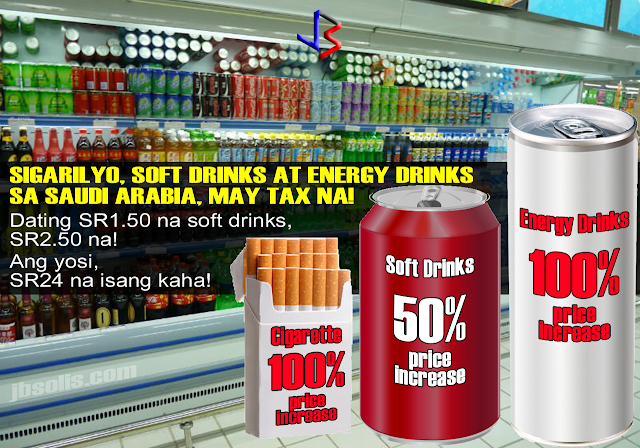
Prices of cigarettes and energy drinks have doubled with the implementation of an excise tax that became effective midnight Saturday in a measure unprecedented in the Kingdom.  The excise tax, commonly known as a “sin tax,” is imposed on “unhealthy products” that are likely to cause health problems and eventually increase medical expenses paid by individuals or the government, according to the General Authority of Zakat and Tax (GAZT) official website.  Items that are now taxed include: cigarettes and cigar products, energy drinks and softdrinks. It is unclear if other sugary beverages are included since some shops still sell these at normal prices.  A few days prior to the implementation, some smokers struggled to find boxes of their usual cigarettes. Consumers attempted to stock up on cigarettes at their pre-tax price, while suppliers were trying to keep the products off the shelves until the prices rose.  At one of the main supermarkets in Jeddah, a shelf stacker said “There was nothing here yesterday,” pointing at the shelf. “Yesterday, the price was normal. But today, a soft drink can is SR2.25 ($0.60).”  Some supermarkets had also kept the newly taxed drinks away from customers so they are sold 50 percent higher in price in the case of soft drinks, and double the price for energy drinks.  Consumers will now pay SR12 at one supermarket for a 250ml can of a popular taurine drink, which is priced at SR11.90 at another supermarket. Aside from tags of doubled priced energy drinks, a new sign has been posted on market shelves stating: “Energy drinks harmful to health.” The full warning matches the text on beverage cans. This is part of the new move to curb consumption of sugary and energy drinks in the kingdom.  The tax authority urged producers and suppliers of taxable goods to register for the excise tax, the GAZT official website stated. The taxing body expects to lower consumption by people with limited income of the taxed products after the price hike.  Officials of Saudi General Authority of Zakat and Tax, the entity responsible for collecting VAT and excise tax, have told local media that they expect excise tax revenues of $1.87 billion (SR7bn) in just six months.  A regular smoker and energy-drinks lover from Jeddah said the move would not make her quit. “It’s an extra strain on the pocket, but it’s a habit that I can’t just quit or cut down on,” she said.  She bought her last pack of the cigarettes she smokes for SR12 one day before the tax into effect. Now it is SR24. Gulf Cooperation Council (GCC) countries are also set to implement a value-added tax (VAT) of 5 percent on certain goods beginning in 2018.  This is just the beginning of taxation imposed on goods in the Kingdom. Starting 2018, a 5%VAT will be implemented on goods throughout the GCC - Saudi Arabia, Bahrain, Kuwait, Oman, Qatar and UAE.


Prices of cigarettes and energy drinks have doubled with the implementation of an excise tax that became effective midnight Saturday in a measure unprecedented in the Kingdom.

The excise tax, commonly known as a “sin tax,” is imposed on “unhealthy products” that are likely to cause health problems and eventually increase medical expenses paid by individuals or the government, according to the General Authority of Zakat and Tax (GAZT) official website.

Items that are now taxed include: cigarettes and cigar products, energy drinks and softdrinks. It is unclear if other sugary beverages are included since some shops still sell these at normal prices.


A few days prior to the implementation, some smokers struggled to find boxes of their usual cigarettes. Consumers attempted to stock up on cigarettes at their pre-tax price, while suppliers were trying to keep the products off the shelves until the prices rose.

At one of the main supermarkets in Jeddah, a shelf stacker said “There was nothing here yesterday,” pointing at the shelf. “Yesterday, the price was normal. But today, a soft drink can is SR2.25 ($0.60).”

Some supermarkets had also kept the newly taxed drinks away from customers so they are sold 50 percent higher in price in the case of soft drinks, and double the price for energy drinks.


Consumers will now pay SR12 at one supermarket for a 250ml can of a popular taurine drink, which is priced at SR11.90 at another supermarket. Aside from tags of doubled priced energy drinks, a new sign has been posted on market shelves stating: “Energy drinks harmful to health.” The full warning matches the text on beverage cans. This is part of the new move to curb consumption of sugary and energy drinks in the kingdom.
Prices of cigarettes and energy drinks have doubled with the implementation of an excise tax that became effective midnight Saturday in a measure unprecedented in the Kingdom.  The excise tax, commonly known as a “sin tax,” is imposed on “unhealthy products” that are likely to cause health problems and eventually increase medical expenses paid by individuals or the government, according to the General Authority of Zakat and Tax (GAZT) official website.  Items that are now taxed include: cigarettes and cigar products, energy drinks and softdrinks. It is unclear if other sugary beverages are included since some shops still sell these at normal prices.  A few days prior to the implementation, some smokers struggled to find boxes of their usual cigarettes. Consumers attempted to stock up on cigarettes at their pre-tax price, while suppliers were trying to keep the products off the shelves until the prices rose.  At one of the main supermarkets in Jeddah, a shelf stacker said “There was nothing here yesterday,” pointing at the shelf. “Yesterday, the price was normal. But today, a soft drink can is SR2.25 ($0.60).”  Some supermarkets had also kept the newly taxed drinks away from customers so they are sold 50 percent higher in price in the case of soft drinks, and double the price for energy drinks.  Consumers will now pay SR12 at one supermarket for a 250ml can of a popular taurine drink, which is priced at SR11.90 at another supermarket. Aside from tags of doubled priced energy drinks, a new sign has been posted on market shelves stating: “Energy drinks harmful to health.” The full warning matches the text on beverage cans. This is part of the new move to curb consumption of sugary and energy drinks in the kingdom.  The tax authority urged producers and suppliers of taxable goods to register for the excise tax, the GAZT official website stated. The taxing body expects to lower consumption by people with limited income of the taxed products after the price hike.  Officials of Saudi General Authority of Zakat and Tax, the entity responsible for collecting VAT and excise tax, have told local media that they expect excise tax revenues of $1.87 billion (SR7bn) in just six months.  A regular smoker and energy-drinks lover from Jeddah said the move would not make her quit. “It’s an extra strain on the pocket, but it’s a habit that I can’t just quit or cut down on,” she said.  She bought her last pack of the cigarettes she smokes for SR12 one day before the tax into effect. Now it is SR24. Gulf Cooperation Council (GCC) countries are also set to implement a value-added tax (VAT) of 5 percent on certain goods beginning in 2018.  This is just the beginning of taxation imposed on goods in the Kingdom. Starting 2018, a 5%VAT will be implemented on goods throughout the GCC - Saudi Arabia, Bahrain, Kuwait, Oman, Qatar and UAE.

The tax authority urged producers and suppliers of taxable goods to register for the excise tax, the GAZT official website stated. The taxing body expects to lower consumption by people with limited income of the taxed products after the price hike.


Officials of Saudi General Authority of Zakat and Tax, the entity responsible for collecting VAT and excise tax, have told local media that they expect excise tax revenues of $1.87 billion (SR7bn) in just six months.


A regular smoker and energy-drinks lover from Jeddah said the move would not make her quit.
“It’s an extra strain on the pocket, but it’s a habit that I can’t just quit or cut down on,” she said.

She bought her last pack of the cigarettes she smokes for SR12 one day before the tax into effect. Now it is SR24.
Gulf Cooperation Council (GCC) countries are also set to implement a value-added tax (VAT) of 5 percent on certain goods beginning in 2018.

This is just the beginning of taxation imposed on goods in the Kingdom. Starting 2018, a 5%VAT will be implemented on goods throughout the GCC - Saudi Arabia, Bahrain, Kuwait, Oman, Qatar and UAE.


©2017 THOUGHTSKOTO
SEARCH JBSOLIS, TYPE KEYWORDS and TITLE OF ARTICLE at the box below