Carousel

Sponsored Links

Looking for House and Lot Within Tagaytay Area? CONTACT US!

Name

Email *

Message *

Showing posts with label Qatar crisis. Show all posts

Friday, June 23, 2017

Arab States Give Qatar 10 Days To Comply With These 13 Demands Or Else

Saudi Arabia and other Arab countries that have cut ties to Qatar issued a steep list of demands Thursday to end the diplomatic crisis which has been going on for weeks now.   The list compiled by Saudi Arabia, the United Arab Emirates (UAE), Egypt and Bahrain makes various demands relating to Qatari media and government policy, according to news agencies Reuters and the Associated Press.  It was handed over to Qatar by Kuwait, which is mediating in the ongoing dispute.  There are a total of 13 demands, which includes the closing of the Al Jazeera Television Network. Not only must Qatar shut down the Doha-based satellite broadcaster, the list says, but also all of its affiliates. The list also demands that Qatar stop funding a host of other news outlets including Arabi21 and Middle East Eye.  Qatar is also being asked to reduce its ties to Saudi Arabia's regional adversary Iran and instead align itself politically, economically and otherwise with the Gulf Cooperation Council. Qatar must shut down all diplomatic posts in Iran, kick out from Qatar any members of Iran’s elite Revolutionary Guard, and only conduct trade and commerce with Iran that complies with U.S. sanctions.  Included in the list is the closing of a Turkish military base in Qatar, the location of which is somewhat a secret. The Turkish base was formally acknowledged only in 2016. Qatar also hosts the United States' largest military base abroad, which began in 2001. Turkey rejected the call to shut down its military base in Qatar, saying the base was a guarantor of security in the Gulf and demands for its closure represented interference in its ties with Doha. In fact, since the crisis began, Turkey has been a pivotal ally of Qatar, supplying much-needed goods, as well as bolstering its military presence in the region.  The country must also publicly announce that it is cutting ties with terrorist, ideological and sectarian organizations including the Muslim Brotherhood, ISIS, al Qaeda, Hezbollah, and Jabhat Fateh al Sham (formerly al Qaeda in Syria). It must also surrender all individuals on its territory that the four Arab nations have designated as terrorists.  The country must provide detailed information about opposition figures that Qatar has funded, ostensibly in Saudi Arabia and the other nations. It may be well remembered that the four Arab countries published a list of individuals with alleged terrorist links, and enforced banks to freeze bank accounts linked to these individuals and organizations.  The list also require that Qatar stop interfering in the four countries' domestic and foreign affairs and stop a practice of giving Qatari nationality to citizens of the four countries. They must expel those citizens that are currently in Qatar.  Qatar must also pay reparations to these countries for any damage or costs incurred over the past few years because of Qatari policies. Any resulting agreement to comply with the demands will be monitored, with monthly reports in the first year, then every three months the next year, then annually for 10 years.  Qatari officials did not reply immediately to requests for comment. But on Monday, Foreign Minister Sheikh Mohammed bin Abdulrahman al-Thani said Qatar would not negotiate with the four states unless they lifted their measures against Doha.  The four Arab countries give Doha 10 days to comply, failing which the list becomes "void", the official said without elaborating, suggesting the offer to end the dispute in return for the 13 steps would no longer be on the table.


Saudi Arabia and other Arab countries that have cut ties to Qatar issued a steep list of demands Thursday to end the diplomatic crisis which has been going on for weeks now. 

The list compiled by Saudi Arabia, the United Arab Emirates (UAE), Egypt and Bahrain makes various demands relating to Qatari media and government policy, according to news agencies Reuters and the Associated Press.

It was handed over to Qatar by Kuwait, which is mediating in the ongoing dispute.

Saudi Arabia and other Arab countries that have cut ties to Qatar issued a steep list of demands Thursday to end the diplomatic crisis which has been going on for weeks now.   The list compiled by Saudi Arabia, the United Arab Emirates (UAE), Egypt and Bahrain makes various demands relating to Qatari media and government policy, according to news agencies Reuters and the Associated Press.  It was handed over to Qatar by Kuwait, which is mediating in the ongoing dispute.  There are a total of 13 demands, which includes the closing of the Al Jazeera Television Network. Not only must Qatar shut down the Doha-based satellite broadcaster, the list says, but also all of its affiliates. The list also demands that Qatar stop funding a host of other news outlets including Arabi21 and Middle East Eye.  Qatar is also being asked to reduce its ties to Saudi Arabia's regional adversary Iran and instead align itself politically, economically and otherwise with the Gulf Cooperation Council. Qatar must shut down all diplomatic posts in Iran, kick out from Qatar any members of Iran’s elite Revolutionary Guard, and only conduct trade and commerce with Iran that complies with U.S. sanctions.  Included in the list is the closing of a Turkish military base in Qatar, the location of which is somewhat a secret. The Turkish base was formally acknowledged only in 2016. Qatar also hosts the United States' largest military base abroad, which began in 2001. Turkey rejected the call to shut down its military base in Qatar, saying the base was a guarantor of security in the Gulf and demands for its closure represented interference in its ties with Doha. In fact, since the crisis began, Turkey has been a pivotal ally of Qatar, supplying much-needed goods, as well as bolstering its military presence in the region.  The country must also publicly announce that it is cutting ties with terrorist, ideological and sectarian organizations including the Muslim Brotherhood, ISIS, al Qaeda, Hezbollah, and Jabhat Fateh al Sham (formerly al Qaeda in Syria). It must also surrender all individuals on its territory that the four Arab nations have designated as terrorists.  The country must provide detailed information about opposition figures that Qatar has funded, ostensibly in Saudi Arabia and the other nations. It may be well remembered that the four Arab countries published a list of individuals with alleged terrorist links, and enforced banks to freeze bank accounts linked to these individuals and organizations.  The list also require that Qatar stop interfering in the four countries' domestic and foreign affairs and stop a practice of giving Qatari nationality to citizens of the four countries. They must expel those citizens that are currently in Qatar.  Qatar must also pay reparations to these countries for any damage or costs incurred over the past few years because of Qatari policies. Any resulting agreement to comply with the demands will be monitored, with monthly reports in the first year, then every three months the next year, then annually for 10 years.  Qatari officials did not reply immediately to requests for comment. But on Monday, Foreign Minister Sheikh Mohammed bin Abdulrahman al-Thani said Qatar would not negotiate with the four states unless they lifted their measures against Doha.  The four Arab countries give Doha 10 days to comply, failing which the list becomes "void", the official said without elaborating, suggesting the offer to end the dispute in return for the 13 steps would no longer be on the table.

There are a total of 13 demands, which includes the closing of the Al Jazeera Television Network. Not only must Qatar shut down the Doha-based satellite broadcaster, the list says, but also all of its affiliates. The list also demands that Qatar stop funding a host of other news outlets including Arabi21 and Middle East Eye.

Qatar is also being asked to reduce its ties to Saudi Arabia's regional adversary Iran and instead align itself politically, economically and otherwise with the Gulf Cooperation CouncilQatar must shut down all diplomatic posts in Iran, kick out from Qatar any members of Iran’s elite Revolutionary Guard, and only conduct trade and commerce with Iran that complies with U.S. sanctions.

Included in the list is the closing of a Turkish military base in Qatar, the location of which is somewhat a secret. The Turkish base was formally acknowledged only in 2016. Qatar also hosts the United States' largest military base abroad, which began in 2001. Turkey rejected the call to shut down its military base in Qatar, saying the base was a guarantor of security in the Gulf and demands for its closure represented interference in its ties with Doha. In fact, since the crisis began, Turkey has been a pivotal ally of Qatar, supplying much-needed goods, as well as bolstering its military presence in the region.

Saudi Arabia and other Arab countries that have cut ties to Qatar issued a steep list of demands Thursday to end the diplomatic crisis which has been going on for weeks now.   The list compiled by Saudi Arabia, the United Arab Emirates (UAE), Egypt and Bahrain makes various demands relating to Qatari media and government policy, according to news agencies Reuters and the Associated Press.  It was handed over to Qatar by Kuwait, which is mediating in the ongoing dispute.  There are a total of 13 demands, which includes the closing of the Al Jazeera Television Network. Not only must Qatar shut down the Doha-based satellite broadcaster, the list says, but also all of its affiliates. The list also demands that Qatar stop funding a host of other news outlets including Arabi21 and Middle East Eye.  Qatar is also being asked to reduce its ties to Saudi Arabia's regional adversary Iran and instead align itself politically, economically and otherwise with the Gulf Cooperation Council. Qatar must shut down all diplomatic posts in Iran, kick out from Qatar any members of Iran’s elite Revolutionary Guard, and only conduct trade and commerce with Iran that complies with U.S. sanctions.  Included in the list is the closing of a Turkish military base in Qatar, the location of which is somewhat a secret. The Turkish base was formally acknowledged only in 2016. Qatar also hosts the United States' largest military base abroad, which began in 2001. Turkey rejected the call to shut down its military base in Qatar, saying the base was a guarantor of security in the Gulf and demands for its closure represented interference in its ties with Doha. In fact, since the crisis began, Turkey has been a pivotal ally of Qatar, supplying much-needed goods, as well as bolstering its military presence in the region.  The country must also publicly announce that it is cutting ties with terrorist, ideological and sectarian organizations including the Muslim Brotherhood, ISIS, al Qaeda, Hezbollah, and Jabhat Fateh al Sham (formerly al Qaeda in Syria). It must also surrender all individuals on its territory that the four Arab nations have designated as terrorists.  The country must provide detailed information about opposition figures that Qatar has funded, ostensibly in Saudi Arabia and the other nations. It may be well remembered that the four Arab countries published a list of individuals with alleged terrorist links, and enforced banks to freeze bank accounts linked to these individuals and organizations.  The list also require that Qatar stop interfering in the four countries' domestic and foreign affairs and stop a practice of giving Qatari nationality to citizens of the four countries. They must expel those citizens that are currently in Qatar.  Qatar must also pay reparations to these countries for any damage or costs incurred over the past few years because of Qatari policies. Any resulting agreement to comply with the demands will be monitored, with monthly reports in the first year, then every three months the next year, then annually for 10 years.  Qatari officials did not reply immediately to requests for comment. But on Monday, Foreign Minister Sheikh Mohammed bin Abdulrahman al-Thani said Qatar would not negotiate with the four states unless they lifted their measures against Doha.  The four Arab countries give Doha 10 days to comply, failing which the list becomes "void", the official said without elaborating, suggesting the offer to end the dispute in return for the 13 steps would no longer be on the table.

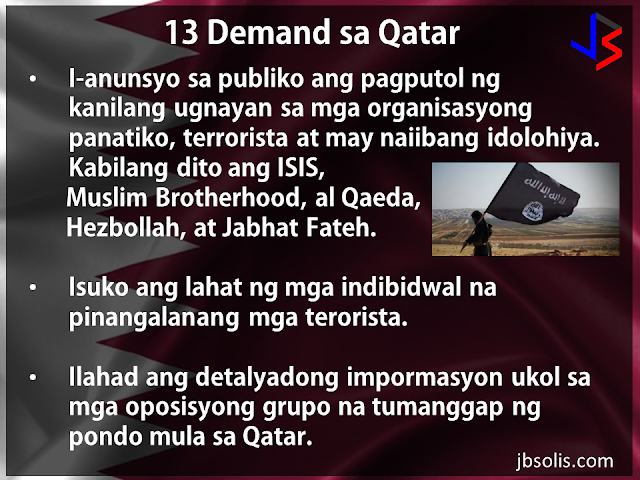
The country must also publicly announce that it is cutting ties with terrorist, ideological and sectarian organizations including the Muslim Brotherhood, ISIS, al Qaeda, Hezbollah, and Jabhat Fateh al Sham (formerly al Qaeda in Syria). It must also surrender all individuals on its territory that the four Arab nations have designated as terrorists.

The country must provide detailed information about opposition figures that Qatar has funded, ostensibly in Saudi Arabia and the other nations. It may be well remembered that the four Arab countries published a list of individuals with alleged terrorist links, and enforced banks to freeze bank accounts linked to these individuals and organizations.
Saudi Arabia and other Arab countries that have cut ties to Qatar issued a steep list of demands Thursday to end the diplomatic crisis which has been going on for weeks now.   The list compiled by Saudi Arabia, the United Arab Emirates (UAE), Egypt and Bahrain makes various demands relating to Qatari media and government policy, according to news agencies Reuters and the Associated Press.  It was handed over to Qatar by Kuwait, which is mediating in the ongoing dispute.  There are a total of 13 demands, which includes the closing of the Al Jazeera Television Network. Not only must Qatar shut down the Doha-based satellite broadcaster, the list says, but also all of its affiliates. The list also demands that Qatar stop funding a host of other news outlets including Arabi21 and Middle East Eye.  Qatar is also being asked to reduce its ties to Saudi Arabia's regional adversary Iran and instead align itself politically, economically and otherwise with the Gulf Cooperation Council. Qatar must shut down all diplomatic posts in Iran, kick out from Qatar any members of Iran’s elite Revolutionary Guard, and only conduct trade and commerce with Iran that complies with U.S. sanctions.  Included in the list is the closing of a Turkish military base in Qatar, the location of which is somewhat a secret. The Turkish base was formally acknowledged only in 2016. Qatar also hosts the United States' largest military base abroad, which began in 2001. Turkey rejected the call to shut down its military base in Qatar, saying the base was a guarantor of security in the Gulf and demands for its closure represented interference in its ties with Doha. In fact, since the crisis began, Turkey has been a pivotal ally of Qatar, supplying much-needed goods, as well as bolstering its military presence in the region.  The country must also publicly announce that it is cutting ties with terrorist, ideological and sectarian organizations including the Muslim Brotherhood, ISIS, al Qaeda, Hezbollah, and Jabhat Fateh al Sham (formerly al Qaeda in Syria). It must also surrender all individuals on its territory that the four Arab nations have designated as terrorists.  The country must provide detailed information about opposition figures that Qatar has funded, ostensibly in Saudi Arabia and the other nations. It may be well remembered that the four Arab countries published a list of individuals with alleged terrorist links, and enforced banks to freeze bank accounts linked to these individuals and organizations.  The list also require that Qatar stop interfering in the four countries' domestic and foreign affairs and stop a practice of giving Qatari nationality to citizens of the four countries. They must expel those citizens that are currently in Qatar.  Qatar must also pay reparations to these countries for any damage or costs incurred over the past few years because of Qatari policies. Any resulting agreement to comply with the demands will be monitored, with monthly reports in the first year, then every three months the next year, then annually for 10 years.  Qatari officials did not reply immediately to requests for comment. But on Monday, Foreign Minister Sheikh Mohammed bin Abdulrahman al-Thani said Qatar would not negotiate with the four states unless they lifted their measures against Doha.  The four Arab countries give Doha 10 days to comply, failing which the list becomes "void", the official said without elaborating, suggesting the offer to end the dispute in return for the 13 steps would no longer be on the table.

UAE Banks Freeze Accounts Linked To Terrorists

Banks and other financial institutions in the United Arab Emirates have been instructed to search for and freeze any accounts, deposits or investments held by individuals or entities designated as terrorists or terrorist organizations, state-run Emirates News Agency reported, citing a circular issued by the central bank.


The list also require that Qatar stop interfering in the four countries' domestic and foreign affairs and stop a practice of giving Qatari nationality to citizens of the four countries. They must expel those citizens that are currently in Qatar.

Saudi Arabia and other Arab countries that have cut ties to Qatar issued a steep list of demands Thursday to end the diplomatic crisis which has been going on for weeks now.   The list compiled by Saudi Arabia, the United Arab Emirates (UAE), Egypt and Bahrain makes various demands relating to Qatari media and government policy, according to news agencies Reuters and the Associated Press.  It was handed over to Qatar by Kuwait, which is mediating in the ongoing dispute.  There are a total of 13 demands, which includes the closing of the Al Jazeera Television Network. Not only must Qatar shut down the Doha-based satellite broadcaster, the list says, but also all of its affiliates. The list also demands that Qatar stop funding a host of other news outlets including Arabi21 and Middle East Eye.  Qatar is also being asked to reduce its ties to Saudi Arabia's regional adversary Iran and instead align itself politically, economically and otherwise with the Gulf Cooperation Council. Qatar must shut down all diplomatic posts in Iran, kick out from Qatar any members of Iran’s elite Revolutionary Guard, and only conduct trade and commerce with Iran that complies with U.S. sanctions.  Included in the list is the closing of a Turkish military base in Qatar, the location of which is somewhat a secret. The Turkish base was formally acknowledged only in 2016. Qatar also hosts the United States' largest military base abroad, which began in 2001. Turkey rejected the call to shut down its military base in Qatar, saying the base was a guarantor of security in the Gulf and demands for its closure represented interference in its ties with Doha. In fact, since the crisis began, Turkey has been a pivotal ally of Qatar, supplying much-needed goods, as well as bolstering its military presence in the region.  The country must also publicly announce that it is cutting ties with terrorist, ideological and sectarian organizations including the Muslim Brotherhood, ISIS, al Qaeda, Hezbollah, and Jabhat Fateh al Sham (formerly al Qaeda in Syria). It must also surrender all individuals on its territory that the four Arab nations have designated as terrorists.  The country must provide detailed information about opposition figures that Qatar has funded, ostensibly in Saudi Arabia and the other nations. It may be well remembered that the four Arab countries published a list of individuals with alleged terrorist links, and enforced banks to freeze bank accounts linked to these individuals and organizations.  The list also require that Qatar stop interfering in the four countries' domestic and foreign affairs and stop a practice of giving Qatari nationality to citizens of the four countries. They must expel those citizens that are currently in Qatar.  Qatar must also pay reparations to these countries for any damage or costs incurred over the past few years because of Qatari policies. Any resulting agreement to comply with the demands will be monitored, with monthly reports in the first year, then every three months the next year, then annually for 10 years.  Qatari officials did not reply immediately to requests for comment. But on Monday, Foreign Minister Sheikh Mohammed bin Abdulrahman al-Thani said Qatar would not negotiate with the four states unless they lifted their measures against Doha.  The four Arab countries give Doha 10 days to comply, failing which the list becomes "void", the official said without elaborating, suggesting the offer to end the dispute in return for the 13 steps would no longer be on the table.

Qatar must also pay reparations to these countries for any damage or costs incurred over the past few years because of Qatari policies. Any resulting agreement to comply with the demands will be monitored, with monthly reports in the first year, then every three months the next year, then annually for 10 years. 


Qatari officials did not reply immediately to requests for comment. But on Monday, Foreign Minister Sheikh Mohammed bin Abdulrahman al-Thani said Qatar would not negotiate with the four states unless they lifted their measures against Doha.

The four Arab countries give Doha 10 days to comply, failing which the list becomes "void", the official said without elaborating, suggesting the offer to end the dispute in return for the 13 steps would no longer be on the table. 


source: NY Times, Associated Press, Arab News,


©2017 THOUGHTSKOTO
SEARCH JBSOLIS, TYPE KEYWORDS and TITLE OF ARTICLE at the box below

Thursday, June 15, 2017

No More Suspension for New Hires OFWs in Qatar!


Life now goes on to all Overseas Filipino Workers going to Qatar.  It is because the Department of Labor and Employment (DOLE) has lifted the moratorium on the deployment of Filipino Workers to Qatar.  According to DOLE Secretary Silvestre Bello III, this is based on the recommendation of the Philippine Overseas Labor Office and consultation with the Department of Foreign Affairs (DFA).


(TV Patrol: Gobyerno ng Qatar, tiniyak na sapat ang supply ng kanilang pagkain)


Life now goes on to all Overseas Filipino Workers going to Qatar.

It is because the Department of Labor and Employment (DOLE) has lifted the moratorium on the deployment of Filipino Workers to Qatar.

According to DOLE Secretary Silvestre Bello III, this is based on the recommendation of the Philippine Overseas Labor Office and consultation with the Department of Foreign Affairs (DFA).


Last week, Bello mandated the temporary suspension in the deployment of OFWs to Qatar to secure the welfare and security of OFWs.

This is after the Saudi Arabia and allies isolates Qatar and severed diplomatic ties, even cut air travel and other business in the said country due to the allegation that the Gulf State is supporting militant terrorism.

Qatar has been denying the accusations.

According to Attaché David Des Dicang, the situation in Qatar has normalized.

Even the Philippine Embassy has requested for the deployment of newly-hired workers to Qatar, particularly to the Philippine School Doha (PSD) and Philippine International School-Qatar (PISQ).

DOLE's News Release dated June 15, 2017


“This decision was arrived at on the advice of Foreign Affairs Secretary Allan Peter Cayetano and upon the recommendation of Qatar POLO following their assessment of the situation in the Gulf state,” Bello said.

“We respectfully request to allow the deployment so as not to hamper the operations of our Philippine schools and to allay fears of the revocation of their school permits issued by the Qatar government,” Dicang said.


With 240,000 OFWs in Qatar, the Qatari government ensured the safety of these workers and guaranteed that they have the ability to withstand any possible economic effects of the current situation.

DOLE said that even OFWs in Qatar expressed confidence for their safety with the strengthened efforts of the labor department and other concerned government agencies in ensuring their basic welfare and security amid the diplomatic crisis.


(Bandila: Pagputol ng ugnayan ng 7 bansa sa Qatar, ano ang epekto sa mga OFW?)


©2017 THOUGHTSKOTO
SEARCH JBSOLIS, TYPE KEYWORDS and TITLE OF ARTICLE at the box below