Carousel

Sponsored Links

Looking for House and Lot Within Tagaytay Area? CONTACT US!

Name

Email *

Message *

Wednesday, October 03, 2018

Four Containers Of Yolanda Donations In Cebu Destroyed By BOC

Super Typhoon Haiyan with a local name Yolanda has devastated Leyte and parts of the Visayas region and killed thousands of people. Donations from other countries flooded afterward. It was 4 years ago and the controversy still lives up to now. Questions on whether the donations from all over the world had reached the victims or not arises and until recently, four container vans of donations were declared as condemned by the Bureau Of Customs in Cebu and had been destroyed and incinerated. Although some goods especially non-food items were still good but food items have all expired and spoiled.
Super Typhoon Haiyan with a local name Yolanda has devastated Leyte and parts of the Visayas region and killed hundreds of people. It was 4 years ago and the controversy still lives up to now. Questions on whether the donations from all over the world had reached the victims or not arises and until recently, four container vans of donations were declared as condemned by the Bureau Of Customs in Cebu and had been destroyed and incinerated. Although some goods especially non-food items were still good but food items have all expired and spoiled.    Ads      Sponsored Links    The Bureau of Customs (BOC) on Wednesday destroyed four containers of goods donated for the victims of Typhoon Yolanda in Mandaue City, Cebu.  The destroyed goods include clothes, diapers, toiletries, medical supplies and canned goods from Belgium, Norway and the United States transported to Cebu in 2014. BOC-Cebu District Collector Elvira Cruz said the canned goods and medicines are already expired.  The clothes, meanwhile, were not distributed or donated to the Department of Social Welfare and Development (DSWD) since doing so is prohibited under a memorandum released in 2011 that bans the acceptance of forfeited used clothing.  The bureau refused to release an estimation of the value of the destroyed items, as the consignees did not file an "import entry" that determines the value of shipped goods.  The BOC can destruct or condemn harmful and prohibited goods as stated under Republic Act No. 10863 or the Customs Modernization and Tariff Act.    Donations coming from different countries were being disposed of because some of the relief goods like the imported goods and medicine were already been expired.  The relief goods were donated last January 2014. But since the donors and consignees did not get an exemption from the payment of taxes and duties from the Department of Finance which is needed before the shipment will be released, it was declared as abandoned in June 2017. Aside from goods and medicine, diapers, clothing and undergarments, and kitchenware were also donated.    Filed under the category of Super Typhoon Haiyan, Yolanda, donations, Bureau Of Customs, Cebu, expired, spoiled
Ads


Sponsored Links
Super Typhoon Haiyan with a local name Yolanda has devastated Leyte and parts of the Visayas region and killed hundreds of people. It was 4 years ago and the controversy still lives up to now. Questions on whether the donations from all over the world had reached the victims or not arises and until recently, four container vans of donations were declared as condemned by the Bureau Of Customs in Cebu and had been destroyed and incinerated. Although some goods especially non-food items were still good but food items have all expired and spoiled.    Ads      Sponsored Links    The Bureau of Customs (BOC) on Wednesday destroyed four containers of goods donated for the victims of Typhoon Yolanda in Mandaue City, Cebu.  The destroyed goods include clothes, diapers, toiletries, medical supplies and canned goods from Belgium, Norway and the United States transported to Cebu in 2014. BOC-Cebu District Collector Elvira Cruz said the canned goods and medicines are already expired.  The clothes, meanwhile, were not distributed or donated to the Department of Social Welfare and Development (DSWD) since doing so is prohibited under a memorandum released in 2011 that bans the acceptance of forfeited used clothing.  The bureau refused to release an estimation of the value of the destroyed items, as the consignees did not file an "import entry" that determines the value of shipped goods.  The BOC can destruct or condemn harmful and prohibited goods as stated under Republic Act No. 10863 or the Customs Modernization and Tariff Act.    Donations coming from different countries were being disposed of because some of the relief goods like the imported goods and medicine were already been expired.  The relief goods were donated last January 2014. But since the donors and consignees did not get an exemption from the payment of taxes and duties from the Department of Finance which is needed before the shipment will be released, it was declared as abandoned in June 2017. Aside from goods and medicine, diapers, clothing and undergarments, and kitchenware were also donated.    Filed under the category of Super Typhoon Haiyan, Yolanda, donations, Bureau Of Customs, Cebu, expired, spoiled
The Bureau of Customs (BOC)  destroyed four containers of goods donated for the victims of Typhoon Yolanda in Mandaue City, Cebu.

It includes clothes, diapers, toiletries, medical supplies, and canned goods from other countries like Belgium, Norway and the United States transported to Cebu last 2014.
Super Typhoon Haiyan with a local name Yolanda has devastated Leyte and parts of the Visayas region and killed hundreds of people. It was 4 years ago and the controversy still lives up to now. Questions on whether the donations from all over the world had reached the victims or not arises and until recently, four container vans of donations were declared as condemned by the Bureau Of Customs in Cebu and had been destroyed and incinerated. Although some goods especially non-food items were still good but food items have all expired and spoiled.    Ads      Sponsored Links    The Bureau of Customs (BOC) on Wednesday destroyed four containers of goods donated for the victims of Typhoon Yolanda in Mandaue City, Cebu.  The destroyed goods include clothes, diapers, toiletries, medical supplies and canned goods from Belgium, Norway and the United States transported to Cebu in 2014. BOC-Cebu District Collector Elvira Cruz said the canned goods and medicines are already expired.  The clothes, meanwhile, were not distributed or donated to the Department of Social Welfare and Development (DSWD) since doing so is prohibited under a memorandum released in 2011 that bans the acceptance of forfeited used clothing.  The bureau refused to release an estimation of the value of the destroyed items, as the consignees did not file an "import entry" that determines the value of shipped goods.  The BOC can destruct or condemn harmful and prohibited goods as stated under Republic Act No. 10863 or the Customs Modernization and Tariff Act.    Donations coming from different countries were being disposed of because some of the relief goods like the imported goods and medicine were already been expired.  The relief goods were donated last January 2014. But since the donors and consignees did not get an exemption from the payment of taxes and duties from the Department of Finance which is needed before the shipment will be released, it was declared as abandoned in June 2017. Aside from goods and medicine, diapers, clothing and undergarments, and kitchenware were also donated.    Filed under the category of Super Typhoon Haiyan, Yolanda, donations, Bureau Of Customs, Cebu, expired, spoiled
 Elvira Cruz, 
BOC-Cebu District Collector, said the canned goods and medicines are already expired.

The clothes were not distributed or donated to the Department of Social Welfare and Development (DSWD) because it is prohibited under a memorandum released in 2011 that bans the acceptance of forfeited used clothing.

The bureau has not disclosed the value of the destroyed items since the donors or consignees did not file an "import entry" which declares the value of shipped items.

Republic Act No. 10863 or the Customs Modernization and Tariff Act said that 
the BOC can destroy or condemn harmful and prohibited goods.
Super Typhoon Haiyan with a local name Yolanda has devastated Leyte and parts of the Visayas region and killed hundreds of people. It was 4 years ago and the controversy still lives up to now. Questions on whether the donations from all over the world had reached the victims or not arises and until recently, four container vans of donations were declared as condemned by the Bureau Of Customs in Cebu and had been destroyed and incinerated. Although some goods especially non-food items were still good but food items have all expired and spoiled.    Ads      Sponsored Links    The Bureau of Customs (BOC) on Wednesday destroyed four containers of goods donated for the victims of Typhoon Yolanda in Mandaue City, Cebu.  The destroyed goods include clothes, diapers, toiletries, medical supplies and canned goods from Belgium, Norway and the United States transported to Cebu in 2014. BOC-Cebu District Collector Elvira Cruz said the canned goods and medicines are already expired.  The clothes, meanwhile, were not distributed or donated to the Department of Social Welfare and Development (DSWD) since doing so is prohibited under a memorandum released in 2011 that bans the acceptance of forfeited used clothing.  The bureau refused to release an estimation of the value of the destroyed items, as the consignees did not file an "import entry" that determines the value of shipped goods.  The BOC can destruct or condemn harmful and prohibited goods as stated under Republic Act No. 10863 or the Customs Modernization and Tariff Act.    Donations coming from different countries were being disposed of because some of the relief goods like the imported goods and medicine were already been expired.  The relief goods were donated last January 2014. But since the donors and consignees did not get an exemption from the payment of taxes and duties from the Department of Finance which is needed before the shipment will be released, it was declared as abandoned in June 2017. Aside from goods and medicine, diapers, clothing and undergarments, and kitchenware were also donated.    Filed under the category of Super Typhoon Haiyan, Yolanda, donations, Bureau Of Customs, Cebu, expired, spoiled
Since the donors and consignees did not get an exemption from the payment of taxes and duties from the Department of Finance which is needed before the shipment will be released, it was declared as abandoned in June 2017.Super Typhoon Haiyan with a local name Yolanda has devastated Leyte and parts of the Visayas region and killed hundreds of people. It was 4 years ago and the controversy still lives up to now. Questions on whether the donations from all over the world had reached the victims or not arises and until recently, four container vans of donations were declared as condemned by the Bureau Of Customs in Cebu and had been destroyed and incinerated. Although some goods especially non-food items were still good but food items have all expired and spoiled.    Ads      Sponsored Links    The Bureau of Customs (BOC) on Wednesday destroyed four containers of goods donated for the victims of Typhoon Yolanda in Mandaue City, Cebu.  The destroyed goods include clothes, diapers, toiletries, medical supplies and canned goods from Belgium, Norway and the United States transported to Cebu in 2014. BOC-Cebu District Collector Elvira Cruz said the canned goods and medicines are already expired.  The clothes, meanwhile, were not distributed or donated to the Department of Social Welfare and Development (DSWD) since doing so is prohibited under a memorandum released in 2011 that bans the acceptance of forfeited used clothing.  The bureau refused to release an estimation of the value of the destroyed items, as the consignees did not file an "import entry" that determines the value of shipped goods.  The BOC can destruct or condemn harmful and prohibited goods as stated under Republic Act No. 10863 or the Customs Modernization and Tariff Act.    Donations coming from different countries were being disposed of because some of the relief goods like the imported goods and medicine were already been expired.  The relief goods were donated last January 2014. But since the donors and consignees did not get an exemption from the payment of taxes and duties from the Department of Finance which is needed before the shipment will be released, it was declared as abandoned in June 2017. Aside from goods and medicine, diapers, clothing and undergarments, and kitchenware were also donated.    Filed under the category of Super Typhoon Haiyan, Yolanda, donations, Bureau Of Customs, Cebu, expired, spoiled
Among the contents of the said containers are medicine, diapers, clothing, undergarments, and kitchenware.
Super Typhoon Haiyan with a local name Yolanda has devastated Leyte and parts of the Visayas region and killed hundreds of people. It was 4 years ago and the controversy still lives up to now. Questions on whether the donations from all over the world had reached the victims or not arises and until recently, four container vans of donations were declared as condemned by the Bureau Of Customs in Cebu and had been destroyed and incinerated. Although some goods especially non-food items were still good but food items have all expired and spoiled.    Ads      Sponsored Links    The Bureau of Customs (BOC) on Wednesday destroyed four containers of goods donated for the victims of Typhoon Yolanda in Mandaue City, Cebu.  The destroyed goods include clothes, diapers, toiletries, medical supplies and canned goods from Belgium, Norway and the United States transported to Cebu in 2014. BOC-Cebu District Collector Elvira Cruz said the canned goods and medicines are already expired.  The clothes, meanwhile, were not distributed or donated to the Department of Social Welfare and Development (DSWD) since doing so is prohibited under a memorandum released in 2011 that bans the acceptance of forfeited used clothing.  The bureau refused to release an estimation of the value of the destroyed items, as the consignees did not file an "import entry" that determines the value of shipped goods.  The BOC can destruct or condemn harmful and prohibited goods as stated under Republic Act No. 10863 or the Customs Modernization and Tariff Act.    Donations coming from different countries were being disposed of because some of the relief goods like the imported goods and medicine were already been expired.  The relief goods were donated last January 2014. But since the donors and consignees did not get an exemption from the payment of taxes and duties from the Department of Finance which is needed before the shipment will be released, it was declared as abandoned in June 2017. Aside from goods and medicine, diapers, clothing and undergarments, and kitchenware were also donated.    Filed under the category of Super Typhoon Haiyan, Yolanda, donations, Bureau Of Customs, Cebu, expired, spoiled

Filed under the category of Super Typhoon Haiyan, Yolanda, donations, Bureau Of Customs, Cebu, expired, spoiled

Ads


Read More:
As overseas Filipino workers (OFW) working in an unfamiliar territory, we feel comfortable whenever we see a compatriot or a fellow Filipino abroad. In some instances, very unfortunate things happen like getting into a trouble because of a fellow Filipino. The Department of Foreign Affairs (DFA) and the Consulate General in Saudi Arabia confirmed that an OFW was stabbed and killed by a fellow OFW in Jeddah, KSA.      Ads     Sponsored Links    A Filipino was stabbed and killed by a fellow Filipino in Jeddah, Saudi Arabia, according to the confirmation of the Department of Foreign Affairs (DFA).  The victim (name withheld) was a 29-year-old from Datu Odin Sinsuat, Maguindanao, who worked as a family driver in Jeddah.   The suspect (name withheld), a 34-year-old from Capiz, also a driver for the same family  The suspect remains under police custody after he was arrested immediately after the incident. The two "allegedly engaged in a fistfight in front of the house of their employer that ended in the victim getting fatally stabbed by his fellow driver." The motive of the stabbing is still unknown.  The Consulate General and the Philippine Overseas Labor Office in Jeddah will extend full assistance to both Filipinos as well as their families.    The victim is set for a vacation to the Philippines soon but the incident turned out to be unfortunate that he will come home inside a box.  Consul General Edgar Badajos said that the suspect is facing a death sentence as per Saudi Sharia law. However, since they are both Filipinos, it is possible that the victim's family could instead  He assured that they will render assistance to help both OFWs.    Filed under the category of overseas Filipino workers, Filipino abroad, Department of Foreign Affairs (DFA), Saudi Arabia,   stabbed, Jeddah, KSA

More often, families with overseas Filipino workers (OFW) rely on their OFW breadwinner in providing their needs and without doing any efforts to have extra income. They use the money they receive to pay their bills, rents, mortgages, etc. They tend to spend the remittances they receive and wait for the next remittance when the money is over without any savings. This is the reason why no matter how long the OFWs exhaust themselves working overseas, they are still coming home broke and without any savings.  Encouraging our spouse or anyone who is responsible for the remittances you send to save could be a great help and could guarantee a hassle-free retirement, much more if they placed this savings to a profitable investment.      Ads     Sponsored Links    Stick to a budget schedule  Convince your spouse to make a monthly budget and commit to saving a portion of the monthly remittance. They could also spend the remaining part of the budget after setting aside the savings.  No matter how small the savings, it could mean a lot after a period of time you regularly do it.    Use the credit card wisely or do not use it at all  Credit cards could be an advantage when purchasing but it can also lure the holder to spend more. Whenever possible, avoid using credit cards and use cash instead. It would save you from paying extra charges and interests which can really raise your spending.    The best rule should be, do not spend the money you do not have.     Always make a list of important things to buy  Many OFW spouses tend to go on a shopping spree just after receiving the remittance and let their impulses lead in which items they like to buy at the very moment without putting their priorities on the things they really needed.  Encourage them to develop a habit and discipline of making a list of the things they need to prioritize during shopping and strictly follow what is on the list to avoid spending too much on the things that are not really important.    Live a lifestyle that suits your income  Many OFW spouses live like one day millionaire. after claiming the remittances you sent, they will go straight to the mall, eat at the fast-food chain of their choice, go on a shopping spree buying what they want without even thinking if they still have the money to go through the month until the next remittance. If their budget got short, they would borrow money from someone which would cause the next budget to bear the shortage and the cycle goes on.    There's nothing wrong with being generous but not too much  Advise your spouse to exercise caution when giving help to extended families, relatives or friends. There is nothing wrong with extending help but there has to be a limitation. This would avoid them to become dependent on your assistance that they would knock your everytime they need financial help.    Working overseas is not forever and you will eventually come home for good. It is you and your spouse who need to work hand-in-hand to succeed. Together you must find ways to take care of your finances and save for the future of your family.  Filed under the category of overseas Filipino workers, extra income,  bills, rents, mortgages, remittances, working overseas, retirement, investment, savings
©2018 THOUGHTSKOTO

Taking Unauthorized Video, This Kabayan Was Detained In Saudi Arabia

A reminder to all overseas Filipino workers (OFW), especially those who are deployed in Saudi Arabia: never take a video without permission or use a video without authorization or consent from a person you are filming.
There are many cases of OFWs who found refuge and resolution to their situations abroad by posting videos in social media to find help, but the case of an OFW had a different outcome. Instead of just finding justice, the authorities had him arrested and jailed after they saw the video charging him for illegally filming a person without their consent.
A reminder to all overseas Filipino workers (OFW), especially those who are deployed in Saudi Arabia: never take a video without permission or use a video without authorization or consent from a person you are filming.  There are many cases of OFWs who found refuge and resolution to their situations abroad by posting videos in social media to find help, but the case of an OFW had a different outcome. Instead of just finding justice, the authorities had him arrested and jailed after they saw the video charging him for illegally filming a person without their consent.    Ads      Sponsored Links      AN OVERSEAS Filipino Worker (OFW) was arrested and imprisoned in Riyadh, Saudi Arabia for allegedly taking an unauthorized video of the person he was taking care of.         Overseas Workers Welfare Administration (Owwa)-Bacolod Focal Person Rizza Joy Moldes said Bacoleño Wilmar Sayson was arrested by Riyadh authorities because of this.    Moldes said taking unauthorized video is prohibited among Arab countries.    "This has something to do with cultural differences," she said, adding that "though, we are not yet sure of the specific charges his employer might file against him."    Sayson, 27, of Barangay Handumanan in Bacolod City earlier posted series of videos on Facebook to ask for help after allegedly being maltreated by his employer.    The first live video posted on September 25 showed Sayson crying saying that he was punched by his male employer.    Sayson claimed that his employer got mad at him because a fellow caregiver is making up stories against him.    The OFW further claimed that he was fired by his employer without paying for his salary.    On September 26, Sayson again went live on Facebook. The OFW said he was in a coffee shop where a fellow Filipino helped him to look for his agency in Saudi Arabia.    He was able to go live again while riding on a taxi going to his agency.    But on September 29, in his last video post, Sayson can be seen crying and asking for help as he was arrested by the police.    Owwa-Bacolod said they have just talked with the representative of Amera Manpower, the working agency of Sayson, and the latter told them that the OFW is still detained at the police station.    Investigation of his case is ongoing, it added.    Earlier, it said that Sayson's employer probably filed an absconding case against him as he reportedly went to his friend after leaving his workplace instead of proceeding to the embassy.    Moldes said they cannot yet ascertain the "gravity" of the offense. "That would depend on the investigation and if his employer would press other charges.    The family of Sayson again went to the office of the Owwa in Bacolod City on Monday, October 1. They first reported the incident on September 26.    The agency has endorsed them to the Department of Foreign Affairs (DFA) as the case involves police matters.    "This is to provide appropriate assistance especially for the family's request for repatriation," Moldes said, adding that they were also notified by Sayson's agency that his concern was already brought up to their foreign counterpart.    In August 2017, the Bacoleño OFW went abroad for a two-year working contract as a household worker.    His mother Susan said he is the youngest of the four siblings. Sayson has been helping the family in terms of finances.    But with the incident, the family said they prefer that he comes home than working abroad.    They are asking authorities for Sayson’s immediate repatriation.  Filed under the category of overseas Filipino workers (OFW), Saudi Arabia, social media, jailed, video
Ads


Sponsored Links

AN OVERSEAS Filipino Worker (OFW) was arrested and imprisoned in Riyadh, Saudi Arabia for allegedly taking an unauthorized video of the person he was taking care of.


Overseas Workers Welfare Administration (Owwa)-Bacolod Focal Person Rizza Joy Moldes said Bacoleño Wilmar Sayson was arrested by Riyadh authorities because of this.

Moldes said taking unauthorized video is prohibited among Arab countries.

"This has something to do with cultural differences," she said, adding that "though, we are not yet sure of the specific charges his employer might file against him."

Sayson, 27, of Barangay Handumanan in Bacolod City earlier posted series of videos on Facebook to ask for help after allegedly being maltreated by his employer.

The first live video posted on September 25 showed Sayson crying saying that he was punched by his male employer.

Sayson claimed that his employer got mad at him because a fellow caregiver is making up stories against him.

The OFW further claimed that he was fired by his employer without paying for his salary.

On September 26, Sayson again went live on Facebook. The OFW said he was in a coffee shop where a fellow Filipino helped him to look for his agency in Saudi Arabia.

He was able to go live again while riding on a taxi going to his agency.

But on September 29, in his last video post, Sayson can be seen crying and asking for help as he was arrested by the police.

Owwa-Bacolod said they have just talked with the representative of Amera Manpower, the working agency of Sayson, and the latter told them that the OFW is still detained at the police station.

Investigation of his case is ongoing, it added.

Earlier, it said that Sayson's employer probably filed an absconding case against him as he reportedly went to his friend after leaving his workplace instead of proceeding to the embassy.

Moldes said they cannot yet ascertain the "gravity" of the offense. "That would depend on the investigation and if his employer would press other charges.

The family of Sayson again went to the office of the Owwa in Bacolod City on Monday, October 1. They first reported the incident on September 26.

The agency has endorsed them to the Department of Foreign Affairs (DFA) as the case involves police matters.

"This is to provide appropriate assistance especially for the family's request for repatriation," Moldes said, adding that they were also notified by Sayson's agency that his concern was already brought up to their foreign counterpart.

In August 2017, the Bacoleño OFW went abroad for a two-year working contract as a household worker.

His mother Susan said he is the youngest of the four siblings. Sayson has been helping the family in terms of finances.

But with the incident, the family said they prefer that he comes home than working abroad.

They are asking authorities for Sayson’s immediate repatriation.
Filed under the category of overseas Filipino workers (OFW), Saudi Arabia, social media, jailed, video


Ads

Read More:
As overseas Filipino workers (OFW) working in an unfamiliar territory, we feel comfortable whenever we see a compatriot or a fellow Filipino abroad. In some instances, very unfortunate things happen like getting into a trouble because of a fellow Filipino. The Department of Foreign Affairs (DFA) and the Consulate General in Saudi Arabia confirmed that an OFW was stabbed and killed by a fellow OFW in Jeddah, KSA.      Ads     Sponsored Links    A Filipino was stabbed and killed by a fellow Filipino in Jeddah, Saudi Arabia, according to the confirmation of the Department of Foreign Affairs (DFA).  The victim (name withheld) was a 29-year-old from Datu Odin Sinsuat, Maguindanao, who worked as a family driver in Jeddah.   The suspect (name withheld), a 34-year-old from Capiz, also a driver for the same family  The suspect remains under police custody after he was arrested immediately after the incident. The two "allegedly engaged in a fistfight in front of the house of their employer that ended in the victim getting fatally stabbed by his fellow driver." The motive of the stabbing is still unknown.  The Consulate General and the Philippine Overseas Labor Office in Jeddah will extend full assistance to both Filipinos as well as their families.    The victim is set for a vacation to the Philippines soon but the incident turned out to be unfortunate that he will come home inside a box.  Consul General Edgar Badajos said that the suspect is facing a death sentence as per Saudi Sharia law. However, since they are both Filipinos, it is possible that the victim's family could instead  He assured that they will render assistance to help both OFWs.    Filed under the category of overseas Filipino workers, Filipino abroad, Department of Foreign Affairs (DFA), Saudi Arabia,   stabbed, Jeddah, KSA

More often, families with overseas Filipino workers (OFW) rely on their OFW breadwinner in providing their needs and without doing any efforts to have extra income. They use the money they receive to pay their bills, rents, mortgages, etc. They tend to spend the remittances they receive and wait for the next remittance when the money is over without any savings. This is the reason why no matter how long the OFWs exhaust themselves working overseas, they are still coming home broke and without any savings.  Encouraging our spouse or anyone who is responsible for the remittances you send to save could be a great help and could guarantee a hassle-free retirement, much more if they placed this savings to a profitable investment.      Ads     Sponsored Links    Stick to a budget schedule  Convince your spouse to make a monthly budget and commit to saving a portion of the monthly remittance. They could also spend the remaining part of the budget after setting aside the savings.  No matter how small the savings, it could mean a lot after a period of time you regularly do it.    Use the credit card wisely or do not use it at all  Credit cards could be an advantage when purchasing but it can also lure the holder to spend more. Whenever possible, avoid using credit cards and use cash instead. It would save you from paying extra charges and interests which can really raise your spending.    The best rule should be, do not spend the money you do not have.     Always make a list of important things to buy  Many OFW spouses tend to go on a shopping spree just after receiving the remittance and let their impulses lead in which items they like to buy at the very moment without putting their priorities on the things they really needed.  Encourage them to develop a habit and discipline of making a list of the things they need to prioritize during shopping and strictly follow what is on the list to avoid spending too much on the things that are not really important.    Live a lifestyle that suits your income  Many OFW spouses live like one day millionaire. after claiming the remittances you sent, they will go straight to the mall, eat at the fast-food chain of their choice, go on a shopping spree buying what they want without even thinking if they still have the money to go through the month until the next remittance. If their budget got short, they would borrow money from someone which would cause the next budget to bear the shortage and the cycle goes on.    There's nothing wrong with being generous but not too much  Advise your spouse to exercise caution when giving help to extended families, relatives or friends. There is nothing wrong with extending help but there has to be a limitation. This would avoid them to become dependent on your assistance that they would knock your everytime they need financial help.    Working overseas is not forever and you will eventually come home for good. It is you and your spouse who need to work hand-in-hand to succeed. Together you must find ways to take care of your finances and save for the future of your family.  Filed under the category of overseas Filipino workers, extra income,  bills, rents, mortgages, remittances, working overseas, retirement, investment, savings
©2018 THOUGHTSKOTO

DFA Advisory: 6 Things to Keep in Mind While Travelling Abroad


Whether you are a tourist or overseas Filipino workers (OFW), these reminders from the Department of Foreign Affairs (DFA) are applicable to you one way or another when traveling abroad or visiting other countries.  Filipinos love to see new places. No doubt that many of us love to travel and dream to work in other countries as well. But being a tourist or a foreigner does not give you a guarantee that you will be safe from any crimes. Sometimes in other countries, foreigners and tourist are the targets of petty crimes that we can avoid if we are on-guard of ourselves.   According to the DFA, regardless of where you are, you should watch out for the following; thieves pickpockets snatchers scammers other petty criminals Aside from this, DFA reminded Filipinos of the following things to keep in mind while traveling in other countries. These things may help you avoid any inconveniences on your travel.   Be mindful of and respect local laws and regulations; Always keep alert in crowded areas such as popular tourist spots, airports, bus, train and metro stations, markets and shopping areas, large sports and concert venues, and onboard public transportation, among others, where petty criminals tend to congregate;  Be wary of con artists who use a variety of tactics to distract tourists while accomplices gain access to one’s personal items;  Be careful of your belongings. Never leave items that may easily be picked up, such as wallets, mobile phones, and cameras, unattended. Always keep these close to you, especially in crowded areas;  As much as possible, distribute your cash, credit cards, important documents, and other valuables in separate compartments in your bag; and  Keep both hard and electronic copies of your passport, IDs, credit cards and important documents handy while on travel.  The DFA said Filipinos whose passports get lost or stolen should immediately secure a Police Report and contact the nearest Philippine Embassy or Consulate for assistance.  In a case that you lost your passport in other countries, the DFA said that the Philippine embassy or consulate can help Filipinos by issuing a travel document that will allow them to travel back to the Philippines. But obtaining a replacement for a lost or stolen passport in other countries needs more requirements and much harder compared to applying for a regular passport.
Whether you are a tourist or overseas Filipino workers (OFW), these reminders from the Department of Foreign Affairs (DFA) are applicable to you one way or another when traveling abroad or visiting other countries.

Filipinos love to see new places. No doubt that many of us love to travel and dream to work in other countries as well. But being a tourist or a foreigner does not give you a guarantee that you will be safe from any crimes. Sometimes in other countries, foreigners and tourist are the targets of petty crimes that we can avoid if we are on-guard of ourselves. 
Ads


According to the DFA, regardless of where you are, you should watch out for the following;

  • thieves
  • pickpockets
  • snatchers
  • scammers
  • other petty criminals

Aside from this, DFA reminded Filipinos of the following things to keep in mind while traveling in other countries. These things may help you avoid any inconveniences on your travel.

Read: 6 Survival Guides for OFWs

Sponsored Links


1. Be mindful of and respect local laws and regulations. 

2. Always keep alert in crowded areas such as popular tourist spots, airports, bus, train and metro stations, markets and shopping areas, large sports and concert venues, and on-board public transportation, among others, where petty criminals tend to congregate.


3. Be wary of con artists who use a variety of tactics to distract tourists while accomplices gain access to one’s personal items

4. Be careful of your belongings. Never leave items that may easily be picked up, such as wallets, mobile phones, and cameras, unattended. Always keep these close to you, especially in crowded areas.


Whether you are a tourist or overseas Filipino workers (OFW), these reminders from the Department of Foreign Affairs (DFA) are applicable to you one way or another when traveling abroad or visiting other countries.  Filipinos love to see new places. No doubt that many of us love to travel and dream to work in other countries as well. But being a tourist or a foreigner does not give you a guarantee that you will be safe from any crimes. Sometimes in other countries, foreigners and tourist are the targets of petty crimes that we can avoid if we are on-guard of ourselves.   According to the DFA, regardless of where you are, you should watch out for the following; thieves pickpockets snatchers scammers other petty criminals Aside from this, DFA reminded Filipinos of the following things to keep in mind while traveling in other countries. These things may help you avoid any inconveniences on your travel.   Be mindful of and respect local laws and regulations; Always keep alert in crowded areas such as popular tourist spots, airports, bus, train and metro stations, markets and shopping areas, large sports and concert venues, and onboard public transportation, among others, where petty criminals tend to congregate;  Be wary of con artists who use a variety of tactics to distract tourists while accomplices gain access to one’s personal items;  Be careful of your belongings. Never leave items that may easily be picked up, such as wallets, mobile phones, and cameras, unattended. Always keep these close to you, especially in crowded areas;  As much as possible, distribute your cash, credit cards, important documents, and other valuables in separate compartments in your bag; and  Keep both hard and electronic copies of your passport, IDs, credit cards and important documents handy while on travel.  The DFA said Filipinos whose passports get lost or stolen should immediately secure a Police Report and contact the nearest Philippine Embassy or Consulate for assistance.  In a case that you lost your passport in other countries, the DFA said that the Philippine embassy or consulate can help Filipinos by issuing a travel document that will allow them to travel back to the Philippines. But obtaining a replacement for a lost or stolen passport in other countries needs more requirements and much harder compared to applying for a regular passport.
5. As much as possible, distribute your cash, credit cards, important documents, and other valuables in separate compartments in your bag. 

6. Keep both hard and electronic copies of your passport, IDs, credit cards and important documents handy while on travel.
Whether you are a tourist or overseas Filipino workers (OFW), these reminders from the Department of Foreign Affairs (DFA) are applicable to you one way or another when traveling abroad or visiting other countries.  Filipinos love to see new places. No doubt that many of us love to travel and dream to work in other countries as well. But being a tourist or a foreigner does not give you a guarantee that you will be safe from any crimes. Sometimes in other countries, foreigners and tourist are the targets of petty crimes that we can avoid if we are on-guard of ourselves.   According to the DFA, regardless of where you are, you should watch out for the following; thieves pickpockets snatchers scammers other petty criminals Aside from this, DFA reminded Filipinos of the following things to keep in mind while traveling in other countries. These things may help you avoid any inconveniences on your travel.   Be mindful of and respect local laws and regulations; Always keep alert in crowded areas such as popular tourist spots, airports, bus, train and metro stations, markets and shopping areas, large sports and concert venues, and onboard public transportation, among others, where petty criminals tend to congregate;  Be wary of con artists who use a variety of tactics to distract tourists while accomplices gain access to one’s personal items;  Be careful of your belongings. Never leave items that may easily be picked up, such as wallets, mobile phones, and cameras, unattended. Always keep these close to you, especially in crowded areas;  As much as possible, distribute your cash, credit cards, important documents, and other valuables in separate compartments in your bag; and  Keep both hard and electronic copies of your passport, IDs, credit cards and important documents handy while on travel.  The DFA said Filipinos whose passports get lost or stolen should immediately secure a Police Report and contact the nearest Philippine Embassy or Consulate for assistance.  In a case that you lost your passport in other countries, the DFA said that the Philippine embassy or consulate can help Filipinos by issuing a travel document that will allow them to travel back to the Philippines. But obtaining a replacement for a lost or stolen passport in other countries needs more requirements and much harder compared to applying for a regular passport.


Ads


The DFA said Filipinos whose passports get lost or stolen should immediately secure a Police Report and contact the nearest Philippine Embassy or Consulate for assistance.

In a case that you lost your passport in other countries, the DFA said that the Philippine embassy or consulate can help Filipinos by issuing a travel document that will allow them to travel back to the Philippines. But obtaining a replacement for a lost or stolen passport in other countries needs more requirements and much harder compared to applying for a regular passport.

This article is filed under travel advisory, Filipino workers, Filipino tourist, lost passport, stolen passport, travel documents, rules and regulations and traveling abroad.

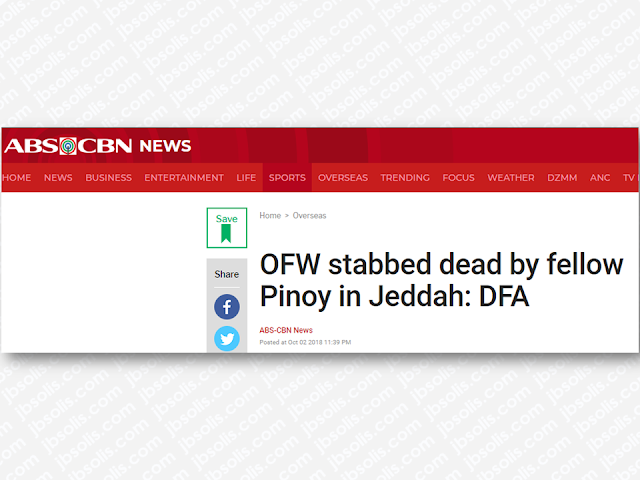
OFW Stabbed To Death By A Fellow OFW in Jeddah- DFA

As overseas Filipino workers (OFW) working in an unfamiliar territory, we feel comfortable whenever we see a compatriot or a fellow Filipino abroad. In some instances, very unfortunate things happen like getting into a trouble because of a fellow Filipino. The Department of Foreign Affairs (DFA) and the Consulate General in Saudi Arabia confirmed that an OFW was stabbed and killed by a fellow OFW in Jeddah, KSA.
As overseas Filipino workers (OFW) working in an unfamiliar territory, we feel comfortable whenever we see a compatriot or a fellow Filipino abroad. In some instances, very unfortunate things happen like getting into a trouble because of a fellow Filipino. The Department of Foreign Affairs (DFA) and the Consulate General in Saudi Arabia confirmed that an OFW was stabbed and killed by a fellow OFW in Jeddah, KSA.      Ads     Sponsored Links    A Filipino was stabbed and killed by a fellow Filipino in Jeddah, Saudi Arabia, according to the confirmation of the Department of Foreign Affairs (DFA).  The victim (name withheld) was a 29-year-old from Datu Odin Sinsuat, Maguindanao, who worked as a family driver in Jeddah.   The suspect (name withheld), a 34-year-old from Capiz, also a driver for the same family  The suspect remains under police custody after he was arrested immediately after the incident. The two "allegedly engaged in a fistfight in front of the house of their employer that ended in the victim getting fatally stabbed by his fellow driver." The motive of the stabbing is still unknown.  The Consulate General and the Philippine Overseas Labor Office in Jeddah will extend full assistance to both Filipinos as well as their families.    The victim is set for a vacation to the Philippines soon but the incident turned out to be unfortunate that he will come home inside a box.  Consul General Edgar Badajos said that the suspect is facing a death sentence as per Saudi Sharia law. However, since they are both Filipinos, it is possible that the victim's family could instead  He assured that they will render assistance to help both OFWs.    Filed under the category of overseas Filipino workers, Filipino abroad, Department of Foreign Affairs (DFA), Saudi Arabia,   stabbed, Jeddah, KSA

Ads


Sponsored Links


A Filipino was stabbed and killed by a fellow Filipino in Jeddah, Saudi Arabia, according to the confirmation of the Department of Foreign Affairs (DFA).

The victim (name withheld) was a 29-year-old from Datu Odin Sinsuat, Maguindanao, who worked as a family driver in Jeddah.

The suspect (name withheld), a 34-year-old from Capiz, also a driver for the same family

The suspect remains under police custody after he was arrested immediately after the incident. The two "allegedly engaged in a fistfight in front of the house of their employer that ended in the victim getting fatally stabbed by his fellow driver." The motive of the stabbing is still unknown.

The Consulate General and the Philippine Overseas Labor Office in Jeddah will extend full assistance to both Filipinos as well as their families.

The victim is set for a vacation to the Philippines soon but the incident turned out to be so unfortunate that he will come home inside a wooden box.

Consul General Edgar Badajos said that the suspect is facing a death sentence as per Saudi Sharia law. However, since they are both Filipinos, it is possible that the victim's family could instead ask for a blood money in exchange for his life and freedom. He assured that they will render assistance to help both OFWs and their families.
As overseas Filipino workers (OFW) working in an unfamiliar territory, we feel comfortable whenever we see a compatriot or a fellow Filipino abroad. In some instances, very unfortunate things happen like getting into a trouble because of a fellow Filipino. The Department of Foreign Affairs (DFA) and the Consulate General in Saudi Arabia confirmed that an OFW was stabbed and killed by a fellow OFW in Jeddah, KSA.      Ads     Sponsored Links    A Filipino was stabbed and killed by a fellow Filipino in Jeddah, Saudi Arabia, according to the confirmation of the Department of Foreign Affairs (DFA).  The victim (name withheld) was a 29-year-old from Datu Odin Sinsuat, Maguindanao, who worked as a family driver in Jeddah.   The suspect (name withheld), a 34-year-old from Capiz, also a driver for the same family  The suspect remains under police custody after he was arrested immediately after the incident. The two "allegedly engaged in a fistfight in front of the house of their employer that ended in the victim getting fatally stabbed by his fellow driver." The motive of the stabbing is still unknown.  The Consulate General and the Philippine Overseas Labor Office in Jeddah will extend full assistance to both Filipinos as well as their families.    The victim is set for a vacation to the Philippines soon but the incident turned out to be unfortunate that he will come home inside a box.  Consul General Edgar Badajos said that the suspect is facing a death sentence as per Saudi Sharia law. However, since they are both Filipinos, it is possible that the victim's family could instead  He assured that they will render assistance to help both OFWs.    Filed under the category of overseas Filipino workers, Filipino abroad, Department of Foreign Affairs (DFA), Saudi Arabia,   stabbed, Jeddah, KSA
Filed under the category of overseas Filipino workers, Filipino abroad, Department of Foreign Affairs (DFA), Saudi Arabia,   stabbed, Jeddah, KSA 
Ads

Read More:

More often, families with overseas Filipino workers (OFW) rely on their OFW breadwinner in providing their needs and without doing any efforts to have extra income. They use the money they receive to pay their bills, rents, mortgages, etc. They tend to spend the remittances they receive and wait for the next remittance when the money is over without any savings. This is the reason why no matter how long the OFWs exhaust themselves working overseas, they are still coming home broke and without any savings.  Encouraging our spouse or anyone who is responsible for the remittances you send to save could be a great help and could guarantee a hassle-free retirement, much more if they placed this savings to a profitable investment.      Ads     Sponsored Links    Stick to a budget schedule  Convince your spouse to make a monthly budget and commit to saving a portion of the monthly remittance. They could also spend the remaining part of the budget after setting aside the savings.  No matter how small the savings, it could mean a lot after a period of time you regularly do it.    Use the credit card wisely or do not use it at all  Credit cards could be an advantage when purchasing but it can also lure the holder to spend more. Whenever possible, avoid using credit cards and use cash instead. It would save you from paying extra charges and interests which can really raise your spending.    The best rule should be, do not spend the money you do not have.     Always make a list of important things to buy  Many OFW spouses tend to go on a shopping spree just after receiving the remittance and let their impulses lead in which items they like to buy at the very moment without putting their priorities on the things they really needed.  Encourage them to develop a habit and discipline of making a list of the things they need to prioritize during shopping and strictly follow what is on the list to avoid spending too much on the things that are not really important.    Live a lifestyle that suits your income  Many OFW spouses live like one day millionaire. after claiming the remittances you sent, they will go straight to the mall, eat at the fast-food chain of their choice, go on a shopping spree buying what they want without even thinking if they still have the money to go through the month until the next remittance. If their budget got short, they would borrow money from someone which would cause the next budget to bear the shortage and the cycle goes on.    There's nothing wrong with being generous but not too much  Advise your spouse to exercise caution when giving help to extended families, relatives or friends. There is nothing wrong with extending help but there has to be a limitation. This would avoid them to become dependent on your assistance that they would knock your everytime they need financial help.    Working overseas is not forever and you will eventually come home for good. It is you and your spouse who need to work hand-in-hand to succeed. Together you must find ways to take care of your finances and save for the future of your family.  Filed under the category of overseas Filipino workers, extra income,  bills, rents, mortgages, remittances, working overseas, retirement, investment, savings