Carousel

Sponsored Links

Looking for House and Lot Within Tagaytay Area? CONTACT US!

Name

Email *

Message *

Showing posts with label DFA. Show all posts

Wednesday, January 05, 2022

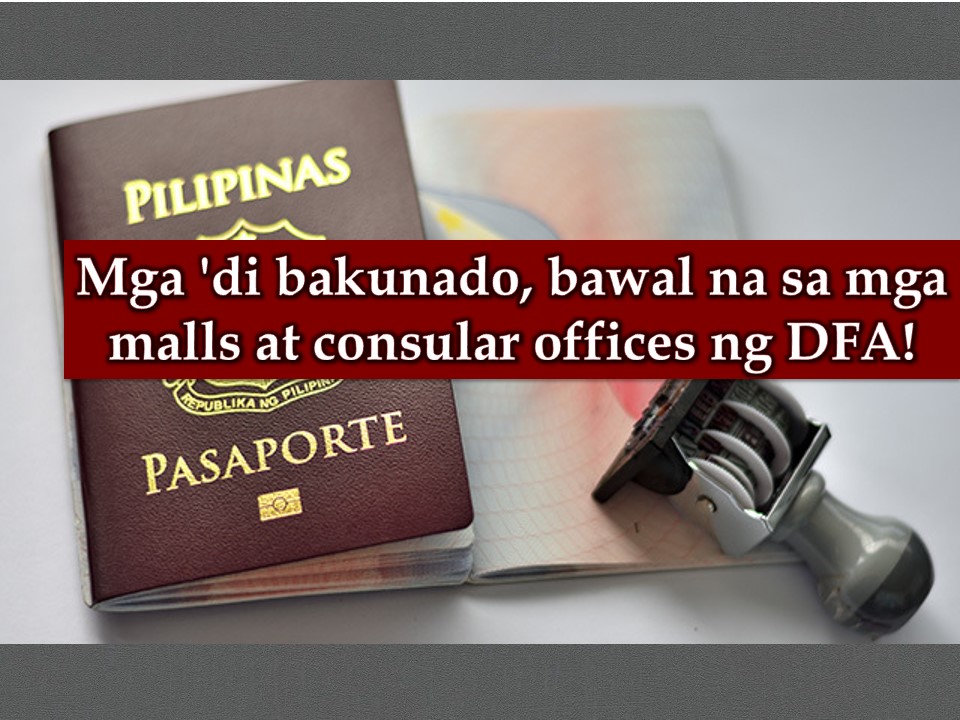
'Di bakunado, 'di na makag-proseso ng passport sa mga malls at consular offices ng DFA


MANILA, Philippines — NAGLABAS ngayon ng abiso ang Department of Foreign Affairs o DFA na hindi na tatanggapin sa kanilang mga consular offices at off-site mall passport services na nasa Alert Level 3 areas ang mga hindi pa bakunado laban sa Covid-19.

Sa advisory, nilinaw ng DFA na ang pagbabawal sa pagpasok ng mga hindi pa nabakunahan laban sa Covid-19 ay ipinatutupad ng mga shopping malls kung nasaan ang kanilang consular offices at Temporary Off-Site Passport Services at TOPS.

“The [DFA]…informs the public that its Consular Offices (COs) and [TOPS] located in malls in areas where at least Alert Level 3 is raised will not be able to accommodate unvaccinated individuals, including minors, due to the restrictions imposed by their host malls barring the entry of unvaccinated persons,” paliwanag ng DFA.

Ads


“Consular Offices are unable to override the host malls’ security and health protocols,” dagdag pa nito.

Pinayuhan naman ng DFA ang mga hindi pa bakunadong mga aplikante kasama na ang mga minor de edad na i-check muna ang regulations ng mga malls kung saan naroon ang kanilang opisina bago pumunta para sa kanilang appointments.

Maaari naman umanong i-reschedule ng mga apektadong aplikante ang kanilang appointment sakaling maging fully-vaccinated na laban sa Covid-19 o “after malls and local government units have lifted the entry restriction on unvaccinated persons.”

“The Department requests the public’s cooperation as it strives to deliver passport services to the public while ensuring the public’s safety and health amidst the ongoing pandemic,” pahayag ng DFA.

Ads


Sponsored Links


Matatandaan na isinailalim ng gobyerno sa mas istriktong Alert Level 3 hanggang Enero 3 ang Metro Manila dahil sa labis na pagtaas ng bagong kaso ng Covid-19.

Maliban sa Metro Manila, nasa Alert Level 3 din simula Enero 5 ang mga probinsiya ng Bulacan, Cavite, at Rizal na tatagal din hanggang Enero 15.

Nananatili naman sa Alert Level 2 ang natitirang bahagi ng bansa.

©2020 THOUGHTSKOTO

Friday, October 04, 2019

Applying or Renewing for Passport? Check the Valid ID's Accepted by DFA


Whether you are planning to work or travel abroad, a valid Philippine passport is one of the most important things you must have because, without it, you can't leave the country.

Applying for a Philippine passport is now easy with more online appointment slots available and a simplified process. In fact, you can apply for passport hassle-free if you study the process first and complete the requirements needed before proceeding to the Department of Foreign Affairs. 

One of the most important requirements in the process is a valid identification card or ID. But remember that not all valid IDs are accepted in the DFA. 


Ads


So if you are planning to apply or renew your passport, the Department of Foreign Affairs accepts at least one of the following valid IDs with one photocopy.

  • Social Security System card
  • Government Service Insurance System card
  • Unified Multi-Purpose Identification card
  • Land Transportation Office driver’s License (student permits will be accepted if in card format)
  • Professional Regulatory Commission ID
  • Overseas Workers Welfare Administration e-card
  • Commission on Elections voter's ID or Voter's Certification from the election officer (with dry seal)
  • Philippine National Police firearms license
  • Senior Citizen ID
  • Airman license (issued August 2016 onwards)
  • School ID (if applicable)
  • Current Valid ePassport (for renewal of ePassport)


Ads


Aside from the above mentioned IDs, the DFA is also accepting postal ID as a valid recognized ID for passport application. The acceptance of postal ID started last August 1, 2019. The Postal ID presented must be valid during the time of the passport application. Valid Postal IDs are those that were issued starting November 2016.

Sponsored Links


The DFA clarifies that the following IDs are not accepted as valid IDs in passport processing.
  • Tax Identification Number (TIN)
  • PAG-IBIG ID
  • Philippine Health Insurance Corporation (Philhealth) ID
  • Barangay ID
  • Police Clearance
  • Barangay Clearance
  • SSS E-1 Form
  • LTO Driver's License receipt
  • Paper-format Student Driver's Permit
  • Company ID
Read: Where to Apply or Renew Your Passport This 2019?

This article is filed under Philippine passport, passport application, passport processing, passport online appointment, DFA, and valid IDs for passport.


©2019 THOUGHTSKOTO

Wednesday, September 18, 2019

DFA Launched "OFW Help" To Improve Assistance To The OFWs

To further improve and hasten rendering services to the
 overseas Filipino  workers (OFW), the Department of Foreign Affairs (DFA) launched their social media page.
To further improve and hasten rendering services to the   overseas Filipino  workers (OFW), the Department of Foreign Affairs (DFA) launched their social media page.  Upang mas mapagbuti at mapabilis ang pagbibigay ng serbisyo sa mga overseas Filipino  workers (OFW), naglunsad ng social media page ang Department of Foreign Affairs (DFA).      Ads  Inilunsad ng DFA ang "OFW Help" Facebook Page upang mabigyan ng bagong sistema ang mga distressed OFW upang maiparating sa gobyerno ang kanilang mga hiling at agarang tulong.  Ito ay pinangangasiwaan ng  DFA-Office of the Undersecretary for Migrant Workers' Affairs (OUMWA). Layunin nito na magbigay ng tulong sa mga OFW na mga undocumented o  hindi mga miyembro ng Overseas Workers Welfare Administration (OWWA) na kailangan ng agarang tulong. Ads          Sponsored Links        "It aims to provide a more preferable system in receiving request for assistance from the next-of-kin of OFWs and OUMWA case officers. Especially if the client is unable to contact the OUMWA hotline or travel to the nearest Post," ayon sa nakasulat sa profile nito.  Ang OUMWA ang pangunahing tanggapan na inatasang humawak sa mga paghingi ng tulong ng mga kamag-anak ng OFW o ng mga OFW mismo.  Ang mga request ay inire-refer naman sa Philippine Embassy o sa konsulado ng bansa kung saan naroon ang kailangang bigyan ng tulong na siya namang gumagawa ng hakbang upang makipag-ugnayan sa employer at sa iba pang kinauukulan upang bigyan ng tulong ang distressed OFW.    Ads    The DFA now has "OFW Help" Facebook Page giving distressed OFWs a new avenue to get in touch with the government regarding their plea for help and immediate assistance.    It is under the DFA-Office of the Undersecretary for Migrant Workers' Affairs (OUMWA). Its goal is to render assistance to the undocumented or OFWs who are not members of  the Overseas Workers Welfare Administration (OWWA) who need immediate help.  Ads          Sponsored Links        "It aims to provide a more preferable system in receiving request for assistance from the next-of-kin of OFWs and OUMWA case officers. Especially if the client is unable to contact the OUMWA hotline or travel to the nearest Post," according to its profile.     OUMWA  is the prime office mandated to handle cases of the OFWs appealed  y their relatives in the Philippines or the OFWs themselves.  The requests are then referred to the Philippine Embassy or consulates of the host country where the OFWs is located. They are the ones who communicate with with the employer and other concerned agencies which can provide assistance to the OFWs in distress.

Ads


The DFA now has "OFW Help" Facebook Page giving distressed OFWs a new avenue to get in touch with the government regarding their plea for help and immediate assistance.

It is under the DFA-Office of the Undersecretary for Migrant Workers' Affairs (OUMWA). Its goal is to render assistance to the undocumented or OFWs who are not members of
the Overseas Workers Welfare Administration (OWWA) who need immediate help.
Ads


Sponsored Links


"It aims to provide a more preferable system in receiving request for assistance from the next-of-kin of OFWs and OUMWA case officers. Especially if the client is unable to contact the OUMWA hotline or travel to the nearest Post," according to its profile.

 OUMWA  is the prime office mandated to handle cases of the OFWs appealed  y their relatives in the Philippines or the OFWs themselves.
The requests are then referred to the Philippine Embassy or consulates of the host country where the OFWs is located. They are the ones who communicate with with the employer and other concerned agencies which can provide assistance to the OFWs in distress.

©2019 THOUGHTSKOTO

Friday, August 23, 2019

Transfer OFW Detainees To Philippine Jail - Lacson

POEA statistics  show that there are around 2.3 million overseas  Filipino workers deployed across the globe. The most number of them are located in the Middle East. In 2018, there were approximately 4,000 Filipinos in different detention facilities overseas with various cases and over a hundred of them are in death row.
 Sen. Fanfilo Lacson issued the statement after the DFA presented data during the meeting showing that most Filipinos overseas were detained due to drug charges.
POEA statistics  show that there are around 2.3 million overseas  Filipino workers deployed across the globe. The most number of them are located in the Middle East. In 2018, there were approximately 4,000 Filipinos in different detention facilities overseas with various cases and over a hundred of them are in death row.   Sen. Fanfilo Lacson issued the statement after the DFA presented data during the meeting showing that most Filipinos overseas were detained due to drug charges.      Ads   SEN. Panfilo “Ping” Lacson wants the repatriation of Filipino convicts from abroad, reported Inquirer.    Lacson urged the Department of Foreign Affairs (DFA) to pursue more Transfer of Sentenced Persons agreements with other countries.    Lacson called for it Monday during the organizational meeting of the Senate Committee Foreign Relations, where the DFA presented data showing that most Filipinos overseas were detained over drug charges.    “How do you reconcile (the fact that) here in our country we’re killing people and then we’re saving drug convicts detained in another country. I’m just curious,” Lacson asked Foreign Affairs Secretary Teodoro Locsin Jr.    “Going back to the repatriation of Filipino convicts, maybe you should pursue more Transfer of Sentenced Persons treaties, just like what we have with Spain. I’m just wondering if they would agree to be transferred to Muntinlupa [that is, the New Bilibid Prison] from where they are being detained abroad,” Inquirer quoted Lacson as saying.    The Treaty on the Transfer of Sentenced Persons states that individuals tried and convicted in a foreign country have the option to serve their remaining sentence in their home country.    The DFA extends financial and legal aid to Filipinos abroad, including those detained or convicted.  Ads      Sponsored Links    “We are not saying that they [Filipino convicts abroad] should not be punished, but since they are our nationals, we take care of them, we monitor how they are treated, we look at their condition. So is that a way to rationalize?” Sen. Aquilino Pimentel III, chair of the Senate foreign relations committee, said.  “Cause we will never ask a foreign country, do not punish our countryman who is involved in drugs because we also will jail him here if he violates our loss. But when you incarcerate him and you punish him, we should be allowed to take a look and pay a visit to our countryman and look at his condition or situation,” he added.

Ads


SEN. Panfilo “Ping” Lacson wants the repatriation of Filipino convicts from abroad, reported Inquirer.

Lacson urged the Department of Foreign Affairs (DFA) to pursue more Transfer of Sentenced Persons agreements with other countries.

Lacson called for it Monday during the organizational meeting of the Senate Committee Foreign Relations, where the DFA presented data showing that most Filipinos overseas were detained over drug charges.

“How do you reconcile (the fact that) here in our country we’re killing people and then we’re saving drug convicts detained in another country. I’m just curious,” Lacson asked Foreign Affairs Secretary Teodoro Locsin Jr.

“Going back to the repatriation of Filipino convicts, maybe you should pursue more Transfer of Sentenced Persons treaties, just like what we have with Spain. I’m just wondering if they would agree to be transferred to Muntinlupa [that is, the New Bilibid Prison] from where they are being detained abroad,” Inquirer quoted Lacson as saying.

The Treaty on the Transfer of Sentenced Persons states that individuals tried and convicted in a foreign country have the option to serve their remaining sentence in their home country.

The DFA extends financial and legal aid to Filipinos abroad, including those detained or convicted.

Ads


Sponsored Links


“We are not saying that they [Filipino convicts abroad] should not be punished, but since they are our nationals, we take care of them, we monitor how they are treated, we look at their condition. So is that a way to rationalize?” Sen. Aquilino Pimentel III, chair of the Senate foreign relations committee, said.

“Cause we will never ask a foreign country, do not punish our countryman who is involved in drugs because we also will jail him here if he violates our loss. But when you incarcerate him and you punish him, we should be allowed to take a look and pay a visit to our countryman and look at his condition or situation,” he added.
©2019 THOUGHTSKOTO

Sunday, August 18, 2019

Robber Attacked OFW In Saudi Arabia

Overseas Filipino workers (OFW) work overseas for a better income but sometimes, untoward incidents are inevitable. An OFW in Saudi Arabia had been a victim of an armed robber taking the company money as well as his own cash which is allocated for his dialysis treatment.

Overseas Filipino workers work overseas for a better income but sometimes, untoward incidents are inevitable. An OFW in Saudi Arabia had been a victim of an armed robber taking the company money as well as his own cash which is allocated for his dialysis treatment.       Ads  Michael Arsolacia, the OFW was working inside their office in Saudi Arabia when a man disguised as a Saudi national entered their office posing as complaining about a certain employee of their office.   According to the statement of the OFW, the man approached him and grabbed a bag containing the shop's money Iqama and other valuables amounting to over SAR 2,000  including his own cash intended for his medication and hemodialysis treatment. The victim tried to recover the bag from the assailant but the man was holding a bladed weapon and threatened the victim using the said knife. The OFW tried to follow him but later retracted upon learning that the suspect was not alone.  Ads          Sponsored Links   The OFW victim is pleading for the Philippine government for help to locate and arrest the suspect. The Department of Foreign Affairs-OUMWA is summoning Arsolacia to their office in order to help him file the appropriate case against the suspect and to give him help as well.  labor Secretary Silvestre Bello III reminded the OFW's that should they have become a victim of any crimes, they should go immediately to the Philippine Overseas Labor Office or the consulate in their host country to seek help. He emphasized that these offices are there to help and protect them.

Ads

Michael Arsolacia, the OFW was working inside their office in Saudi Arabia when a man disguised as a Saudi national entered their office posing as complaining about a certain employee of their office. 
According to the statement of the OFW, the man approached him and grabbed a bag containing the shop's money Iqama and other valuables amounting to over SAR 2,000  including his own cash intended for his medication and hemodialysis treatment. The victim tried to recover the bag from the assailant but the man was holding a bladed weapon and threatened the victim using the said knife. The OFW tried to follow him but later retracted upon learning that the suspect was not alone.
Ads


Sponsored Links


The OFW victim is pleading for the Philippine government for help to locate and arrest the suspect. The Department of Foreign Affairs-OUMWA is summoning Arsolacia to their office in order to help him file the appropriate case against the suspect and to give him help as well.

labor Secretary Silvestre Bello III reminded the OFW's that should they have become a victim of any crimes, they should go immediately to the Philippine Overseas Labor Office or the consulate in their host country to seek help. He emphasized that these offices are there to help and protect them. 
©2019 THOUGHTSKOTO

Wednesday, July 31, 2019

First-ever Online Passport Appointment Abroad Now Open In Hong Kong

For overseas Filipino workers deployed in Hong Kong who want to apply for renewal of their passports, they can do it at the comfort of their own home through the online passport appointment made possible by the Department of Foreign Affairs (DFA).

For overseas Filipino workers deployed in Hong Kong who want to apply for renewal of their passports, they can do it at the comfort of their own home through the online passport appointment made possible by the Department of Foreign Affairs (DFA).      Ads    The first-ever online passport portal abroad was launched in Hong Kong by the Department of Foreign Affairs (DFA) to expedite the process of setting appointments.  “The Online Appointment System (OAS) aims to slash the long queues for passport appointments in Hong Kong, especially on Sundays, by providing an easy-to-navigate, faster and more convenient way to get a passport appointment,” Foreign Affairs Secretary Teddyboy Locsin, Jr. said.   Consul general to Hong Kong Antonio A. Morales thanked Locsin for choosing Hong Kong as the first site for the OAS outside the country.   More than 234,000 Filipinos are deployed in Hong Kong, 215,000 of whom or 92% are household service workers.   Ads          Sponsored Links    Last year, the Consulate General in Hong Kong issued more than 48,000 passports to OFWs.   The OAS hopes to give workers abroad flexibility in choosing passport appointments. With just four easy steps and a few minutes using either a mobile phone or computer, passport applicants no longer have to line up, call or e-mail to make an appointment.  Locsin said he hopes to expand the OAS to other countries in Asia, as well as in other regions such as the Middle East, Europe and the Americas.

Ads


The first-ever online passport portal abroad was launched in Hong Kong by the Department of Foreign Affairs (DFA) to expedite the process of setting appointments.

“The Online Appointment System (OAS) aims to slash the long queues for passport appointments in Hong Kong, especially on Sundays, by providing an easy-to-navigate, faster and more convenient way to get a passport appointment,” Foreign Affairs Secretary Teddyboy Locsin, Jr. said.

 Consul general to Hong Kong Antonio A. Morales thanked Locsin for choosing Hong Kong as the first site for the OAS outside the country.

 More than 234,000 Filipinos are deployed in Hong Kong, 215,000 of whom or 92% are household service workers.

Ads


Sponsored Links


Last year, the Consulate General in Hong Kong issued more than 48,000 passports to OFWs.

The OAS hopes to give workers abroad flexibility in choosing passport appointments. With just four easy steps and a few minutes using either a mobile phone or computer, passport applicants no longer have to line up, call or e-mail to make an appointment.

Locsin said he hopes to expand the OAS to other countries in Asia, as well as in other regions such as the Middle East, Europe and the Americas.
©2019 THOUGHTSKOTO

Thursday, May 09, 2019

Red Ribbon No Longer Required To These Countries Starting May 14

The Department of Foreign Affairs said they will no longer issue Authentication Certificates for documents issued by the Philippine government that will be submitted to or have originated from 150 countries starting Tuesday, May 14

This is made possible because the Philippines signed the Hague Apostille Convention, an international law that entitles the Philippine to simplify procedures in the use of public documents abroad or from abroad here in the Philippines.

The Department of Foreign Affairs said they will no longer issue Authentication Certificates for documents issued by the Philippine government that will be submitted to or have originated from 150 countries starting Tuesday, May 14  This is made possible because the Philippines signed the Hague Apostille Convention, an international law that entitles the Philippine to simplify procedures in the use of public documents abroad or from abroad here in the Philippines.      Ads    The Department of Foreign Affairs said they will no longer issue Authentication Certificates for documents issued by the Philippine government that will be submitted to or have originated from 150 countries starting Tuesday, May 14  This is made possible because the Philippines signed the Hague Apostille Convention, an international law that entitles the Philippine to simplify procedures in the use of public documents abroad or from abroad here in the Philippines.  Filipinos used to undergo a lengthy process of authenticating public documents like birth certificates, marriage certificates, death certificates, university diplomas, and professional licensure certificates required for employment or immigration.    The DFA advisory reads: PUBLIC ADVISORY: APOSTILLE CONVENTION ON AUTHENTICATION OF DOCUMENTS TAKES EFFECT IN PH ON 14 MAY 2019 Public Advisory: Apostille Convention on Authentication of Documents Takes Effect in PH on 14 May 2019  07 May 2019 — The Department of Foreign Affairs (DFA)—Office of Consular Affairs wishes to inform the public that it will no longer issue Authentication Certificates from 14 May 2019. Instead, the DFA will affix an Apostille to documents for use abroad as proof of authentication for use in Apostille-contracting parties.  After authentication by the DFA, there is no more need for authentication (legalization) by the concerned Foreign Embassies or Consulates General if the country or territory of destination of the authenticated document is already a member of the Apostille Convention.  Public documents executed in Apostille-contracting countries and territories (except for Austria, Finland, Germany, and Greece) to be used in the Philippines no longer have to be authenticated by the Philippine Embassy or Consulate General once Apostillized.  However, in countries and territories which are not Apostille-contracting parties, the previous process of authentication applies.  Documents still have to be authenticated by the Philippine Embassy or Consulate General before they can be used in the Philippines.  Also, there is still a need for authentication (legalization) by the concerned Foreign Embassies or Consulates General if the country of destination of the authenticated document is not yet a member of the Apostille Convention.  Authentication fees will remain at PhP100 (regular processing) and PhP200 (expedited processing) per document.   For the updated list of Apostille-contracting parties, please visit this link.   Ads  The following countries no longer require authentication of documents.   Contracting Party S 1 R/A/S2 Type3 EIF4 EXT5 Auth6 Res/D/N/DC7 Albania  3-IX-2003 A 9-V-2004  1  Andorra  15-IV-1996 A 31-XII-1996  1  Antigua and Barbuda  1-V-1985 Su 1-XI-1981  1  Argentina  8-V-1987 A 18-II-1988  1 D Armenia  19-XI-1993 A 14-VIII-1994  1  Australia  11-VII-1994 A 16-III-1995  1 D Austria 5-X-1961 14-XI-1967 R 13-I-1968  1 D Azerbaijan  13-V-2004 A** 2-III-2005  1  Bahamas  30-IV-1976 Su 10-VII-1973  1  Bahrain  10-IV-2013 A 31-XII-2013  1 D Barbados  11-VIII-1995 Su 30-XI-1966  1  Belarus  16-VI-1992 Su 31-V-1992  1  Belgium 10-III-1970 11-XII-1975 R 9-II-1976  1  Belize  17-VII-1992 A 11-IV-1993  1  Bolivia  6-IX-2017 A 7-V-2018  1  Bosnia and Herzegovina  23-VIII-1993 Su 6-III-1992  1 D Botswana  16-IX-1968 Su 30-IX-1966  1  Brazil  2-XII-2015 A 14-VIII-2016  1 D Brunei Darussalam  23-II-1987 A 3-XII-1987  1  Bulgaria  1-VIII-2000 A 29-IV-2001  1  Burundi  10-VI-2014 A** 13-II-2015  1  Cabo Verde  7-V-2009 A 13-II-2010  1  Chile  16-XII-2015 A 30-VIII-2016  1  China, People's Republic of   C   2 D,N Colombia  27-IV-2000 A 30-I-2001  1 D Cook Islands  13-VII-2004 A 30-IV-2005  1  Costa Rica  6-IV-2011 A 14-XII-2011  1  Croatia  23-IV-1993 Su 8-X-1991  1  Cyprus  26-VII-1972 A 30-IV-1973  1  Czech Republic  23-VI-1998 A 16-III-1999  1  Denmark 20-X-2006 30-X-2006 R 29-XII-2006  1 D Dominica  22-X-2002 Su 3-XI-1978  1  Dominican Republic  12-XII-2008 A** 30-VIII-2009  1  Ecuador  2-VII-2004 A 2-IV-2005  1 D El Salvador  14-IX-1995 A 31-V-1996  1  Estonia  11-XII-2000 A 30-IX-2001  1 D Eswatini (formerly Swaziland)  3-VII-1978 Su 6-IX-1968  1  Fiji  29-III-1971 Su 10-X-1970  1  Finland 13-III-1962 27-VI-1985 R 26-VIII-1985  1 D France 9-X-1961 25-XI-1964 R 24-I-1965  1 D Georgia  21-VIII-2006 A 14-V-2007  1 D Germany 5-X-1961 15-XII-1965 R 13-II-1966  1 D,N Greece 5-X-1961 19-III-1985 R 18-V-1985  1  Grenada  17-VII-2001 A 7-IV-2002  1  Guatemala  19-I-2017 A 18-IX-2017  1 D Guyana  30-VII-2018 A 18-IV-2019  1  Honduras  20-I-2004 A 30-IX-2004  1  Hungary  18-IV-1972 A 18-I-1973  1 D Iceland 7-IX-2004 28-IX-2004 R 27-XI-2004  1  India  26-X-2004 A** 14-VII-2005  1  Ireland 29-X-1996 8-I-1999 R 9-III-1999  1  Israel  11-XI-1977 A 14-VIII-1978  1  Italy 15-XII-1961 13-XII-1977 R 11-II-1978  1  Japan 12-III-1970 28-V-1970 R 27-VII-1970  1  Kazakhstan  5-IV-2000 A 30-I-2001  1 D Korea, Republic of  25-X-2006 A 14-VII-2007  1  Kosovo  6-XI-2015 A** 14-VII-2016  1 D,DC Kyrgyzstan  15-XI-2010 A** 31-VII-2011  1  Latvia  11-V-1995 A 30-I-1996  1 D Lesotho  24-IV-1972 Su 4-X-1966  1  Liberia  24-V-1995 A** 8-II-1996  1  Liechtenstein 18-IV-1962 19-VII-1972 R 17-IX-1972  1  Lithuania  5-XI-1996 A 19-VII-1997  1  Luxembourg 5-X-1961 4-IV-1979 R 3-VI-1979  1  Malawi  24-II-1967 A 2-XII-1967  1  Malta  12-VI-1967 A 3-III-1968  1  Marshall Islands  18-XI-1991 A 14-VIII-1992  1  Mauritius  20-XII-1968 Su 12-III-1968  1  Mexico  1-XII-1994 A 14-VIII-1995  1  Monaco  24-IV-2002 A 31-XII-2002  1  Mongolia  2-IV-2009 A** 31-XII-2009  1  Montenegro  30-I-2007 Su 3-VI-2006  1  Morocco  27-XI-2015 A** 14-VIII-2016  1  Namibia  25-IV-2000 A 30-I-2001  1  Netherlands 30-XI-1962 9-VIII-1965 R 8-X-1965 4 1 D New Zealand  7-II-2001 A 22-XI-2001  1 D Nicaragua  7-IX-2012 A 14-V-2013  1  Niue  10-VI-1998 A 2-III-1999  1  Norway 30-V-1983 30-V-1983 R 29-VII-1983  1  Oman  12-V-2011 A 30-I-2012  1  Panama  30-X-1990 A 4-VIII-1991  1  Paraguay  10-XII-2013 A** 30-VIII-2014  1  Peru  13-I-2010 A** 30-IX-2010  1  Philippines  12-IX-2018 A** 14-V-2019  1 D Poland  19-XI-2004 A 14-VIII-2005  1  Portugal 20-VIII-1965 6-XII-1968 R 4-II-1969  1 D Republic of Moldova  19-VI-2006 A** 16-III-2007  1  Republic of North Macedonia  20-IX-1993 Su 17-XI-1991  1  Romania  7-VI-2000 A 16-III-2001  1 D Russian Federation  4-IX-1991 Su 31-V-1992  1 D,N Saint Kitts and Nevis  26-II-1994 A 14-XII-1994  1  Saint Lucia  5-XII-2001 A 31-VII-2002  1  Saint Vincent and the Grenadines  2-V-2002 Su 27-X-1979  1  Samoa  18-I-1999 A 13-IX-1999  1  San Marino  26-V-1994 A 13-II-1995  1  Sao Tome and Principe  19-XII-2007 A 13-IX-2008  1  Serbia  26-IV-2001 Su 27-IV-1992  1 D Seychelles  9-VI-1978 A 31-III-1979  1  Slovakia  6-VI-2001 A 18-II-2002  1  Slovenia  8-VI-1992 Su 25-VI-1991  1  South Africa  3-VIII-1994 A 30-IV-1995  1  Spain 21-X-1976 27-VII-1978 R 25-IX-1978  1 D Suriname  29-X-1976 Su 25-XI-1975  1  Sweden 2-III-1999 2-III-1999 R 1-V-1999  1  Switzerland 5-X-1961 10-I-1973 R 11-III-1973  1 D Tajikistan  20-II-2015 A** 31-X-2015  1  Tonga  28-X-1971 Su 4-VI-1970  1 D Trinidad and Tobago  28-X-1999 A 14-VII-2000  1  Tunisia  10-VII-2017 A** 30-III-2018  1  Turkey 8-V-1962 31-VII-1985 R 29-IX-1985  1  Ukraine  2-IV-2003 A 22-XII-2003  1 D United Kingdom of Great Britain and Northern Ireland 19-X-1961 21-VIII-1964 R 24-I-1965 13 1 D United States of America  24-XII-1980 A 15-X-1981  1 D Uruguay  9-II-2012 A 14-X-2012  1  Uzbekistan  25-VII-2011 A** 15-IV-2012  1  Vanuatu  1-VIII-2008 Su 30-VII-1980  1  Venezuela  Sponsored Links    For those in the Philippines, the usual process is that after getting an original or certified true copy, they need to apply the document for authentication or popularly known as the “red ribbon” at the DFA, and then submit it to the concerned foreign embassy or consulate where they are going to. For Filipinos outside the country, a public document issued by the foreign government needs authentication by the foreign ministry and then by the Philippine embassy or nearest consulate.  Starting May 14, this two-step authentication process is now cut to one step only — with the DFA only affix an Apostille to document being submitted. It also applies to Filipinos in countries which signed the Apostille Convention  Top destination countries for OFWs which are also members of the Apostille Convention include the United States,  However, for Filipinos in countries which are not members of the Apostille Convention like the UAE, red ribbons and foreign embassy authentication are still required.  Authentication fees will remain at P100 for regular processing and P200 for expedited processing per document.

Ads


The Department of Foreign Affairs said they will no longer issue Authentication Certificates for documents issued by the Philippine government that will be submitted to or have originated from 150 countries starting Tuesday, May 14

This is made possible because the Philippines signed the Hague Apostille Convention, an international law that entitles the Philippine to simplify procedures in the use of public documents abroad or from abroad here in the Philippines.

Filipinos used to undergo a lengthy process of authenticating public documents like birth certificates, marriage certificates, death certificates, university diplomas, and professional licensure certificates required for employment or immigration.
The Department of Foreign Affairs said they will no longer issue Authentication Certificates for documents issued by the Philippine government that will be submitted to or have originated from 150 countries starting Tuesday, May 14  This is made possible because the Philippines signed the Hague Apostille Convention, an international law that entitles the Philippine to simplify procedures in the use of public documents abroad or from abroad here in the Philippines.      Ads    The Department of Foreign Affairs said they will no longer issue Authentication Certificates for documents issued by the Philippine government that will be submitted to or have originated from 150 countries starting Tuesday, May 14  This is made possible because the Philippines signed the Hague Apostille Convention, an international law that entitles the Philippine to simplify procedures in the use of public documents abroad or from abroad here in the Philippines.  Filipinos used to undergo a lengthy process of authenticating public documents like birth certificates, marriage certificates, death certificates, university diplomas, and professional licensure certificates required for employment or immigration.    The DFA advisory reads: PUBLIC ADVISORY: APOSTILLE CONVENTION ON AUTHENTICATION OF DOCUMENTS TAKES EFFECT IN PH ON 14 MAY 2019 Public Advisory: Apostille Convention on Authentication of Documents Takes Effect in PH on 14 May 2019  07 May 2019 — The Department of Foreign Affairs (DFA)—Office of Consular Affairs wishes to inform the public that it will no longer issue Authentication Certificates from 14 May 2019. Instead, the DFA will affix an Apostille to documents for use abroad as proof of authentication for use in Apostille-contracting parties.  After authentication by the DFA, there is no more need for authentication (legalization) by the concerned Foreign Embassies or Consulates General if the country or territory of destination of the authenticated document is already a member of the Apostille Convention.  Public documents executed in Apostille-contracting countries and territories (except for Austria, Finland, Germany, and Greece) to be used in the Philippines no longer have to be authenticated by the Philippine Embassy or Consulate General once Apostillized.  However, in countries and territories which are not Apostille-contracting parties, the previous process of authentication applies.  Documents still have to be authenticated by the Philippine Embassy or Consulate General before they can be used in the Philippines.  Also, there is still a need for authentication (legalization) by the concerned Foreign Embassies or Consulates General if the country of destination of the authenticated document is not yet a member of the Apostille Convention.  Authentication fees will remain at PhP100 (regular processing) and PhP200 (expedited processing) per document.   For the updated list of Apostille-contracting parties, please visit this link.   Ads  The following countries no longer require authentication of documents.   Contracting Party S 1 R/A/S2 Type3 EIF4 EXT5 Auth6 Res/D/N/DC7 Albania  3-IX-2003 A 9-V-2004  1  Andorra  15-IV-1996 A 31-XII-1996  1  Antigua and Barbuda  1-V-1985 Su 1-XI-1981  1  Argentina  8-V-1987 A 18-II-1988  1 D Armenia  19-XI-1993 A 14-VIII-1994  1  Australia  11-VII-1994 A 16-III-1995  1 D Austria 5-X-1961 14-XI-1967 R 13-I-1968  1 D Azerbaijan  13-V-2004 A** 2-III-2005  1  Bahamas  30-IV-1976 Su 10-VII-1973  1  Bahrain  10-IV-2013 A 31-XII-2013  1 D Barbados  11-VIII-1995 Su 30-XI-1966  1  Belarus  16-VI-1992 Su 31-V-1992  1  Belgium 10-III-1970 11-XII-1975 R 9-II-1976  1  Belize  17-VII-1992 A 11-IV-1993  1  Bolivia  6-IX-2017 A 7-V-2018  1  Bosnia and Herzegovina  23-VIII-1993 Su 6-III-1992  1 D Botswana  16-IX-1968 Su 30-IX-1966  1  Brazil  2-XII-2015 A 14-VIII-2016  1 D Brunei Darussalam  23-II-1987 A 3-XII-1987  1  Bulgaria  1-VIII-2000 A 29-IV-2001  1  Burundi  10-VI-2014 A** 13-II-2015  1  Cabo Verde  7-V-2009 A 13-II-2010  1  Chile  16-XII-2015 A 30-VIII-2016  1  China, People's Republic of   C   2 D,N Colombia  27-IV-2000 A 30-I-2001  1 D Cook Islands  13-VII-2004 A 30-IV-2005  1  Costa Rica  6-IV-2011 A 14-XII-2011  1  Croatia  23-IV-1993 Su 8-X-1991  1  Cyprus  26-VII-1972 A 30-IV-1973  1  Czech Republic  23-VI-1998 A 16-III-1999  1  Denmark 20-X-2006 30-X-2006 R 29-XII-2006  1 D Dominica  22-X-2002 Su 3-XI-1978  1  Dominican Republic  12-XII-2008 A** 30-VIII-2009  1  Ecuador  2-VII-2004 A 2-IV-2005  1 D El Salvador  14-IX-1995 A 31-V-1996  1  Estonia  11-XII-2000 A 30-IX-2001  1 D Eswatini (formerly Swaziland)  3-VII-1978 Su 6-IX-1968  1  Fiji  29-III-1971 Su 10-X-1970  1  Finland 13-III-1962 27-VI-1985 R 26-VIII-1985  1 D France 9-X-1961 25-XI-1964 R 24-I-1965  1 D Georgia  21-VIII-2006 A 14-V-2007  1 D Germany 5-X-1961 15-XII-1965 R 13-II-1966  1 D,N Greece 5-X-1961 19-III-1985 R 18-V-1985  1  Grenada  17-VII-2001 A 7-IV-2002  1  Guatemala  19-I-2017 A 18-IX-2017  1 D Guyana  30-VII-2018 A 18-IV-2019  1  Honduras  20-I-2004 A 30-IX-2004  1  Hungary  18-IV-1972 A 18-I-1973  1 D Iceland 7-IX-2004 28-IX-2004 R 27-XI-2004  1  India  26-X-2004 A** 14-VII-2005  1  Ireland 29-X-1996 8-I-1999 R 9-III-1999  1  Israel  11-XI-1977 A 14-VIII-1978  1  Italy 15-XII-1961 13-XII-1977 R 11-II-1978  1  Japan 12-III-1970 28-V-1970 R 27-VII-1970  1  Kazakhstan  5-IV-2000 A 30-I-2001  1 D Korea, Republic of  25-X-2006 A 14-VII-2007  1  Kosovo  6-XI-2015 A** 14-VII-2016  1 D,DC Kyrgyzstan  15-XI-2010 A** 31-VII-2011  1  Latvia  11-V-1995 A 30-I-1996  1 D Lesotho  24-IV-1972 Su 4-X-1966  1  Liberia  24-V-1995 A** 8-II-1996  1  Liechtenstein 18-IV-1962 19-VII-1972 R 17-IX-1972  1  Lithuania  5-XI-1996 A 19-VII-1997  1  Luxembourg 5-X-1961 4-IV-1979 R 3-VI-1979  1  Malawi  24-II-1967 A 2-XII-1967  1  Malta  12-VI-1967 A 3-III-1968  1  Marshall Islands  18-XI-1991 A 14-VIII-1992  1  Mauritius  20-XII-1968 Su 12-III-1968  1  Mexico  1-XII-1994 A 14-VIII-1995  1  Monaco  24-IV-2002 A 31-XII-2002  1  Mongolia  2-IV-2009 A** 31-XII-2009  1  Montenegro  30-I-2007 Su 3-VI-2006  1  Morocco  27-XI-2015 A** 14-VIII-2016  1  Namibia  25-IV-2000 A 30-I-2001  1  Netherlands 30-XI-1962 9-VIII-1965 R 8-X-1965 4 1 D New Zealand  7-II-2001 A 22-XI-2001  1 D Nicaragua  7-IX-2012 A 14-V-2013  1  Niue  10-VI-1998 A 2-III-1999  1  Norway 30-V-1983 30-V-1983 R 29-VII-1983  1  Oman  12-V-2011 A 30-I-2012  1  Panama  30-X-1990 A 4-VIII-1991  1  Paraguay  10-XII-2013 A** 30-VIII-2014  1  Peru  13-I-2010 A** 30-IX-2010  1  Philippines  12-IX-2018 A** 14-V-2019  1 D Poland  19-XI-2004 A 14-VIII-2005  1  Portugal 20-VIII-1965 6-XII-1968 R 4-II-1969  1 D Republic of Moldova  19-VI-2006 A** 16-III-2007  1  Republic of North Macedonia  20-IX-1993 Su 17-XI-1991  1  Romania  7-VI-2000 A 16-III-2001  1 D Russian Federation  4-IX-1991 Su 31-V-1992  1 D,N Saint Kitts and Nevis  26-II-1994 A 14-XII-1994  1  Saint Lucia  5-XII-2001 A 31-VII-2002  1  Saint Vincent and the Grenadines  2-V-2002 Su 27-X-1979  1  Samoa  18-I-1999 A 13-IX-1999  1  San Marino  26-V-1994 A 13-II-1995  1  Sao Tome and Principe  19-XII-2007 A 13-IX-2008  1  Serbia  26-IV-2001 Su 27-IV-1992  1 D Seychelles  9-VI-1978 A 31-III-1979  1  Slovakia  6-VI-2001 A 18-II-2002  1  Slovenia  8-VI-1992 Su 25-VI-1991  1  South Africa  3-VIII-1994 A 30-IV-1995  1  Spain 21-X-1976 27-VII-1978 R 25-IX-1978  1 D Suriname  29-X-1976 Su 25-XI-1975  1  Sweden 2-III-1999 2-III-1999 R 1-V-1999  1  Switzerland 5-X-1961 10-I-1973 R 11-III-1973  1 D Tajikistan  20-II-2015 A** 31-X-2015  1  Tonga  28-X-1971 Su 4-VI-1970  1 D Trinidad and Tobago  28-X-1999 A 14-VII-2000  1  Tunisia  10-VII-2017 A** 30-III-2018  1  Turkey 8-V-1962 31-VII-1985 R 29-IX-1985  1  Ukraine  2-IV-2003 A 22-XII-2003  1 D United Kingdom of Great Britain and Northern Ireland 19-X-1961 21-VIII-1964 R 24-I-1965 13 1 D United States of America  24-XII-1980 A 15-X-1981  1 D Uruguay  9-II-2012 A 14-X-2012  1  Uzbekistan  25-VII-2011 A** 15-IV-2012  1  Vanuatu  1-VIII-2008 Su 30-VII-1980  1  Venezuela  Sponsored Links    For those in the Philippines, the usual process is that after getting an original or certified true copy, they need to apply the document for authentication or popularly known as the “red ribbon” at the DFA, and then submit it to the concerned foreign embassy or consulate where they are going to. For Filipinos outside the country, a public document issued by the foreign government needs authentication by the foreign ministry and then by the Philippine embassy or nearest consulate.  Starting May 14, this two-step authentication process is now cut to one step only — with the DFA only affix an Apostille to document being submitted. It also applies to Filipinos in countries which signed the Apostille Convention  Top destination countries for OFWs which are also members of the Apostille Convention include the United States,  However, for Filipinos in countries which are not members of the Apostille Convention like the UAE, red ribbons and foreign embassy authentication are still required.  Authentication fees will remain at P100 for regular processing and P200 for expedited processing per document.
 The DFA advisory reads:

PUBLIC ADVISORY: APOSTILLE CONVENTION ON AUTHENTICATION OF DOCUMENTS TAKES EFFECT IN PH ON 14 MAY 2019

Public Advisory: Apostille Convention on Authentication of Documents Takes Effect in PH on 14 May 2019
07 May 2019 — The Department of Foreign Affairs (DFA)—Office of Consular Affairs wishes to inform the public that it will no longer issue Authentication Certificates from 14 May 2019. Instead, the DFA will affix an Apostille to documents for use abroad as proof of authentication for use in Apostille-contracting parties.
After authentication by the DFA, there is no more need for authentication (legalization) by the concerned Foreign Embassies or Consulates General if the country or territory of destination of the authenticated document is already a member of the Apostille Convention.
Public documents executed in Apostille-contracting countries and territories (except for Austria, Finland, Germany, and Greece) to be used in the Philippines no longer have to be authenticated by the Philippine Embassy or Consulate General once Apostillized.
However, in countries and territories which are not Apostille-contracting parties, the previous process of authentication applies.  Documents still have to be authenticated by the Philippine Embassy or Consulate General before they can be used in the Philippines.  Also, there is still a need for authentication (legalization) by the concerned Foreign Embassies or Consulates General if the country of destination of the authenticated document is not yet a member of the Apostille Convention.
Authentication fees will remain at PhP100 (regular processing) and PhP200 (expedited processing) per document. 
For the updated list of Apostille-contracting parties, please visit this link.

Ads

The following countries which are members of the convention no longer require authentication of documents.


Albania
Andorra
Antigua and Barbuda
Argentina
Armenia
Australia
Austria
Azerbaijan
Bahamas
Bahrain
Barbados
Belarus
Belgium
Belize
Bolivia
Bosnia and Herzegovina
Botswana
Brazil
Brunei Darussalam
Bulgaria1
Burundi
Cabo Verde
Chile
China, People's Republic of
Colombia
Cook Islands
Costa Rica
Croatia
Cyprus
Czech Republic
Denmark
Dominica
Dominican Republic
Ecuador
El Salvador
Estonia
Eswatini (formerly Swaziland)
Fiji
Finland
France
Georgia
Germany
Greece
Grenada
Guatemala
Guyana
Honduras
Hungary
Iceland
India
Ireland

Israel
Italy1
Japan
Kazakhstan
Korea, Republic of
Kosovo
Kyrgyzstan1
Latvia
Lesotho
Liberia
Liechtenstein
Lithuania
Luxembourg
Malawi
Malta
Marshall Islands
Mauritius
Mexico1
Monaco
Mongolia
Montenegro3
Morocco
Namibia
Netherlands
New Zealand
Nicaragua
Niue
Norway
Oman
Panama
Paraguay
Peru
Philippines
Poland
Portuga
Republic of Moldova
Republic of North Macedonia
Romania
Russian Federation
Saint Kitts and Nevis
Saint Lucia
Saint Vincent and the Grenadines
Samoa
San Marino
Sao Tome and Principe
Serbia
Seychelles
Slovakia
Slovenia
South Africa
Spain
Suriname
Sweden
Switzerland
Tajikistan
Tonga
Trinidad and Tobago
Tunisia
Turkey
Ukraine
United Kingdom of Great Britain and Northern Ireland
United States of America
Uruguay
Uzbekistan
Vanuatu1
Venezuela

Sponsored Links


For those in the Philippines, the usual process is that after getting an original or certified true copy, they need to apply the document for authentication or popularly known as the “red ribbon” at the DFA, and then submit it to the concerned foreign embassy or consulate where they are going to. For Filipinos outside the country, a public document issued by the foreign government needs authentication by the foreign ministry and then by the Philippine embassy or nearest consulate.

Starting May 14, this two-step authentication process is now cut to one step only — with the DFA only affix an Apostille to document being submitted. It also applies to Filipinos in countries which signed the Apostille Convention

However, for Filipinos in countries which are not members of the Apostille Convention like the UAE, red ribbons and foreign embassy authentication are still required.

Authentication fees will remain at P100 for regular processing and P200 for expedited processing per document.
©2019 THOUGHTSKOTO
Thursday, January 31, 2019

Filipina Domestic Helper, Executed in Saudi Arabia


After being convicted of murder, a 39-years old Filipina domestic helper was executed in Saudi Arabia. Department of Foreign Affairs (DFA) confirms the said execution of Saudi authorities against the unnamed OFW who was found guilty of murder. Earlier the Saudi Supreme Judicial Council classified the case of an OFW as one in which blood money does not apply under Shariah Law.  Blood money is compensation under Shariah Law that is given to the family of murder victims. Should they accept it, the family will execute an affidavit of forgiveness so that the death penalty will not be carried out on the accused.  DFA regrets that it was not able to save the life of the Filipino workers in spite of the help being provided by the Philippine embassy. It said that the Filipina was provided with a lawyer to assist her in all stages of her trial, sent a representative to visit her and gave her family in the Philippines with regular updates about her case.  Also, representatives were sent to visit her while in jail in Saudi Arabia.  The family of the Filipina in the country has been informed of the sad news and they request to withhold the identity of the deceased for privacy.   The DFA has yet to issue information whether the remains of the executed Filipino from Saudi Arabia will be repatriated soon.   The foreign affairs department also extended its condolences to the family. The execution is the second in two years after the death of Jakatia Pawa in Kuwait in January 2017.

After being convicted of murder, a 39-years old Filipina domestic helper was executed in Saudi Arabia. Department of Foreign Affairs (DFA) confirms the said execution of Saudi authorities against the unnamed OFW who was found guilty of murder. Earlier the Saudi Supreme Judicial Council classified the case of an OFW as one in which blood money does not apply under Shariah Law.


Ads


Blood money is compensation under Shariah Law that is given to the family of murder victims. Should they accept it, the family will execute an affidavit of forgiveness so that the death penalty will not be carried out on the accused.


DFA regrets that it was not able to save the life of the Filipino workers in spite of the help being provided by the Philippine embassy. It said that the Filipina was provided with a lawyer to assist her in all stages of her trial, sent a representative to visit her and gave her family in the Philippines with regular updates about her case.


Ads


Sponsored Links
Also, representatives were sent to visit her while in jail in Saudi Arabia.

The family of the Filipina in the country has been informed of the sad news and they request to withhold the identity of the deceased for privacy.

The DFA has yet to issue information whether the remains of the executed Filipino from Saudi Arabia will be repatriated soon. 

The foreign affairs department also extended its condolences to the family. The execution is the second in two years after the death of Jakatia Pawa in Kuwait in January 2017.

©2019 THOUGHTSKOTO